Student Engineers Collaborate with RIT Dubai
LAU engineering students visited RIT Dubai to develop a brain–computer interface redefining human–machine interaction.
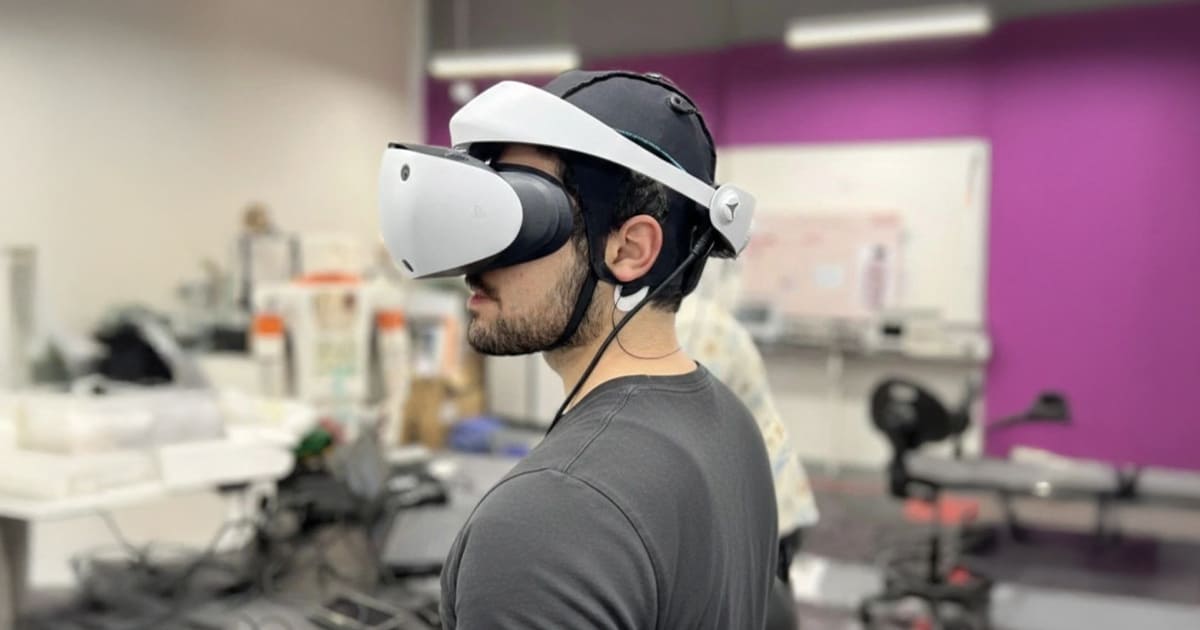
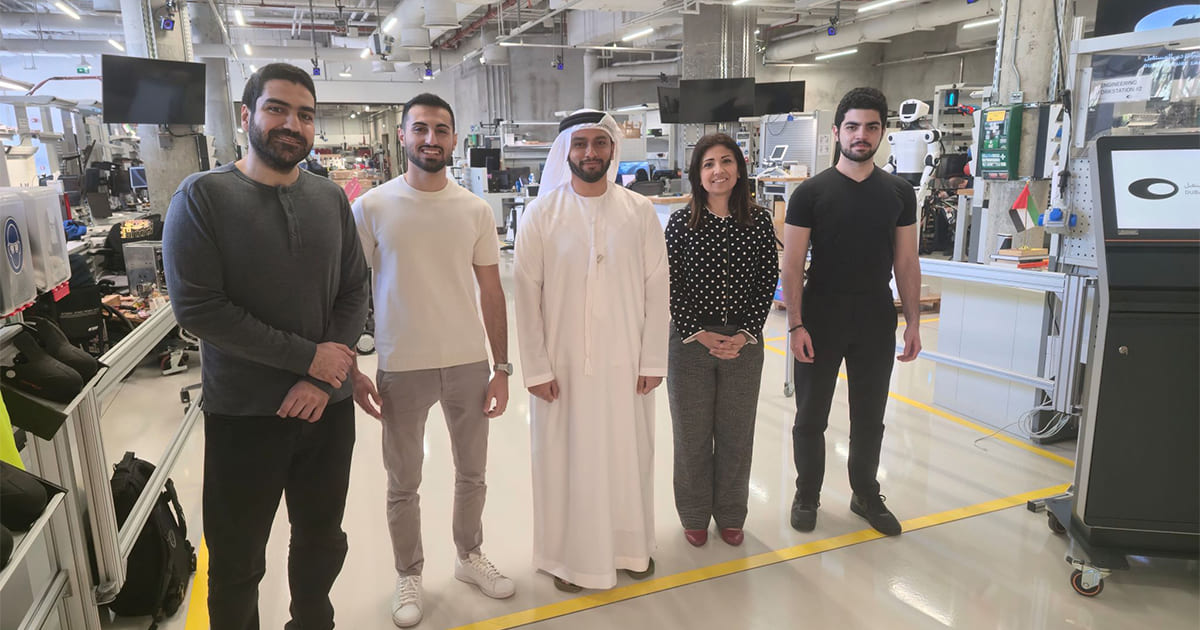
From February 9 to 13, 2026, two students from the LAU School of Engineering (SOE) visited Rochester Institute of Technology Dubai (RIT Dubai), where they collaborated to advance their senior capstone project.
The team comprised mechatronics engineering students Kevin Aoun and Chihabeddin Azzam, and computer engineering student Roni Daou, with Azzam contributing remotely. Together, they worked on developing Humanity’s Last Interface (HELIN), a non-invasive brain–computer interface (BCI) system which records neural activity from outside the skull using electroencephalography (EEG), to enable safe, external control of computers, wheelchairs and robotic devices.
Under the supervision of SOE’s Assistant Professor Noel Maalouf, the students conducted experiments, collected EEG data and created a proprietary EEG dataset using RIT Dubai’s advanced robotics and research facilities.
“We’re building a bridge directly between the human brain and machines, hence the name Humanity’s Last Interface,” said Aoun. “We focus on improving BCI accuracy with fewer electrodes, and bringing this into practical applications like gaming and machine control, not just a lab demo. That is the real challenge.”
Daou highlighted a key innovation of the proposed framework: Its support for zero-shot or near–zero-shot implementation. “As the convergence between the human brain and intelligent systems accelerates, traditional EEG-based BCIs continue to require extensive, user-specific calibration,” he said. “Our framework leverages pre-trained models to enable zero-shot or near–zero-shot implementation, reducing setup time and bringing brain–computer interaction closer to a truly plug-and-use experience.”
“The vision we are trying to achieve is to have a new way to interact with computers, a more intuitive and closer way. HELIN is an attempt to enable the creation of new experiences and flows,” said Azzam. “The main challenge is building a generalizable model, capable of integrating into multiple real use cases with any person.”
The visit marked the first student mobility initiative under the LAU–RIT Dubai memorandum of understanding. “What excites me is the momentum we’re creating: co-supervision is already happening in practice, with several graduate students jointly guided by faculty from both sides, which is the strongest indicator of a real research partnership,” said Dr. Maalouf.
“With the MOU in place, we can broaden this into a longer-term program of collaboration, more joint supervision, impactful research grants, more co-authored publications, and a platform to pursue larger, multi-year research initiatives together,” he added.
Beyond student exchanges, the partnership has also progressed through a range of joint projects. As part of RIT Dubai’s Graduate Webinar Series hosted by its Department of Electrical Engineering and Computing Sciences, LAU faculty—including Assistant Professors Salah Bazzi and Nagham El Ghossein, along with Dr. Maalouf—presented a range of research topics.
“Our collaboration with RIT Dubai is of strategic importance for our mechatronics and electrical engineering students,” said Dr. Chadi Abou Rjeily, chair of the electrical & computer engineering department at SOE and director of research and graduate programs. “RIT Dubai has state-of-the-art research facilities in robotics, communications, and smart grids and its leadership has been instrumental in making these resources accessible to our faculty and students.”
In addition to developing HELIN, Aoun, Daou and Azzam also assisted with experiments for a master’s thesis aligned with the broader project and are expected to have a functional prototype completed in May, with academic publications planned to follow.
“Such partnerships not only help our students gain hands-on experience and develop practical skills,” said Dean Michel Khoury, “they also ensure that LAU faculty remain active collaborators in world-class research, strengthening our role in shaping the future of engineering and innovation.”


