LAU Alumnus Elie Habib Maps the World in Real Time
Anghami co-founder and LAU alumnus Elie Habib (BS ’94) introduces an AI-powered open-source platform that visualizes global events and geopolitical signals as they unfold.
Curiosity has long been a defining force in the career of Elie Habib (BS ’94). Best known as the co-founder of Anghami, the LAU computer engineering graduate and recipient of the LAU Alumni Achievement Award in 2019 has spent decades building platforms that transform how people experience digital content.
Recognized internationally for his entrepreneurial leadership, named Lebanon’s Top Innovator by Forbes in 2018 and an Endeavor High-Impact Entrepreneur, Habib continues to push the boundaries of technology while remaining closely connected to his alma mater as a trustee of LAU.
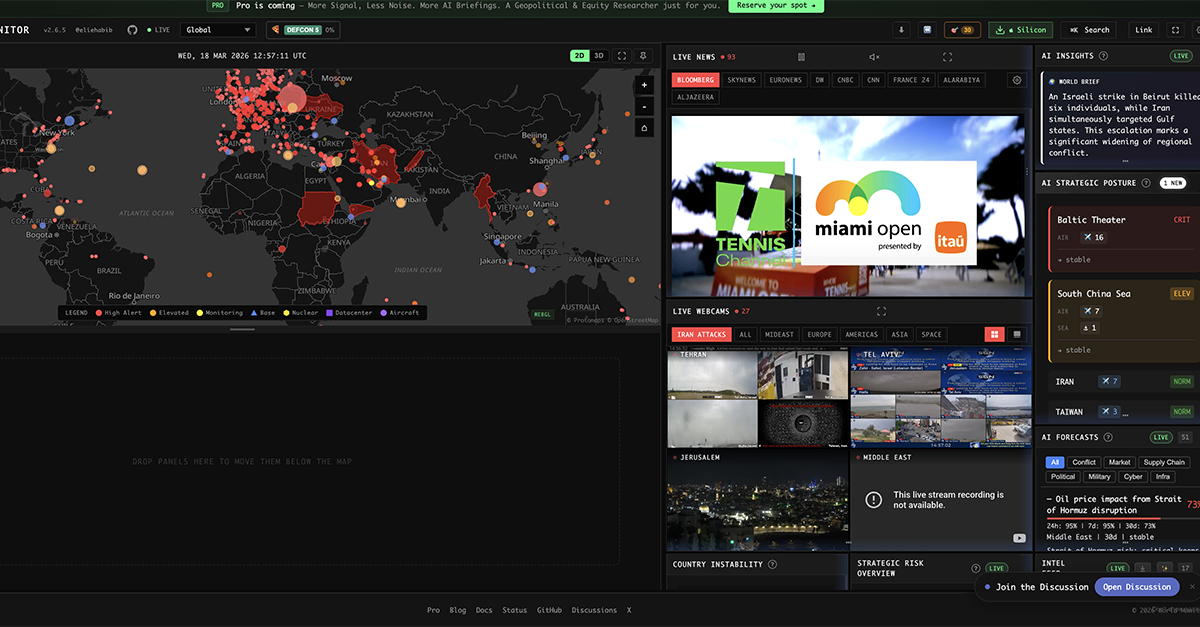
Earlier this year, Habib quietly launched World Monitor, an open-source platform powered by artificial intelligence that visualizes global events in real time through a dynamic interactive map.
Within weeks of its debut, the platform attracted more than four million visitors from 174 countries, drawing journalists, geopolitical analysts, researchers, traders and students alike.
In this conversation, Habib reflects on how a one-day experiment turned into a global platform, why he chose to release the project as open source and how emerging AI tools are reshaping the way information can be gathered, interpreted and shared.
You are widely known as the co-founder of Anghami. How did you make the shift from music streaming to creating World Monitor?
Even as CEO of Anghami and OSN+, I hold myself to a discipline of continuously building and learning new technologies. The shift from music streaming to geopolitical signals is less of a pivot than it looks. Both domains are fundamentally about aggregating signals, surfacing what’s relevant, and delivering it in real time, and both are connected to my curiosity.
The news had become genuinely hard to parse: Iran, Trump’s decisions, financial markets, critical minerals, tensions rising on all fronts. I kept opening tabs, searching on X, reading financial news, and still couldn’t answer a basic question: How are these things connected? Every service had its point of view, and none provided the whole picture.
I needed to see how events correlate in real time. I built the initial version of World Monitor in one day, on a Sunday in early 2026. What people now call a sophisticated platform, which began as a Sunday hack, evolved by iteration to 2,000 more commits than the original version.
World Monitor is open source. What motivated that, and how do you maintain accuracy and reliability across community contributions?
I didn’t intend to commercialize it, but rather to learn and share what I’d learned. Publishing it open-source under AGPL-3.0 was only natural: When you build something interesting, you make it accessible to others. The code is publicly auditable; anyone can verify how signals are processed, weighted, and classified. That structural transparency replaces editorial trust.
Regarding accuracy, the system doesn’t rely on community contributors for data credibility, and every source carries a tier rating. Wire services and official channels such as Reuters, AP, the Pentagon, and the UN sit at tier one, and BBC and Al Jazeera at tier two. Specialist outlets like Bellingcat follow, then 190+ news sources and additional sources (trade routes data, ship data, flight data, etc.), and finally a total of 450+ sources. Breaking alerts require corroboration from at least two independent tier-rated sources, and the news must be less than 15 minutes old.
What has surprised you most about the platform’s response?
The first is the speed with which it generated traffic. Within a week of my post on LinkedIn, we had recorded 400,000 users, and by early March, more than four million total visitors across 174 countries. The platform went from 100 visitors a day to 500K+ in a single day during the Iran strikes.
The second is the diversity of users, from journalists, risk analysts, PhD researchers, traders, military professionals, students in international relations, to a sports bar in the US that screens it on its TVs when there are no games.
I didn’t expect the tool I had built for myself would serve such a range of people. It became known as “the Bloomberg Terminal for geopolitics,” a label given by users. It was never how I positioned the platform. Markets with which I had no prior relationship, Asia, Vietnam, Indonesia, Japan, and Korea, represent 35 percent of the traffic.
Amid current tensions in the Middle East, how does World Monitor help people in the region make sense of rapidly unfolding events?
The core value is correlation, not aggregation. During the Iran strikes, users weren’t watching a news channel report events after the fact. They were reading converging signals live: Military flight patterns via transponders, naval vessel movements, real-time Israeli air raid sirens translated from Hebrew to English, GPS/GNSS jamming detection, prediction markets shifting, airport cancellations and internet outages. When those independent streams activate simultaneously over the same geography, the system surfaces convergence. That’s qualitatively different from a headline feed.
For people in the Middle East, the value is knowing what’s happening in real time. The system processes every event as it arrives, without editorial interference.
Since World Monitor presents raw technical signals without editorial oversight, how do you stay mindful of the real human impact behind the data?
I think about this constantly, and I don’t pretend it’s fully resolved.
I draw a firm line on monetization and refuse to profit from war-related content. I believe that advertising or placing a paywall on access is wrong. I’ve also declined requests to map infrastructure on ethical grounds, as this puts civilians at risk.
As for human impact behind the data, the system is designed to surface signals, not produce narratives. A convergence of military movements, media velocity, and prediction market shifts over a country signals that something significant is happening, but does not interpret the consequences on the people living there. I’m aware of that gap. I want to move toward tools that translate signal into impact. That’s a harder problem than aggregation, but it’s the next step.
How do you envision World Monitor evolving, and what collaborations do you hope to explore?
I would like to build a tool that tells you what matters, why, and how it impacts you specifically, a geopolitical, market and commodity intelligence agent that works for you.
Practically, the next layer is a Pro tier: Insights for what’s happening, but also forecasts, scheduled AI briefings delivered via Slack, email, or WhatsApp; custom alert rules for specific countries, sectors or threshold triggers; API access for organizations integrating World Monitor data into their own tools; and deeper country intelligence briefs combining instability scores, financial data, and security analysis.
I have received collaboration offers from investment funds, newsrooms, government officials, and academic institutions, but I haven’t acted on most of them. I’m still the CEO of two companies, and I don’t intend for World Monitor to become a second full-time job. But the interest shown by academic institutions working on geopolitics and newsrooms using the platform for breaking event coverage is, for me, the most intellectually inviting. Meaningful partnerships begin with a specific problem rather than a general interest in the platform. That’s what will determine who I decide to collaborate with.
This interview has been edited and condensed for the sake of clarity.


