LAU Professor Co-Creates Platform Delivering Real-Time Crisis Information
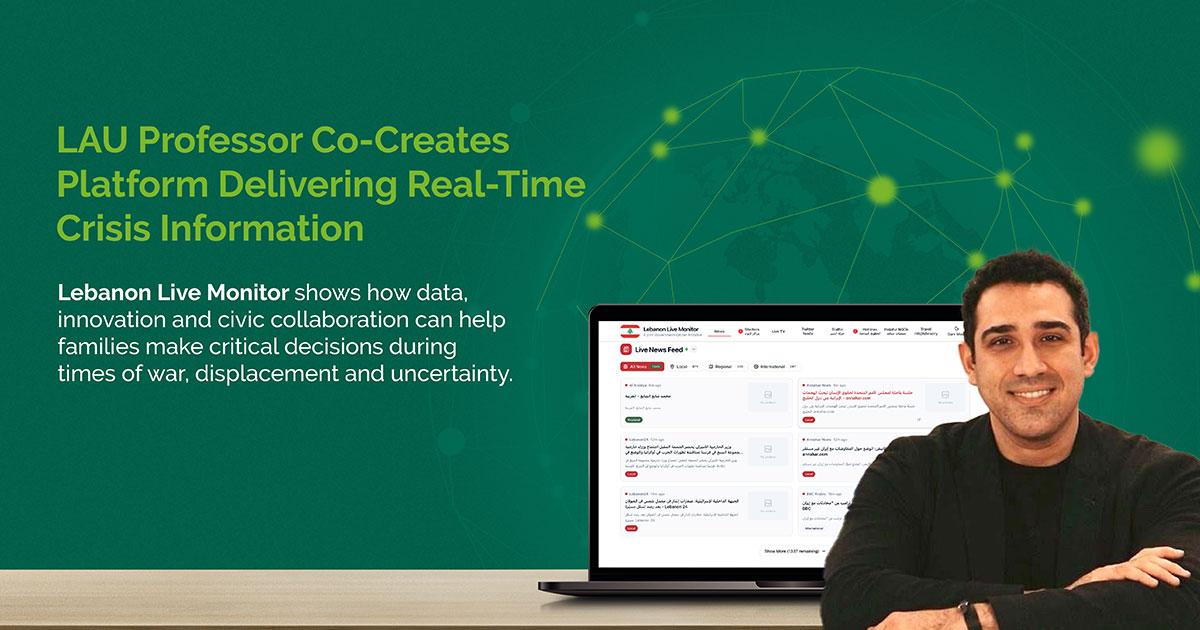
Lebanon Live Monitor demonstrates how data, innovation and civic collaboration can help families make critical decisions during times of war, displacement and uncertainty.
As war continues to displace families across Lebanon, the search for reliable information has become almost as urgent as the search for shelter. Across the country, people are glued to their screens, trying to understand what is happening and what they should do next. Yet in moments of crisis, information often arrives in fragments, scattered across television broadcasts, news websites, social media feeds and messaging groups.
“People were constantly jumping between platforms trying to piece together what was really happening,” said Dr. Wissam Sammouri, professor at the Department of Information Technology and Operations Management at LAU’s Adnan Kassar School of Business. “Though the information existed, it was exhausting to navigate.”
Out of that chaos emerged Lebanon Live Monitor, a real-time digital platform that brings critical updates together in one place. Built and initiated by Dr. Sammouri and Digital Solutions Consultant Olguinia Ferzli, this citizen-government initiative was developed in collaboration with the Disaster Risk Management Unit at the Presidency of the Council of Ministers, guided by Dr. Lamia Moubayed, advisor to the prime minister of Lebanon, and sustained by a dedicated team of volunteers.
What sets Lebanon Live Monitor apart is its focus on live, actionable shelter information, where timing is critical to safety. The platform provides regularly updated details on available shelters, their capacity, regional emergency contacts, NGOs offering assistance and emergency hotlines, giving families immediate, practical answers when they need them most.
“When a family is looking for shelter, they do not need more headlines,” said Dr. Sammouri. “They need practical answers: Where space is available, which hotline to call and which routes remain safe.”
Having those answers in one place can transform a frantic search into informed decision-making and reduce the confusion caused by fragmented updates across multiple sources.
In addition, the platform aggregates verified news and social media feeds into a single, continuously updated stream, eliminating the need to navigate multiple platforms and offering a critical, time-saving resource for users in Lebanon and the diaspora alike. It integrates a range of key information sources, including verified feeds from governmental and non-governmental entities, live television channels, social media updates, travel advisories and a live traffic map to help residents navigate congestion caused by displacement and road disruptions.
AI-powered briefs in Arabic and English, generated every 30 minutes, summarize key developments and provide users with clear, accessible updates.
The value of such a platform for families at risk goes far beyond convenience.
“By consolidating and continuously updating critical information, the platform enables users to find reliable answers quickly,” said Dr. Sammouri, adding that this is particularly important for those who may not have access to the same networks or channels where such information is typically shared.
Developing Lebanon Live Monitor while the crisis itself was unfolding presented significant difficulties. Unlike most technology projects that benefit from long development cycles, the platform had to be built in real time while events were rapidly evolving across the country. “It is difficult to focus on building solutions when the crisis you are monitoring is also affecting your own family and community,” said Dr. Sammouri.
Despite those pressures, the platform was launched within 48 hours of the escalation and attracted more than 10,000 unique visitors in its first few hours, from Lebanon and around the world.
For Dr. Sammouri, the initiative highlights an important skill for students and future innovators, that of recognizing a real human problem before writing a single line of code.
Technical expertise in data science, programming and artificial intelligence is increasingly valuable, he added, but meaningful innovation begins with understanding community needs.


