Alumna Elena Abou Jaoude’s Passport to Possibility
The communication graduate traces her path from LAU to securing a spot in one of Europe’s most competitive graduate scholarships, the Erasmus Mundus Global Studies program.
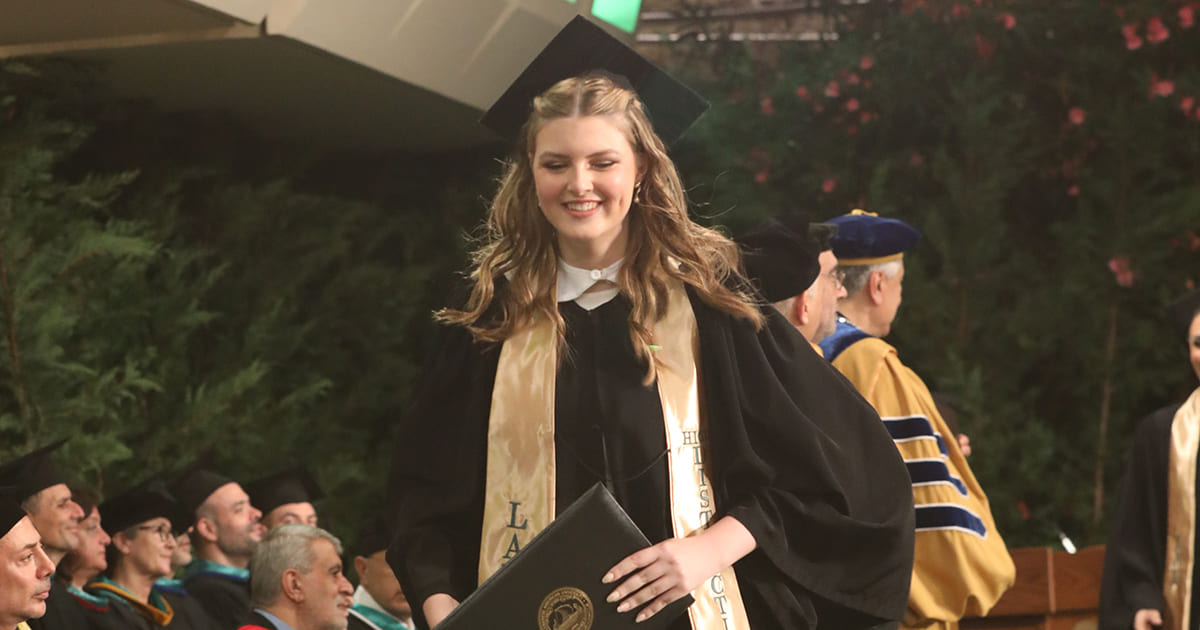
For Communication alumna Elena Abou Jaoude (BA ’25), education has never been about fitting neatly into a single discipline. Instead, she has always connected ideas across fields, cultures, and borders—a mindset that has now earned her admission to the highly competitive Erasmus Mundus Global Studies (EMGS) master’s program.
Selected into a cohort of only 24 students from a pool of approximately 1,800 applicants, Abou Jaoude will begin a two-year academic journey through the EMGS program, a joint master’s degree offered by a consortium of leading European universities. She will spend her first year at Leipzig University in Germany and her second at Ghent University in Belgium, with hopes of completing an additional semester at a partner institution in Asia.
The achievement marks a high point following her undergraduate degree in Communication, offered by the LAU School of Arts and Sciences’ Communication, Mobility and Identity Department, where she developed a strong foundation in political communication, media studies, and critical research.
“I have always been someone who struggles to fit into a single discipline,” Abou Jaoude said. “That’s part of the reason I chose communication at LAU in the first place, as it gave me a multitude of disciplines to learn from.”
That interdisciplinary spirit ultimately drew her to EMGS, a program that examines globalization through political, economic, social, and cultural lenses rather than treating it as a fixed concept. The curriculum’s blend of global history, international relations, and colonial studies aligns closely with the research interests she began developing as an undergraduate.
At LAU, Abou Jaoude immersed herself in courses exploring political communication, Orientalism, and the colonial history of the Levant. She credits faculty members, including Dr. Gretchen King and Dr. Denijal Jegić, for encouraging her intellectual interests and academic ambitions.
A defining experience came during Abou Jaoude’s senior year, when she completed an undergraduate thesis examining media framing in Lebanese war coverage. The project challenged her to conduct rigorous research and helped strengthen her graduate school applications.
“Through EMGS, I plan to take everything I learned at LAU from a communication-studies framework into a much broader interdisciplinary one,” she explained. She hopes to combine global history, international relations, and colonial studies in addressing the current challenges that Lebanon faces today.
Outside the classroom, Abou Jaoude benefited from rich international experience facilitated through LAU’s International Services and Programs Office (ISP). She participated in an Erasmus exchange semester in Copenhagen and later attended the Fund for American Studies program (TFAS) in Prague. These opportunities, she said, exposed her to new academic environments and a global perspective on research, which played a critical role in preparing her for the highly competitive Erasmus Mundus selection process.
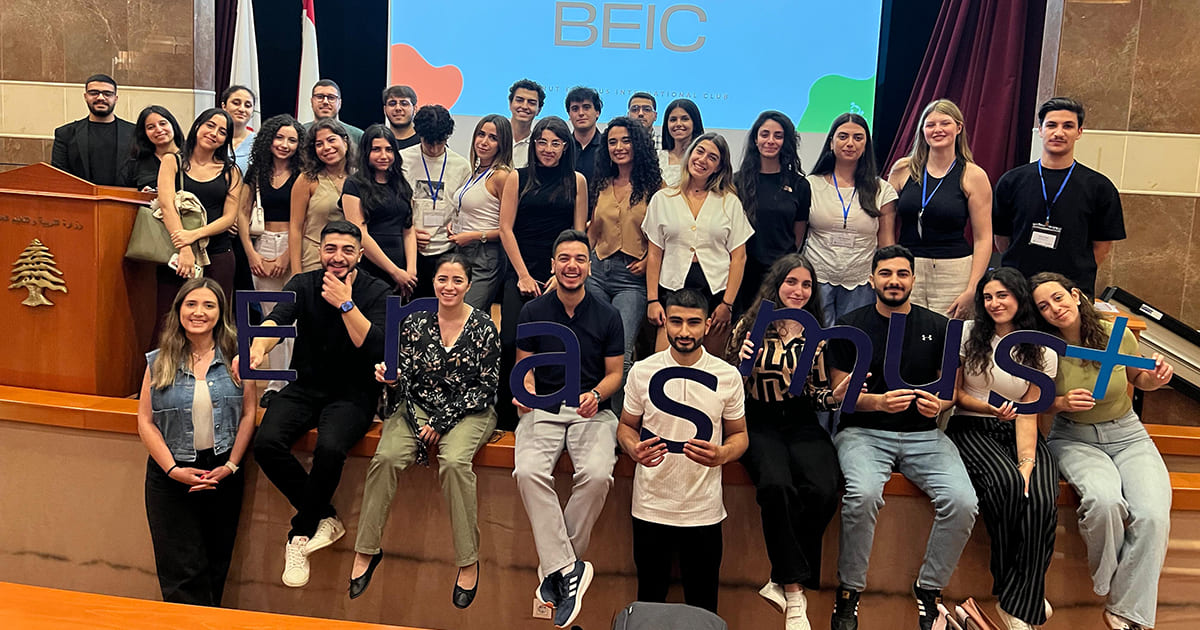
Beyond academics, Abou Jaoude has distinguished herself as a leader committed to expanding opportunities for Lebanese youth. As president of the Beirut Erasmus International Club (BEIC), she has helped grow the organization into Lebanon’s first youth-focused network dedicated to exchange programs and Erasmus+ opportunities.
Over the past two years, BEIC has built a vibrant community that supports Lebanese students seeking international experiences while also welcoming international students to Lebanon. Through partnerships with universities and educational institutions, the organization has worked to make information about study-abroad opportunities more accessible to young people nationwide.
“The Beirut Erasmus International Club taught me how to build something sustainable and meaningful for the community, sustain a mission over time, and work across institutions and bureaucracies,” she noted.
Upon her return from Europe, Abou Jaoude hopes to establish “a clear roadmap for my community to access these opportunities and programs,” she said, drawing from her own setbacks of not being able to secure graduate programs with sufficient funding in previous years.
“I know how hard it is for Lebanese students to go abroad, to find funding, and to have the courage to keep reapplying,” she pointed out, adding: “No one’s path is linear.”


