Anesthesiologists in High-Risk Situations
The LAU Gilbert and Rose-Marie Chagoury School of Medicine convened a timely discussion on the multifaceted role of anesthesiologists in delivering perioperative care in conflict settings.
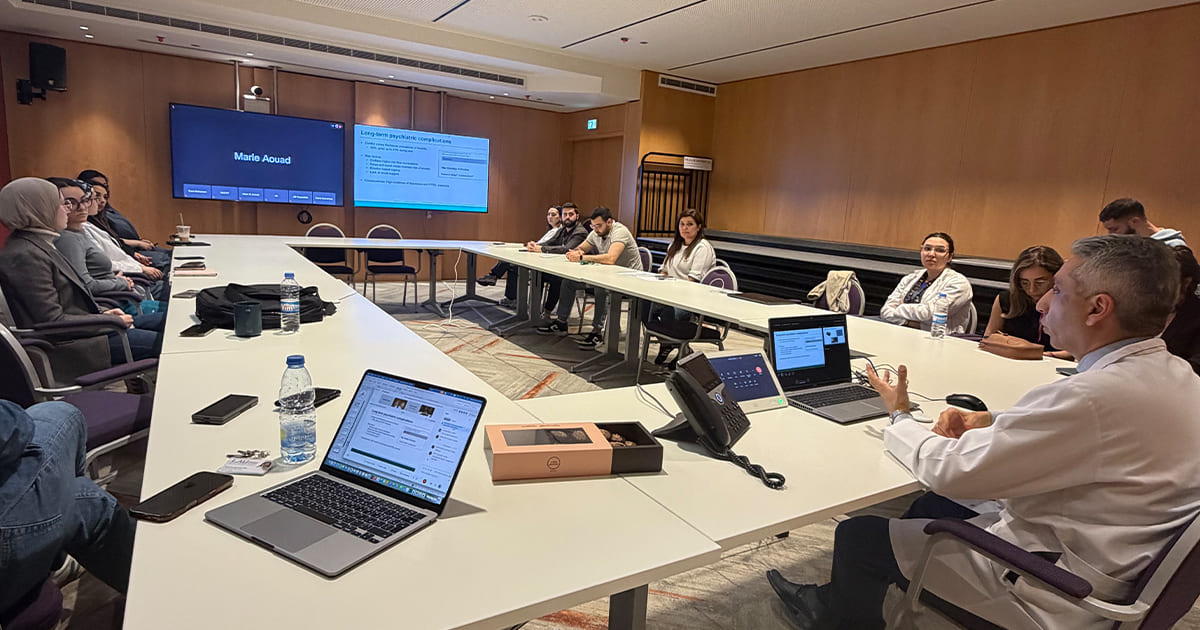
On April 29, 2026, the Anesthesiology Department at the LAU Gilbert and Rose-Marie Chagoury School of Medicine convened a multidisciplinary panel of clinicians and educators to examine the critical role of anesthesiologists in times of crisis.
Titled Anesthesiologists in War and Armed Conflicts: Perioperative Care from ED to ICU, the hybrid session, organized by the Office of Continuing Medical Education and the Professional Development Office, explored the evolving scope of anesthesiology in high-risk environments, the challenges they face in mass casualty incidents, and strategies for coordination across hospital departments.
Moderating the discussion, Dr. Marie T. Aouad, professor and chairperson of the Department of Anesthesiology and Pain Medicine at the American University of Beirut Medical Center and president of the Lebanese Society of Anesthesiologists, framed anesthesiology as a discipline now operating at the crossroads of emergency response, perioperative care, and critical care medicine. “We are at the front line of care,” she said, “and often under extreme pressure and with limited resources.”
“Modern conflicts are reshaping perioperative medicine and expanding the role of anesthesiologists far beyond the operating rooms,” said Dr. Vanda Abi Raad, associate dean for faculty affairs and development and chair of anesthesiology at LAU.
In her presentation, “Perioperative Challenges in Modern Conflicts & Hybrid Warfare,” she examined how the evolving nature of conflict is transforming the profession, noting that hybrid warfare, combining conventional attacks with cyber disruption, infrastructural collapse, and unconventional weapons, has introduced unfamiliar injury patterns and unprecedented operational constraints.
Most strikingly, Dr. Abi Raad challenged the assumption that healthcare facilities remain neutral ground. “Healthcare is no longer collateral damage; it has become part of the battlefield,” she warned, pointing to the growing frequency with which hospitals and medical workers are directly targeted.
Drawing on Lebanon’s own experience with mass casualty incidents, she described acute vulnerabilities exposed in real time: Limited operating room capacity, complex airway management in burn patients, and the need for system-wide leadership under pressure. “Preparedness is now a professional responsibility,” she noted, “we must move from reaction to anticipation.”
Shifting from systemic vulnerabilities to frontline execution, Clinical Associate Professor and Division Head of Emergency Medicine, Director of the CME & CPD Office, Mariana El Helou presented on patient stabilization and perioperative handover, grounding her remarks in recent mass casualty data. “War surgery is an epidemic of trauma,” she said, detailing the cascading challenges that follow such events, like triage in environments where the majority of patients require urgent surgery, patient identification difficulties, overcrowded emergency spaces, and bottlenecks at the threshold of the operating room.
The guiding ethical principle, noted Dr. El Helou, becomes grimly pragmatic: “The logic says do the best for the most.” She argued that embedding anesthesiology teams earlier into emergency workflows, through structured handovers and coordinated prioritization, can meaningfully reduce delays when every minute counts.
Following that, Dr. Dany Gaspard, clinical assistant professor and division head of pulmonary diseases, addressed the sustained aftermath of such events in the ICU in his presentation titled “Postoperative and Critical Care Management in Resource-Limited Conflict Settings.” Established ICU care pathways, he explained, are among the first casualties of a sudden patient surge. “This gets completely derailed when we are in war times,” he said.
Hospitals must respond dynamically, clearing beds, repurposing wards, and revising admission criteria on the fly, while simultaneously managing delayed care for non-trauma patients, rising rates of delirium, and mounting psychological strain on providers. Yet within these constraints, Dr. Gaspard pointed to the adaptability of collaborative medical teams as a consistent source of resilience.
Closing the session, Clinical Associate Professor, Anesthesiology Program Director, and Director of the Clinical Simulation Center Hanan Barakat shifted attention to preparation before a crisis strikes. She described what conflict-zone anesthesia actually looks like with unreliable electricity, inconsistent oxygen supply, and absent or damaged monitoring equipment.
“Providing anesthesia in conflict settings means working without the systems we are usually depending on,” noted Dr. Barakat. Her solution was not simply more equipment, but deeper institutional readiness, simulation-based training, standardized checklists, and disaster medicine woven into medical curricula.
Crucially, she added, preparedness must remain dynamic rather than static, and “should always be updated,” tested through drills, and continuously refined through real-world experience.
The sessions segued into an open panel discussion, during which speakers engaged directly with the audience, extending the conversation to questions practitioners face in the field.
Continuing Medical Education (CME) and Continuing Professional Development (CPD) credits were granted by LAU’s CME/ CPD Office to medical professionals who attended.


