CME Grand Round Highlights Multidisciplinary Advances in Multiple Sclerosis Care
From ophthalmic clues to updated diagnosis criteria, a multidisciplinary Grand Round on Multiple Sclerosis shows how data-driven, collaborative care is transforming diagnosis.
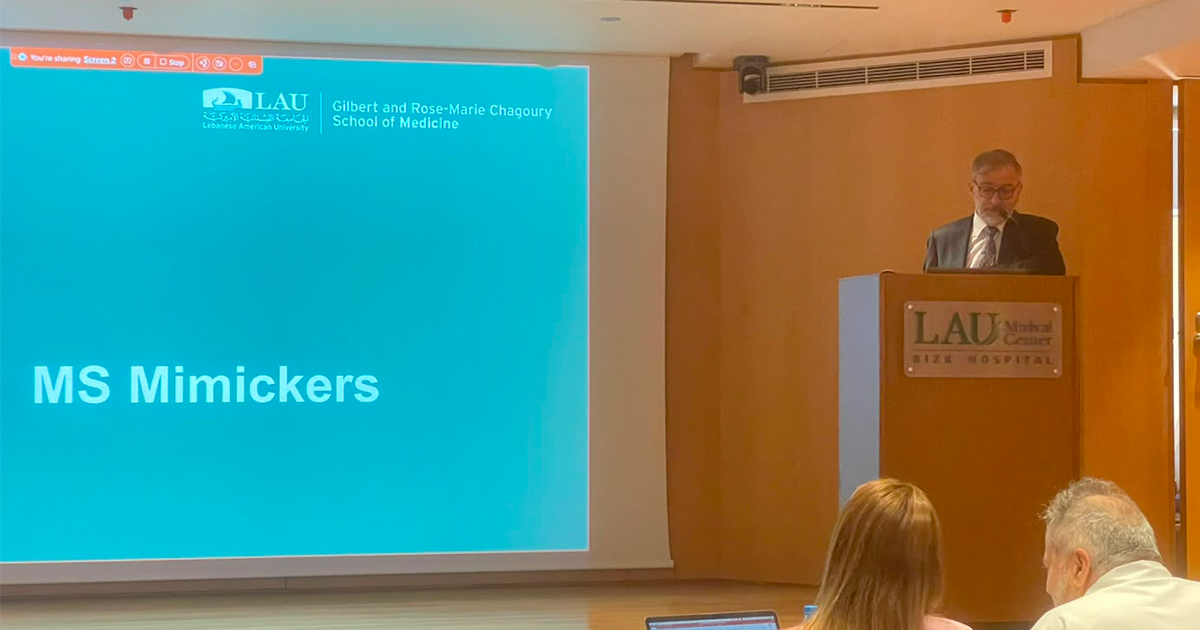
Blurred vision, a numb hand, or sudden unsteadiness can all be early signs of multiple sclerosis (MS), but they overlap so closely with other neurological conditions that pinpointing the right diagnosis is rarely straightforward. Getting there takes more than a single specialist; it calls for a collective, multidisciplinary approach.
This approach was at the heart of a hybrid session in the newly launched multidisciplinary Grand Rounds series organized by the Office of Continuing Medical Education and Professional Development at the LAU Gilbert and Rose-Marie Chagoury School of Medicine. Held on June 18, 2026, the session, which brought together neurological, ophthalmological, and pharmacy perspectives, examined the complexities of diagnosing and managing one of the world’s most complex neurological disorders.
“There is nothing that could look like MS than MS itself,” said Dr. Ayman Tourbah, professor of neurology at Hôpital Raymond Poincaré–Université Paris Saclay and adjunct professor in the Neurology Department at LAU, adding that physicians need to rule out atypical presentations, which can vary by a patient’s age, country, and medical history, before settling on a diagnosis.
Distinguishing MS from its mimics requires a comprehensive evaluation, he explained, combining clinical examination, an MRI, and biological markers such as oligoclonal bands (distinct proteins that signal inflammation in the central nervous system) and the kappa light chain index (a faster test that measures related immune activity), which he described as “easy, cheap, and pertinent.”
Dr. Tourbah also pointed to certain warning signs that should make physicians pause: “If a patient starts with epilepsy, with dementia, with Parkinsonism or other, this is usually not MS.” Advances in diagnostic tools now enable physicians to reach a diagnosis earlier and with greater confidence, he added, though he was careful to note that no single tool can provide the answer alone.
That same complexity for neurologists extends to ophthalmologists. Dr. Ama Sadaka, LAU clinical associate professor and residency program director in the Department of Ophthalmology, noted that while neurologists are well versed in the sudden inflammation of the optic nerve, uveitis—inflammation inside the eye, particularly in the uvea—represents a separate but parallel inflammatory process that shares the same underlying autoimmune mechanisms as MS.
Because uveitis often develops without symptoms at first, she explained, it can go undetected unless patients are specifically screened for it. Identifying uveitis is important because it may influence treatment decisions, including the choice of disease-modifying therapy.
“In MS, ocular symptoms can sometimes appear before any neurological signs emerge, and without a specialized eye examination, they may go unnoticed,” she said.
Dr. Sadaka explained that advances in retinal imaging and optical coherence tomography are providing physicians with new tools to monitor disease activity and protect patients’ vision, but this “requires a lot of collaboration between neurology and ophthalmology,” she said, highlighting how inflammatory eye conditions associated with MS can influence diagnosis and treatment decisions.
Dr. Mohamad El Dassouki, LAU clinical assistant professor and acting chair of the Department of Neurology, then walked the attendees through updates to the 2024 MS diagnostic criteria with refinements aimed at identifying the disease across a wider range of presentations, including in older adults and patients with complex medical histories, without compromising accuracy.
He also shared supporting studies and case data tracking how radiologically isolated syndrome, where the MRI shows MS-like lesions before any symptoms appear, tends to progress to clinically confirmed MS over time, reinforcing the rationale for catching and managing the disease earlier rather than waiting for it to declare itself.
“The goal of any criteria, any disease, is to narrow and tune the final diagnosis,” said Dr. Dassouki, distilling why these revisions matter. “Every mimicking condition ruled out is one step closer to getting a patient onto the right treatment sooner,” he said.
Wrapping up the session, Dr. Maya Zeineddine, clinical associate professor at the LAU School of Pharmacy and Multiple Sclerosis Certified Specialist, traced the shift in MS epidemiology globally and across the Middle East and North Africa (MENA) region.
One of the more striking regional findings she shared with attendees was that the MENA region, once considered a low-prevalence area, has become a moderate- and high-prevalence territory—a trend that underscores the need for sustained research, greater awareness, and earlier intervention across the region.
“Approximately 2.8 million people worldwide are currently living with the disease,” she said, a number that has climbed sharply in recent decades, not necessarily because MS itself is becoming more common, but because diagnostic criteria, imaging technology, treatment options, and epidemiological methods have all improved.


