LAU Engineering Students Earn Second Place at Invent for the Planet
Team TerraCell secured second place at the 2026 Invent for the Planet finals in Ireland, turning a 48-hour university challenge into a globally recognized sustainable innovation.
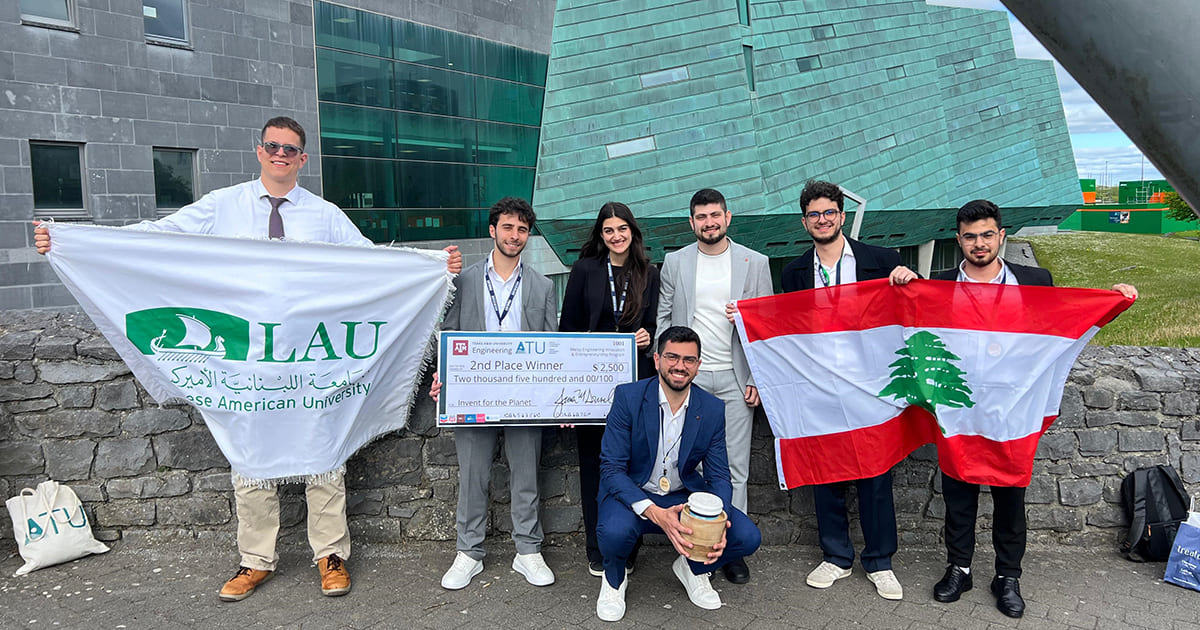
On May 11, LAU senior engineering students Charbel Korbani, Cedra Al Zein, Mounir Nashi, Kiryl Irani, Jason Mitri, and Karl Mansour stood on the international stage in Galway, Ireland, celebrating a second-place finish at the 2026 finals of Invent for the Planet (IFTP)—one of the world’s leading student innovation competitions organized by Texas A&M University. Competing as Team TerraCell, they were among six finalists selected from 32 participating universities worldwide and took home a $2,500 award.
Commenting on the team’s win, Dean Michel Khoury said that the School of Engineering (SOE) was proud to support Team TerraCell throughout the competition process. “We recognized the quality of their work and its potential to compete among the world’s best student innovations,” he said.
Their journey through the competition began with problem identification and ideation as part of course activities in Associate Professor Marc Haddad’s Seminars on Contemporary Issues in Industrial and Mechanical Engineering, then followed a structured progression across participating universities worldwide.
“Competitions like IFTP provide a practical platform where students learn about contemporary local and global challenges, and apply engineering knowledge to develop real-world solutions,” said Dr. Haddad.
Each year, the participating institution hosts a local IFTP weekend, where students are grouped based on shared interest in the challenge topic. Over the course of 48 hours, teams research the problem, develop a plan, and build a simple prototype in their universities’ laboratories.
Within this framework, TerraCell was formed to respond to this year’s challenge of building sustainable agricultural and food systems, prompting the team to ground its work in a pressing local issue: food preservation.
On the final day, teams submit a short video and present their prototype to Dr. Haddad and a panel of judges who nominate the first-place team to the global finals.
It was from this pathway that Team TerraCell emerged, advancing through each stage before being selected among six finalist teams to compete in Ireland.
“We chose food preservation because it is a real challenge in Lebanon,” Nashi explained, “especially for small farmers and vendors who face produce losses, high costs, and unreliable access to electricity.”
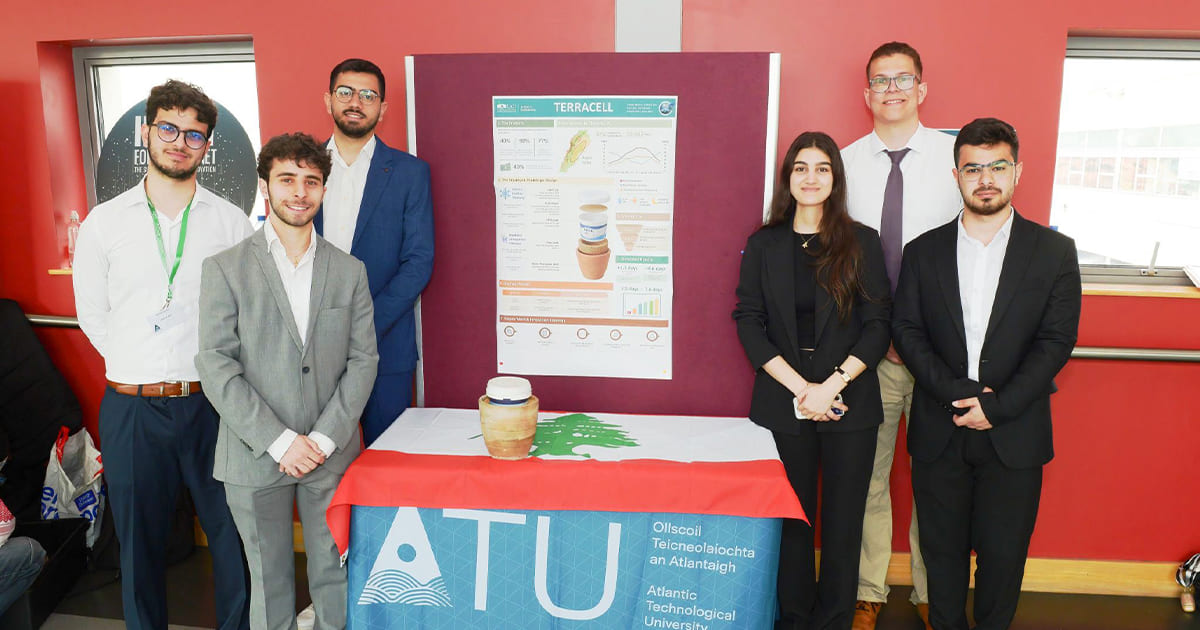
The team’s solution was a passive cooling system designed to preserve fruits and vegetables without electricity. Built from clay, sand, water, and a plastic container, the prototype relies on natural cooling principles rather than energy-intensive technology.
According to Al Zein, what helped the project stand out was that it connected a local problem to a simple, sustainable, and practical solution.
“The greatest challenge was not technical but decisional,” said Irani, “specifically, learning how to prioritize quickly and effectively.”
Mitri recalled that the team had to move from problem to prototype to pitch while constantly deciding what was essential and what could wait. “We did not have the luxury of slowly developing the idea, testing every detail, and polishing everything step by step,” noted Mansour.
Rather than pursuing perfection, the team focused on clarity and functionality, with each member taking on a defined role spanning research, prototyping, business planning, and presentation development.
“Being selected as one of the finalist teams was a proud moment for the whole team,” Korbani said. “It allowed us to represent both LAU and Lebanon on an international stage.”
The team credited their professor and lab instructors for their consistent mentorship, and the SOE for providing financial and logistical support that enabled participation, prototyping, and travel.


