LAU Student Future-Proofs Government Procedures
Computer Science student Hasan Diab presented a modernized digital infrastructure solution to the Ministry of Interior.

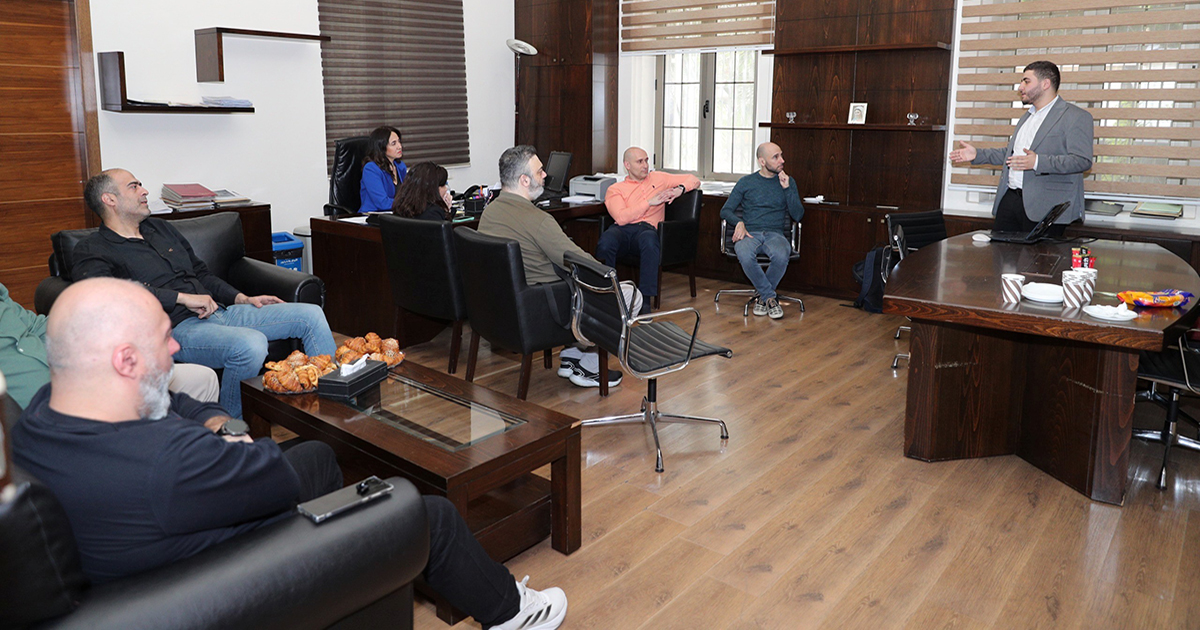
Just a dozen meters away, an LAU student from the School of Arts and Sciences’ Department of Computer Science and Mathematics (CSM) was presenting a fully operational digital platform to MOI senior civil servants.
It all began on June 30, 2025, when, through the efforts of Associate Professor of Computer Science Mohamed Watfa, LAU signed an agreement with the MOI to establish a long-term partnership aimed at advancing digital governance and public safety. The agreement connected CSM students and faculty with real ministerial priorities through internships, capstone and course projects, and applied research. Areas of focus ranged from building AI-powered traffic solutions and cybersecurity auditing tools to creating secure citizen platforms and digital identity initiatives.
As part of this collaboration, CSM invited the MOI’s Head of Digital Transformation Unit, Issa Abboud, to attend a capstone orientation event and share insights into initiatives that directly affect citizens’ daily lives. Students were introduced to project themes grounded in real community needs, reinforcing the link between academic work and tangible societal impact beyond theoretical learning.
Among them was Hasan Diab, a computer science major who immediately gravitated toward one idea in particular: optimizing the ministry’s workflow processes. The son of a government employee, Diab recounted how he “had grown up observing firsthand the inefficiencies and outdated practices” that often define administrative work. To him, “the challenge felt personal” and tailored to his ambitions. Under the supervision of Data Science Professor Seifedine Kadry, he set out to develop a solution as his capstone project: An internal digital system designed to streamline the workflow inside the ministry.
Accompanied by Dr. Kadry and Department Chairperson Leila Issa, Diab presented his project to an assembly of MOI staff that included Abboud. The project features a comprehensive database, file tracking tools, customizable workflows, digital certificates, notifications, Arabic support, document scanning, and analytics— “none of which require any coding experience to use,” asserted Diab.
Drawing on a range of software tools, he built the platform single-handedly, translating the skills he acquired at CSM into a solution with the potential to significantly modernize the ministry’s operations.
The presentation drew strong interest from the civil servants in attendance, who vocally commended Diab’s “ingenuity, resourcefulness, and drive.” The ministry expressed its intention to pilot the system, with a view toward full adoption.
Meanwhile, two teams of graduate students under Dr. Watfa’s supervision tackled additional challenges that had been proposed by Abboud, coming up with innovative solutions which they will be presenting to the MOI sometime this year: The first developed “Jawazak”, a digital passport application and renewal platform, while the second group created “CedroPass,” a national digital identity wallet. Similar to Diab’s project, both initiatives aim to modernize key government procedures, improving efficiency across the public sector and enhancing citizens’ daily experiences.
Other CSM students are already working on similar initiatives, and Abboud will be reprising his inspirational role by presenting new challenges from the ministry at the spring 2026 capstone orientation. If this year is any indication, the next wave of projects promises to be impactful.


