Alumna Nour Fadwa Richani at the Intersection of Innovation and Architecture
From computational design to advanced fabrication, a Saïd Foundation scholar prepares to bridge digital intelligence and physical making at the Bartlett School of Architecture.
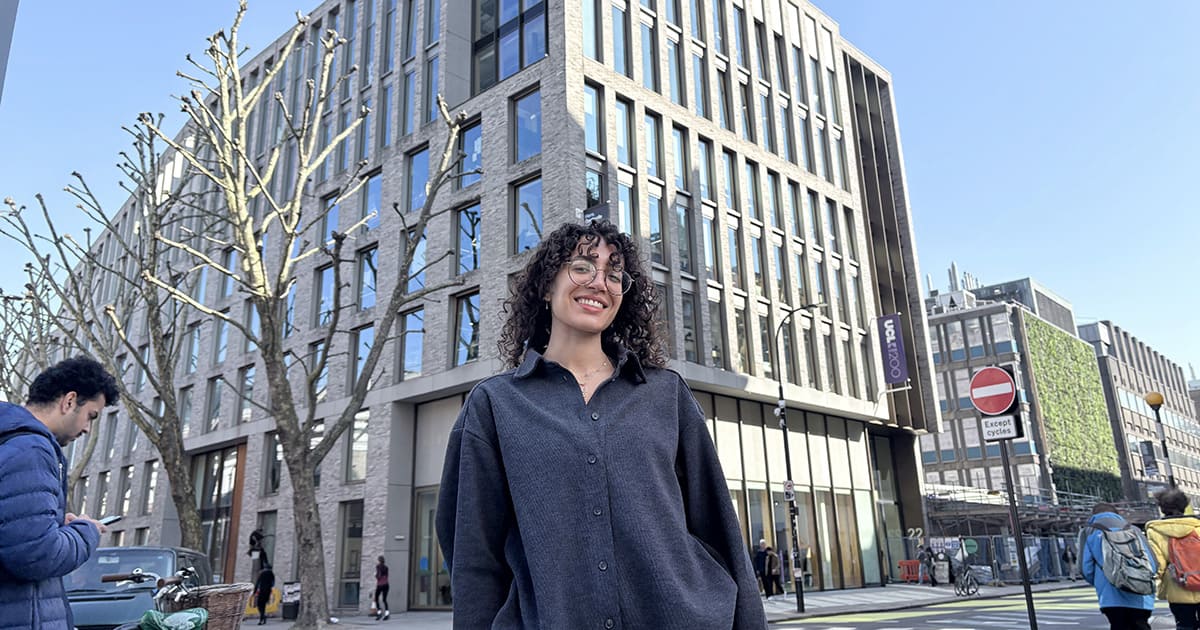
At a time when opportunities for advanced study abroad are increasingly competitive, LAU alumna Nour Fadwa Richani’s (BArch ’22) selection as a recipient of the prestigious Saïd Foundation Scholarship stands out. Chosen among only five students from Lebanon this year, she has earned full funding to pursue a master’s in Architectural Design at the top-ranked Bartlett School of Architecture, part of University College London (UCL).
Richani’s decision to pursue graduate studies at the Bartlett was both strategic and deeply aligned with her evolving interests. While the school’s global reputation played a role, what ultimately drew her in was its forward-looking approach. “What appealed to me most is how engaged it is with what’s happening in architecture today,” she explains. Her academic focus centers on computational and data-driven design, an area that explores how coding, algorithms, and parametric systems can actively shape architectural thinking. The program’s emphasis on emerging technologies, combined with access to advanced fabrication tools such as robotics and high-tech machinery, offers precisely the environment that Richani hopes to refine and expand her approach.
Back at LAU as an undergraduate student, Richani took on the additional challenge of pursuing the Honors Program, ultimately graduating with high distinction and the President’s Award for the School of Architecture and Design, a testimony to her broader engagement within the university community.
Beyond academics, Richani served in leadership roles that shaped her perspective and sense of responsibility. As Freedom By Design Director at the LAU Chapter of the American Institute of Architecture Students and President of the Lebanese Red Cross Club, she balanced academic rigor with active participation in campus life and community service. These experiences, she notes, were instrumental in developing the leadership skills and civic awareness that complement her technical training.
Equally significant was the comprehensive education that Richani received at LAU, an institution recognized for its strength in architecture within Lebanon and the wider region. “The program provided me with a solid and well-rounded foundation,” she said, emphasizing the experiential learning that spans design studios, theoretical frameworks, history, and hands-on fabrication work at the school’s labs, commonly referred to as workshops. “This blend of academic dedication, extracurricular involvement, and the foundation I built at LAU was instrumental in my selection for the Saïd Foundation Scholarship,” she added.
Looking ahead, Richani views her graduate studies not simply as a continuation of her education, but as an opportunity to deepen her engagement with the technologies reshaping architecture today. By strengthening her expertise in computational design while working across digital and physical processes, she aims to position herself at the forefront of a discipline increasingly defined by innovation.


