LAU Engineering Students Win National Renewable Energy Competition With Electric Bus Solution
A multidisciplinary team from the LAU School of Engineering earns national recognition for designing an end-to-end solar-powered electric bus network linking Byblos and Beirut.
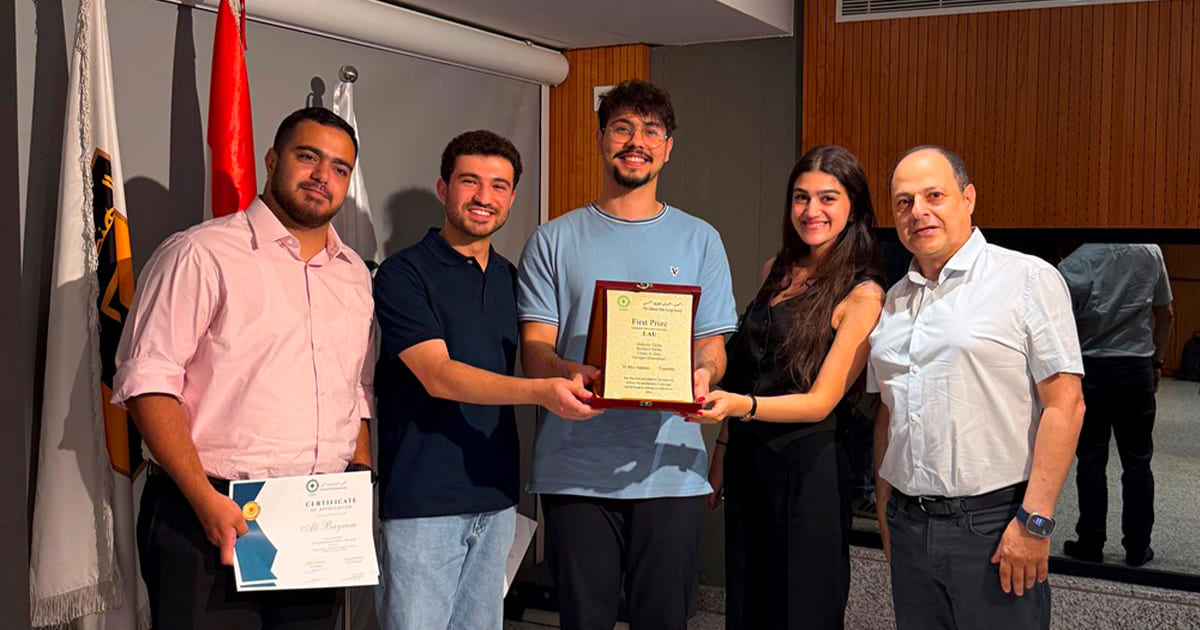
When engineering students Bechara Saliba, Cedra El Zein, Georges Maacaroun, and Anthony Farha set out to design a cleaner way to travel between Byblos and Beirut, they were not just completing their final year project at LAU; they were tackling one of Lebanon’s most pressing infrastructure challenges.
Their project was recognized on June 17, 2026, when they clinched first place in the Lebanese Solar Energy Society’s (LSES) Engineering Students Final Year Project Renewable Energy Contest, held at the Order of Engineers and Architects in Beirut.
After a second-place finish in last year’s contest with a photovoltaic-thermal system design by a team of mechanical engineering students, this year’s achievement reaffirmed LAU’s growing excellence in renewable energy innovation. Of the eight finalist projects from six Lebanese universities, three were from LAU.
Titled “Design of a Green Bus Route with Schedule and Charging Facility for a Fleet of Battery-Electric Buses,” the winning project was developed by a multidisciplinary team comprising industrial engineering students Saliba and El Zein, along with mechanical engineering students Maacaroun and Farha.
Inspired by Lebanon’s growing shift toward cleaner transportation pioneered by the United Nations Development Programme (UNDP), the team tackled the design of a fully integrated electric bus system connecting the two cities.
Their project involved designing an end-to-end solution that optimizes passenger demand forecasting, route planning, operating schedules, charging strategies, and the physical infrastructure needed to support an entire fleet. Central to the design was a solar PV-powered charging facility in Byblos, sized specifically to meet the fleet’s energy demand.
“We wanted to demonstrate how renewable energy and smart infrastructure planning could work in tandem to improve public mobility while cutting transportation-related emissions,” said Maacaroun.
To meet the objectives of their final-year project, the students began by analyzing travel demand and mobility patterns between the two cities, then built out fleet schedules, charging requirements, and performance simulations under realistic operating conditions. Working with limited local data while simultaneously balancing technical, operational, and sustainability considerations proved to be the biggest challenge, said El Zein—one that entailed extensive research and continuous refinement at every stage.
According to Farha, the team was well equipped with “the analytical and problem-solving skills needed to tackle a complex, real-world engineering challenge.”
“Through our coursework,” he said, “we learned how to integrate optimization, simulation, data analysis, and systems thinking into practical solutions.”
The team’s interdisciplinary makeup was a defining advantage. The combination of their industrial and mechanical engineering knowledge enabled them to address transportation planning, systems optimization, renewable energy integration, and infrastructure design, with an all-encompassing solution.
Associate Professor and Team Supervisor Marc Haddad identified this combination as central to their success, alongside the students’ ability to communicate their work compellingly.
“There were two main aspects,” explained Dr. Haddad, “the innovation in the technical design solution, which had to advance the cause of renewable energy and sustainability in Lebanon, and the quality of the video pitch, which had to convey the contribution of the project to the jury in a brief and captivating way.”
The final-year project also demonstrated the value of connecting classroom learning with external partners. Thanks to LSES funding support, the students were able to acquire advanced simulation tools to push the boundaries of their design. And by collaborating with the UNDP Sustainable Transport Program, the team was able to work with real transportation data to help develop practical, evidence-based solutions to a real-world challenge.
For the team, winning first place was a rewarding recognition of the dedication and hard work invested throughout the project. “More importantly, it reinforced the value of developing engineering solutions that address real societal challenges,” added Saliba.


