Dr. George E. Nasr Named LAU’s First Provost Emeritus
As Provost Nasr prepares to conclude his two-term tenure in August 2026, the university honors him for his leadership and distinguished scholarship.
From professor, department chair, and dean of the School of Engineering to provost, Dr. George E. Nasr has devoted more than three decades to advancing LAU’s academic standards and strengthening its reputation through visionary leadership and a distinguished record of scholarship.
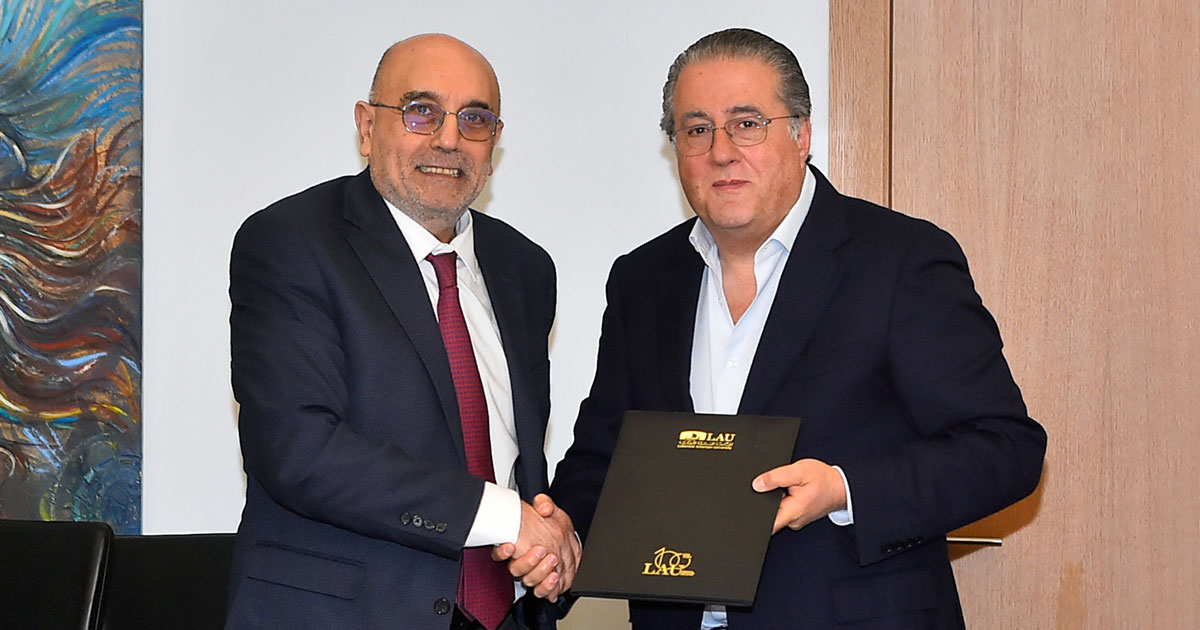
During his eight years as provost and chief academic officer, he safeguarded the university’s academic mission through prolonged periods of existential and national crises. As he concludes his second term this August, the university, on the approval of the LAU Board of Trustees, has named him its first-ever Provost Emeritus, in recognition of his exemplary leadership and lasting contributions to the university.
Receiving the title prompted Dr. Nasr to reflect on the years that led up to this moment. While deeply honored by the recognition, he said he valued even more the opportunity to contribute to LAU’s growth through a defining period in its modern history. He also viewed the distinction as a recognition of the many faculty and staff colleagues who had worked alongside him throughout this remarkable journey.
“I am fortunate to have been here and to have been able to contribute, both directly and indirectly, to many initiatives and developmental plans that have shaped the university,” he said. “But my greatest source of pride and fulfillment has always been the many students, whose journeys I have had the privilege of witnessing and, in some small way, helping to shape.”
His own professional growth, he added, has mirrored that of the university.
A first-generation university student, Dr. Nasr graduated from LAU, then BUC, with a bachelor’s in general science before enrolling in the University of Kentucky at the recommendation of his professor and mentor, Dr. Nabeel Haidar, where he earned a bachelor’s degree in electrical engineering with high distinction, followed by a master’s degree and PhD in electrical engineering.
After holding faculty appointments at the University of Kentucky and Valdosta State University, he returned to LAU in 1993 as a faculty member, contributing to the development and expansion of its engineering programs.
As he rose through the ranks to department chair and later dean of the School of Engineering, he led multiple ABET accreditation cycles, expanded undergraduate and graduate programs, strengthened research and industry partnerships, developed laboratories and educational infrastructure, and supported faculty recruitment and mentoring.
When Dr. Nasr assumed the role of provost in 2018, after serving for 12 years as dean of the School of Engineering, he was fully aware of the challenges ahead: addressing faculty concerns, supporting student success, managing institutional change, and responding to emerging trends in higher education.
He had a clear roadmap in the university’s Third Strategic Plan, along with his vision to enhance research while preserving LAU’s student-centered identity.
What he could not have anticipated were the successive crises that would threaten higher education nationwide and place LAU’s academic excellence under unprecedented strain.
“Almost overnight, we were hit by the economic collapse,” he said. To support students, the university allowed tuition payments in the rapidly devaluing local currency and significantly increased financial aid. At the same time, one of Dr. Nasr’s greatest challenges was retaining faculty members who were receiving attractive offers from institutions abroad.
As the university grappled with the economic meltdown, it was soon confronted by the October Revolution and COVID-19, requiring a swift transition to online learning to maintain academic continuity and preserve the university’s sustainability. Aware that the faculty had limited experience with this mode of instruction, Dr. Nasr taught an online course himself to better understand the demands of the transition.
“What that experience taught us in terms of academics was that online was a valuable teaching method or pedagogy that we should invest in, and continue building, even in the good times,” he said. That realization helped lead to the establishment of the Center for Innovative Learning, which supports faculty development, effective teaching practices, and educational innovation.
As the university adopted budget control measures while continuing to provide extensive financial aid and as the scope for growth in Lebanon narrowed, the need to mitigate risk and strengthen sustainability became paramount. The university accelerated its vision of expanding internationally, translated into LAU Global, to ensure continuity.
Despite all these hurdles, several landmark initiatives came to fruition under Dr. Nasr’s leadership. These included the academic planning and establishment of LAU New York, the university’s successful reaccreditation by the New England Commission of Higher Education (NECHE), the expansion of online programs, and continued investment in research, faculty development, and educational innovation.
An advocate for faculty and student empowerment, Dr. Nasr promoted interdisciplinary inquiry through the Honors Program and led the transformation of the Liberal Arts Curriculum into the LAU Signature Curriculum, which engages students with real-world challenges inspired by the United Nations Sustainable Development Goals.
He also strengthened shared governance and evidence-informed decision-making and encouraged the thoughtful integration of artificial intelligence into teaching, learning, and academic operations.
Furthermore, his contributions extend well beyond LAU through leadership and service with the New England Commission of Higher Education, the ABET Engineering Accreditation Commission, the American Society for Engineering Education, and other national and international organizations. These roles reflect his longstanding contributions to accreditation, quality assurance, academic excellence, and higher education policy.
His guiding principle as dean and provost, he said, has been the belief that students are not passive recipients of education but partners in learning, research, and the university’s future. Throughout his tenure, placing students at the heart of the university’s mission has remained a defining feature of his leadership.
As he prepares to conclude his tenure as provost, Dr. Nasr views this moment not as an ending, but as the beginning of a new chapter in his continued commitment to academic leadership, scholarship, and the advancement of higher education.
In his announcement of the emeritus title, LAU President Chaouki T. Abdallah noted that “Dr. Nasr has exemplified the academic excellence, integrity, and service that define LAU. His contributions have shaped the university in meaningful ways, and his legacy will continue to inspire future generations of students, faculty, and academic leaders.”


