The Colors of Omar Onsi’s Lebanon Return to LAU
The Philip A. Salem Academy for Lebanese Heritage devoted its monthly seminar to the Lebanese painter whose works preserved Beirut’s hills and mountain villages as they looked in the 20th century.
Some places in Lebanon now survive more fully in paintings than on the ground, among them the open hills of Beirut and the quiet mountain villages that once surrounded the capital. Omar Onsi spent nearly five decades recording them, leaving one of the most faithful portraits of a country that has since changed beyond recognition.
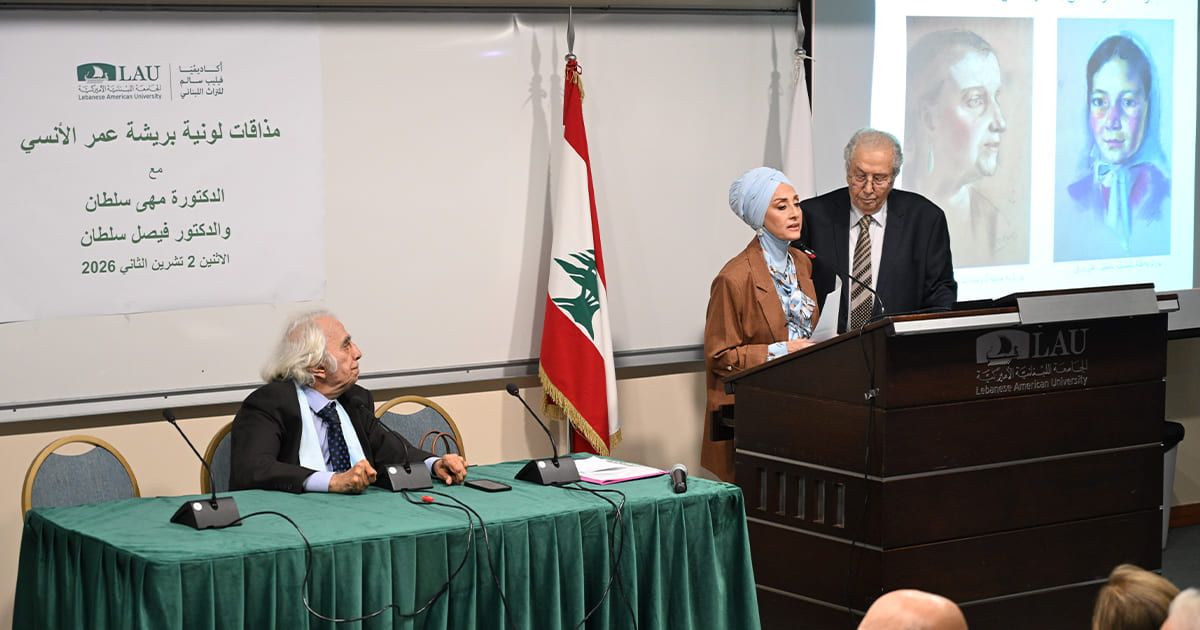
That portrait came back into view on November 2, 2026, when the Philip A. Salem Academy for Lebanese Heritage devoted its monthly seminar at the LAU Beirut campus to the 20th-century painter. Poet Henri Zoghaib, director of the academy, moderated a conversation with art critics, Dr. Maha Sultan and Dr. Faysal Sultan.
With photographs and paintings projected behind them, the speakers followed Onsi from his early drawings in Beirut through his training in Paris, where he studied at the Académie Julian before returning home in 1930 to hold his first solo exhibition. Throughout, they returned to the Lebanese landscape that remained his constant subject, from the city’s seashore to the orchards of the south.
The conversation also showed how closely his palette followed the course of his life. The death of his first wife in 1934 cast a shadow over his work, while friendships within Beirut’s artistic and literary circles and travels across the region gradually drew him back to the canvas. By the time he remarried in 1938, color had returned to his paintings, and he went on to become one of the country’s most accomplished watercolorists.
That renewed sense of color carried him through his later years, as he ventured deeper into the mountains and turned villages such as Aaraya, Souk el-Gharb, and Ain Zhalta, along with the slopes of Sannine, into some of his most recognizable scenes. His olive trees drew particular attention when they were exhibited at Gallery One in 1964, and the rocks and streams of Mayrouba and Faraya continued to occupy his brush until he died in 1969.
Attendees left with a copy of Father Henri Lammens’s Tasrih al-Absar fi ma Yahtawi Lubnan min al-Athar (1903 edition), the Jesuit scholar’s survey of Lebanon’s antiquities, re-published by LAU. The gift echoed the purpose behind the evening, since the academy works to recover and protect a cultural legacy that has too often been lost or scattered within Lebanon and beyond. Its monthly seminars return figures such as Onsi to public memory, and Zoghaib closed by announcing the next ones, along with a program that will bring the same heritage to secondary school students across the country.


