LAU Alumnus Helps Develop Life-Saving Innovation
Anwar Khaddaj won Falling Walls Lab Arizona with a medical imaging system that could reduce preventable trauma deaths.
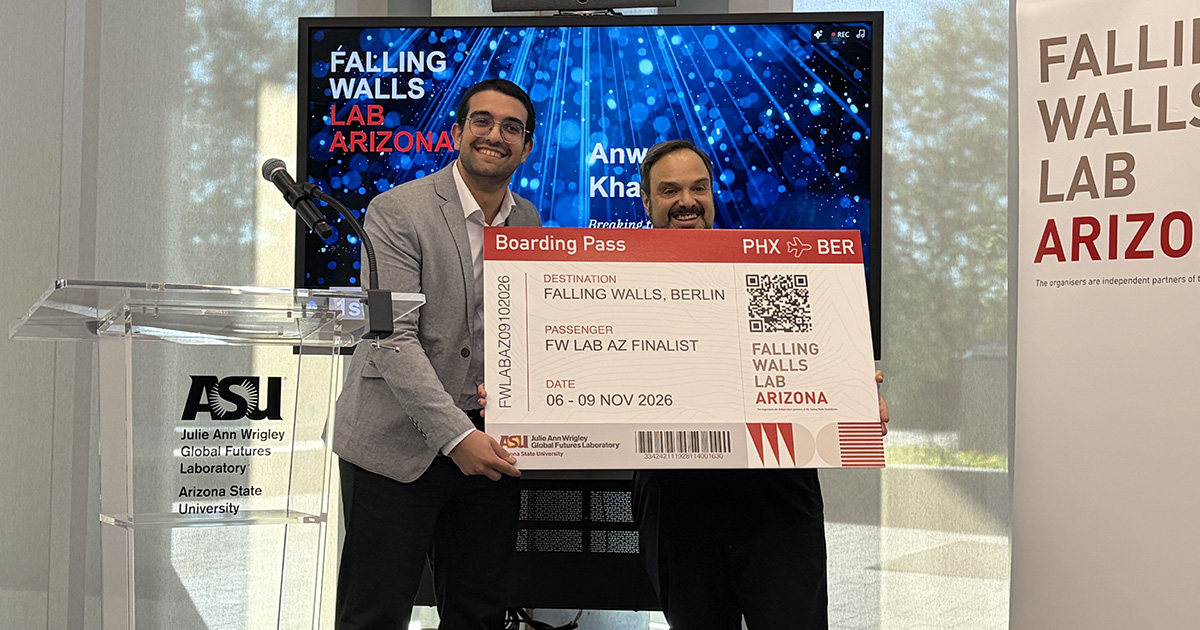
When it comes to saving lives, a mathematician may not be the first person who springs to mind. Yet LAU alumnus Anwar Khaddaj (BS ’22) is demonstrating how mathematics can help address a pressing challenge in trauma medicine. As he puts it, the discipline is “a great foundation for solving many real-world problems.”
A graduate of the School of Arts and Sciences (SoAS), where he earned a bachelor’s degree in mathematics with a minor in computer science, Khaddaj has built an academic and research career at the intersection of mathematics, entrepreneurship, and biomedical engineering.
Currently pursuing a PhD in applied mathematics under the co-advisement of Dr. Malena Español and Dr. Rosalind Sadleir at Arizona State University (ASU), he recently won the Falling Walls Lab Arizona competition for his work on a portable medical imaging system designed to detect internal bleeding in trauma patients outside the hospital. The project is being developed in collaboration with Dr. Sadleir.
Falling Walls Lab is a global pitch competition and networking forum that brings together students and early-career professionals from over 60 countries to present breakthrough ideas addressing some of the world’s most pressing challenges. Khaddaj was selected as one of 100 winners out of over 3,100 applicants worldwide who will advance to the Falling Walls Science Summit in Berlin, Germany, next month.
Khaddaj’s winning pitch centers on a point-of-care electrode belt designed to detect internal bleeding in prehospital settings, where early detection can be critical to a patient’s survival.
“The belt uses a noninvasive, radiation-free medical imaging technique called electrical impedance tomography (EIT),” Khaddaj explained. “Small electrical currents are applied through electrodes on the body to measure voltage data, and then optimization algorithms use those measurements to reconstruct conductivity images inside the body.”
His research focuses on improving the mathematical optimization methods behind this process, developing approaches that can help detect internal bleeding while accounting for patient breathing and other variables.
By addressing these challenges, the research aims to make EIT more practical for first responders by adding a portable tool that could support earlier detection, better-informed triage and transport decisions, and faster intervention for trauma patients.
The project has already received support from the US National Institutes of Health and the Flinn Foundation, an Arizona-based philanthropic organization that supports bioscience innovation. The team is also pursuing additional funding to advance the technology toward commercialization.
Reflecting on his journey, Khaddaj credited LAU with providing the academic foundation that continues to shape his work. He fondly recalled the classes he took with SoAS Associate Dean Leila Issa, describing her as “an inspiration and a wonderful mentor in my journey through mathematics.”


