Rethinking Late Ottoman Arts and Crafts from Beirut
An international conference hosted by LAU’s School of Architecture and Design places the Levant at the center of a period long pushed to the margins of Islamic art history.
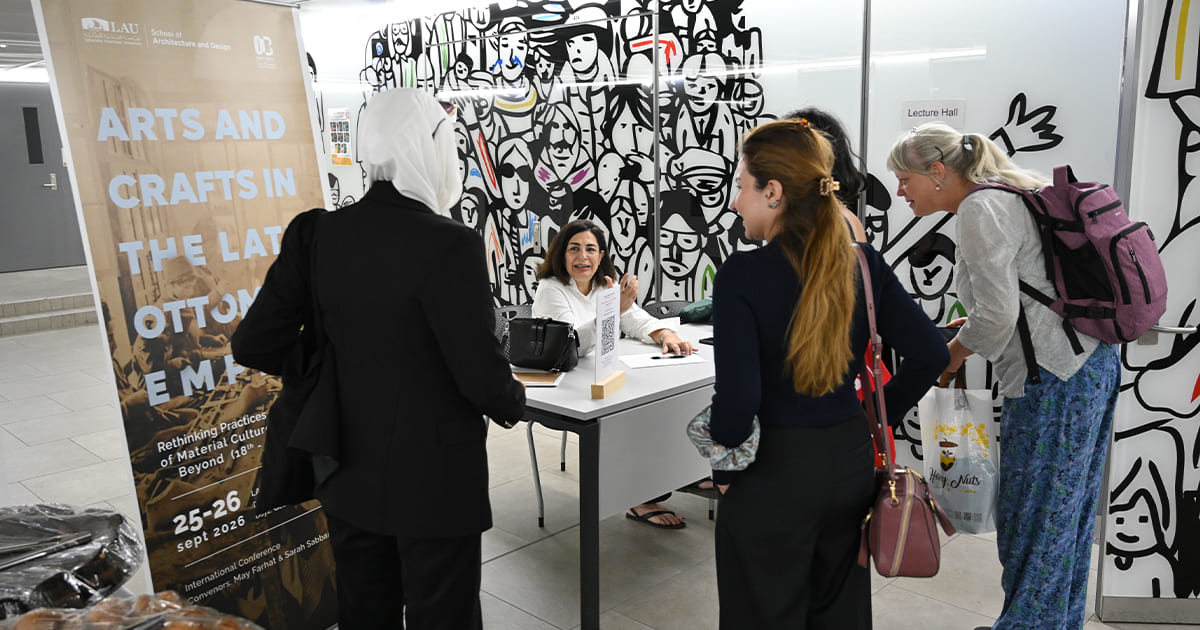
What does it mean to teach Islamic art from Beirut? Associate Professor and Director of the MA in Islamic Art Program May Farhat has carried the question through 22 years of teaching this topic in the city. Unlike Cairo or Istanbul, where the monuments of successive Islamic dynasties still shape the urban fabric, Beirut has “shed all of its medieval core”, she said, and her students often arrive with “assumptions inherited from older Orientalist conceptions of the field.”
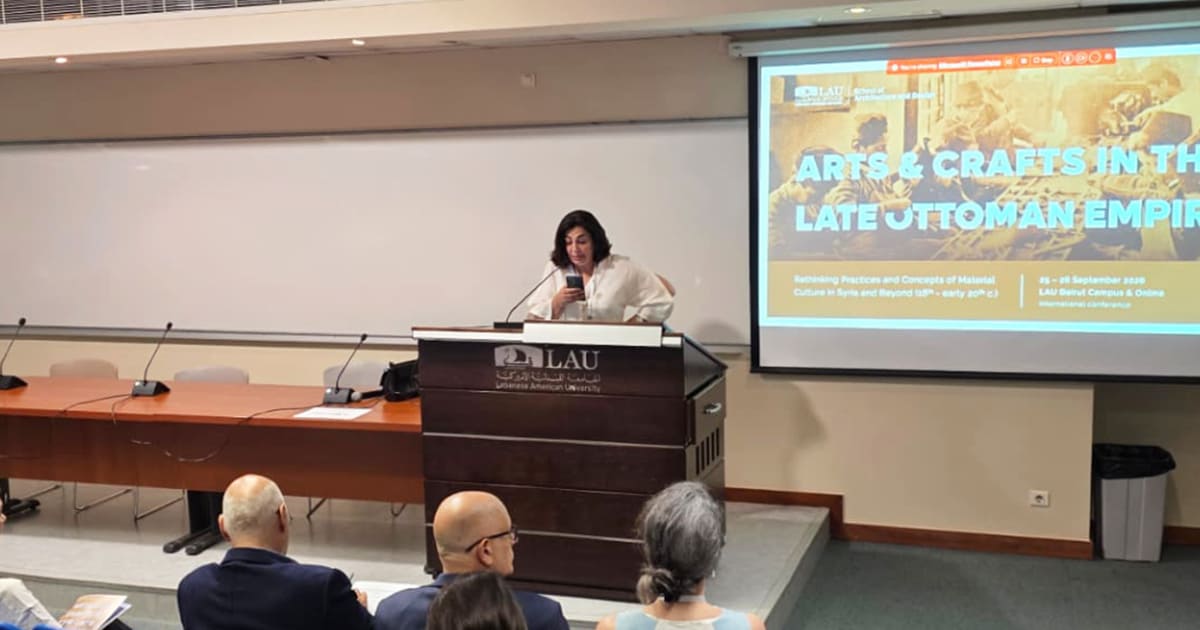
Dr. Farhat pursued this question through a symposium she co-organized with Dr. Sarah Sabban, titled “Arts and Crafts in the Late Ottoman Empire: Rethinking Practices and Concepts of Material Culture in Syria and Beyond,” held on September 25 and 26 at LAU’s Beirut campus. Hosted by the School of Architecture and Design (SArD) in collaboration with the Orient-Institut Beirut (OIB), the hybrid event gathered 30 speakers across eight panels with two keynote lectures, placing scholars from Lebanon, Syria, Palestine, Egypt, and Turkey in conversation with colleagues from Europe and North America.
The idea grew out of a discussion between the two conveners about how to challenge these perceptions and “rethink well-established divisions between historical periods.” They chose to focus on Bilad al Sham—the Levant—and the wider Ottoman Empire from the late 18th to the early 20th Century, “a period that remains beyond the horizons of the discipline”, Dr. Farhat explained. “We also wanted to bring together younger scholars working across the region to give them space to exchange ideas in Beirut and to bring their research to the wider public here.”
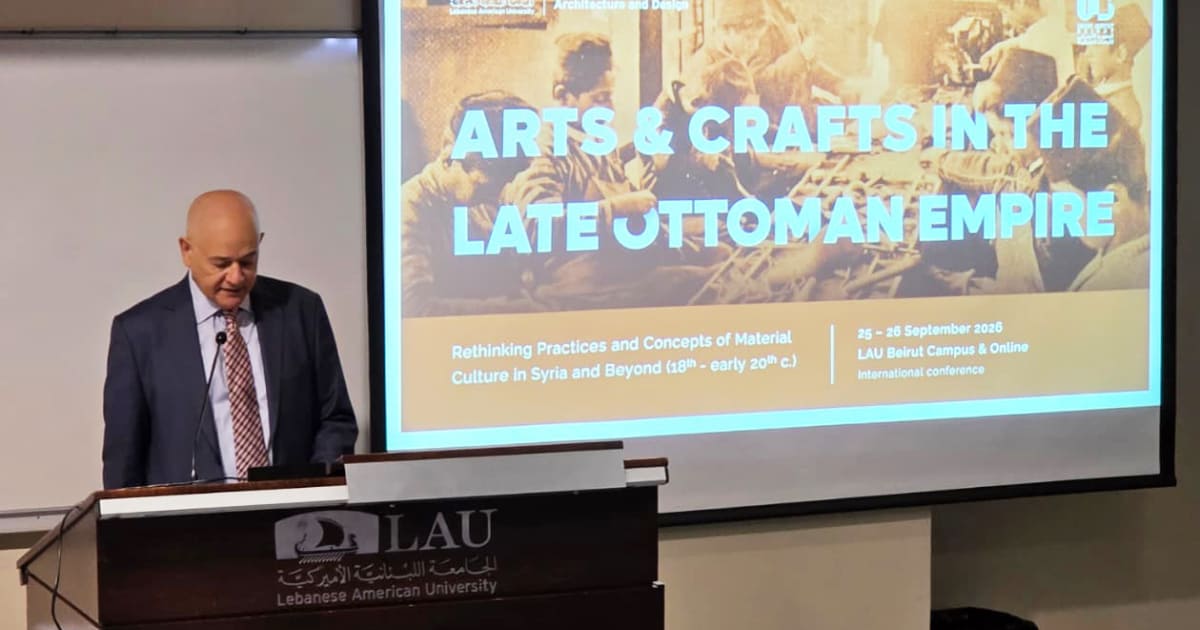
In his welcome address, Dean Elie Haddad noted how the late Ottoman period has long occupied “a marginal place within the discipline,” encouraging attendees to approach it as a “period of significant artistic, technological and cultural production in its own right.” The shift matters the most for Bilad al Sham, he added, whose material culture “has received comparatively less scholarly attention than Egypt, Turkey, and other parts of the Ottoman Empire.”
Dr. Haddad noted the importance of this conference, in connection with the MA program in Islamic Art, sponsored by Mu’taz and Rada Sawwaf , and its relation to the university’s commitment to “creating opportunities for emerging scholars to engage with leading researchers from around the world.” He commended the organizers for staging an international gathering “amid the continuing security challenges facing Lebanon and the region,” and thanked OIB Director Dr. Jens Hanssen and Dr. Alya Karame for the Orient Institute’s support.
For Dr. Sabban, a historian of the Arab and Islamic worlds, the location carries its own weight. “We hope to contribute to the recent developments and transformation of the field, putting Beirut on the map of Islamic art history.” The organizers intend to publish the conference proceedings, extending the exchange well beyond the two days on campus.
Opening keynote speaker, British Academy Global Professor at the University of York Marcus Milwright, set the tone for the first day. He called the conference “a rare and wonderful thing,” devoted to a late period “which until relatively recently has been quite neglected in scholarship.”
In his keynote lecture on the metalworking traditions of Egypt and Greater Syria, Dr. Milwright examined objects in the Mamluk Revival style and asked what it means to copy from a prototype. Such pieces demanded “enormous amounts of skilled labor” and precious metals, he said, yet remain hard to trace, since few bear dates or workshop names.
Over two days, the topics ranged from charcoal production in Mount Lebanon and the chibouk pipes smoked across the empire to Beirut’s triple-arch houses and Damascene underglass paintings.
For participants, the regional focus filled a long-standing gap. Yumna Moussa, a historian of Islamic art and architecture with Megawra–Built Environment Collective in Egypt, remarked on how long the field had waited for a conference centered on the late Ottoman period, and on Syria in particular. Yixin Pu, a PhD candidate at New York University and a doctoral fellow at OIB, presented a source scholars have rarely, if ever, used: silkworm egg boxes held at the State Silk Museum in Tbilisi, Georgia.
Closing the conference, keynote speaker Anke Scharrahs, a German conservator specializing in painted wooden interiors, drew on three decades of research on Damascus’s ‘ajami rooms. Between her first visit in 1998 and January 2012, she visited between 100 and 200 historic houses. Her lecture traced the materials and motifs of these homes, from stone mosaic and ablaq masonry to tiles, textiles and painted panelling, many of which survive only in fragments after generations of refurbishment.


