Tales from the Heartland
The 14th iteration of the annual Creative Writing Competition explored the geography of remembrance, prompting budding writers to map their inner world and share their most cherished memories.
French poet and novelist Anatole France once wrote: “The present is arid and troubled, the future is hidden; all the richness, all the splendor, all the grace of the world is in the past.” The past is our true homeland, the place that continually gives birth to who we are.
Though we cannot turn back the clock, we can, through memory, revisit the places, people, and moments that shaped us, finding our way home, if only for a time.
In its 14th year, LAU’s Creative Writing Competition has much to look back upon, with generations of aspiring young writers having carved their words into its annals. In a time of deep uncertainty and actual physical displacement, it provides a space for students to give voice to their dreams and experiences.
This year’s edition, titled The Geography of Remembrance: Remembering Those We Have Lost, focused on the rituals, monuments, objects, stories, and moments through which writers remember meaningful people, places, and experiences, forming a sacred geography of memory that connects the past to the present.
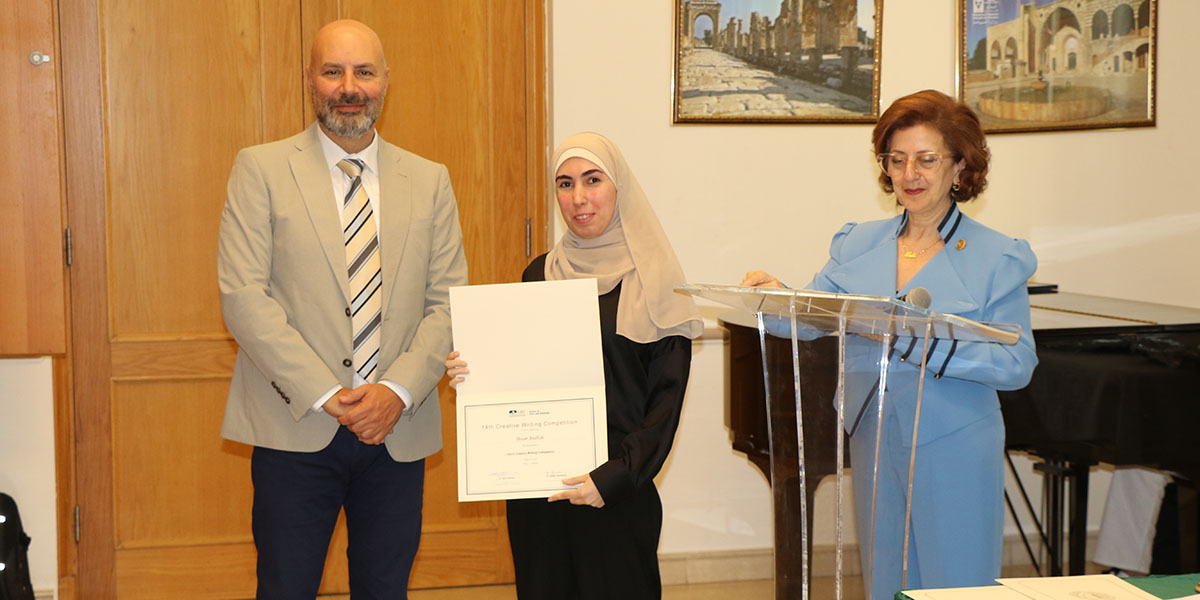
Co-organized by the Department of English and Creative Arts’ Senior Instructor Paula Abboud Habre and Instructor Nayiri Baboudjian Bouchakjian, the awards ceremony took place on May 20, 2026, at the Irwin Hall Faculty Lounge on the Beirut campus. Chairperson Dany Badran opened with a timely reminder of “the healing power of storytelling,” hailing the event as an opportunity for students to embark on an inner voyage to reclaim their agency and sense of self.
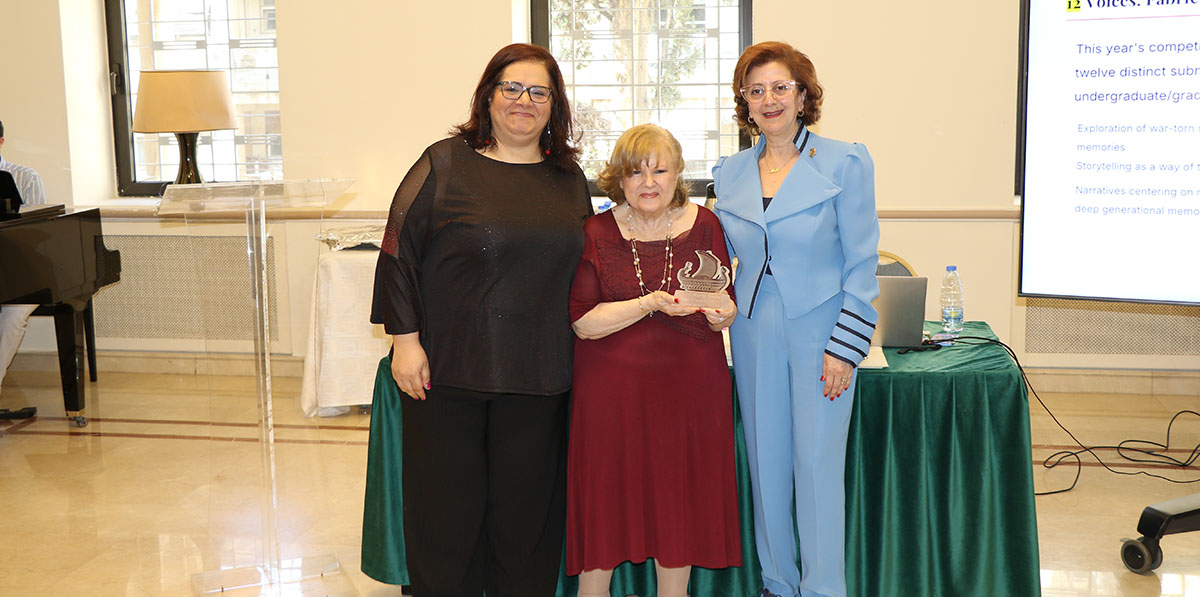
The first to take center stage was the guest of honor Mishka Mojabber Mourani, an esteemed Lebanese author whose writings and life journey reflect the region’s kaleidoscopic history. To honor her years and volumes of work, as well as her lifetime of being an educator, her former student Habre presented her with a trophy on behalf of the Creative Writing Competition committee at LAU. It was a full‑circle moment symbolizing the enduring impact of her teaching and writing.
In a letter to her father, Mojabber Mourani recalled how her family had settled in Lebanon and decided to stay despite the onset of the civil war. “We would not accept to be driven away by circumstance again,” she recounted, and her words struck a chord with the audience, many of whom were here to share similar experiences of attachment to land and home.
Among them were English senior Fatima Besher and MBA student Karen Khalife, who jointly won third place for their stories about the geography of their youth. The former lamented the loss of her village in the South: Her hometown, the mountains and rivers “where the world forgets itself every spring,” whilst she carries the painful burden of memory.
For Khalife, it was the Vendôme stairs at Jeitawi that still echo with the footsteps of the child she once was. “It’s the only place that never questioned my feelings,” she declared wistfully, “the only place where I could be fully myself.”
Second place went to Alumna Karen Hekimian (BA ’21), who, like Mojabber Mourani, has lived across borders. She immigrated from Aleppo to Lebanon, then to Italy, and is now writing from Armenia. The main characters of her piece were “the grandmothers, tangerines and balconies” that populated her childhood, each brought to life in vivid detail as recurring threads in a narrative that spanned the globe.
Ihsan Atallah, who is pursuing an MA in Comparative Literature, won first place for her nostalgic characterization of her childhood home that was torn down by bulldozers before she could even say goodbye. She likened her grief to mourning the loss of “an old lover” that “incessantly haunted [her] in [her] dreams, always there, inviting [her] to come in.” “Every time,” she concluded, “I happily obliged.”
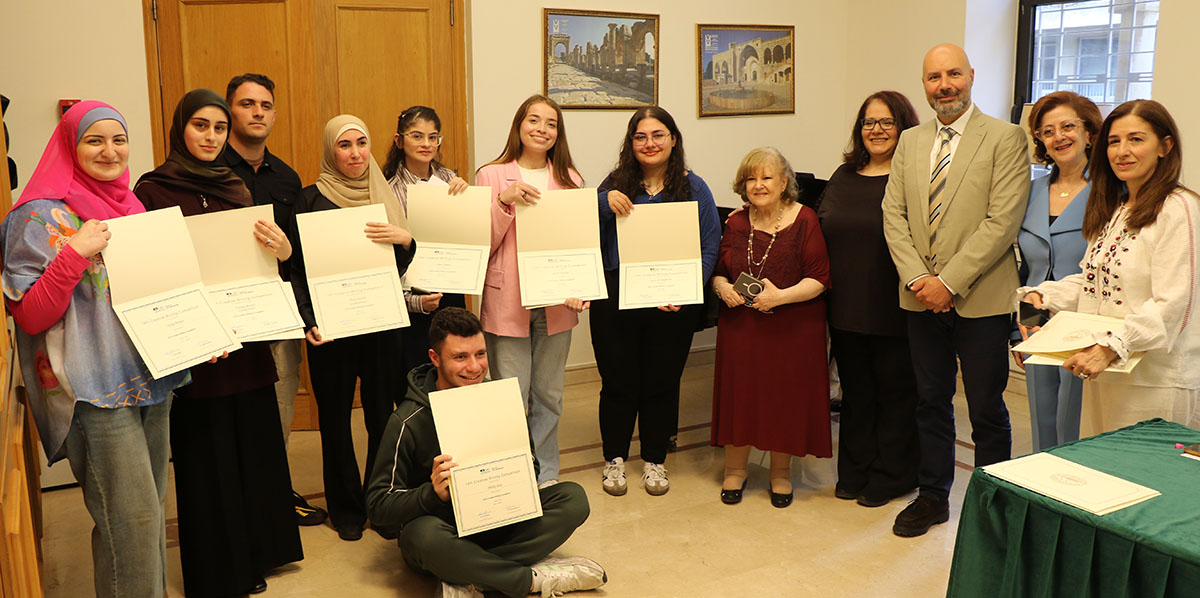
Each of the 12 participants had a different true north their heart pointed to, a formative memory that anchored their identity: A house, a place, an object, a soulmate, a family member, an imaginary partner, a younger self, an experience. Yet all undertook the same expedition across the shifting terrain of remembrance; instead of an escape, it was a moment of self-discovery, or rather, rediscovery at a time when continuity is more important than ever.
Just as the students made their voices heard, so too did the competition itself stand as a bold statement of perseverance in the face of war and chaos. In the spirit of the event’s theme, Habre and Baboudjian Bouchakjian perpetuated a storied LAU tradition and transformed it into a sanctuary where memory and creativity could flourish against all odds.


