Tracing Lebanon’s Forgotten Trams and Trains
The Philip A. Salem Academy for Lebanese Heritage opened its new season with a lecture on Lebanon’s railways and tramways, part of its effort to keep the country’s past within reach.
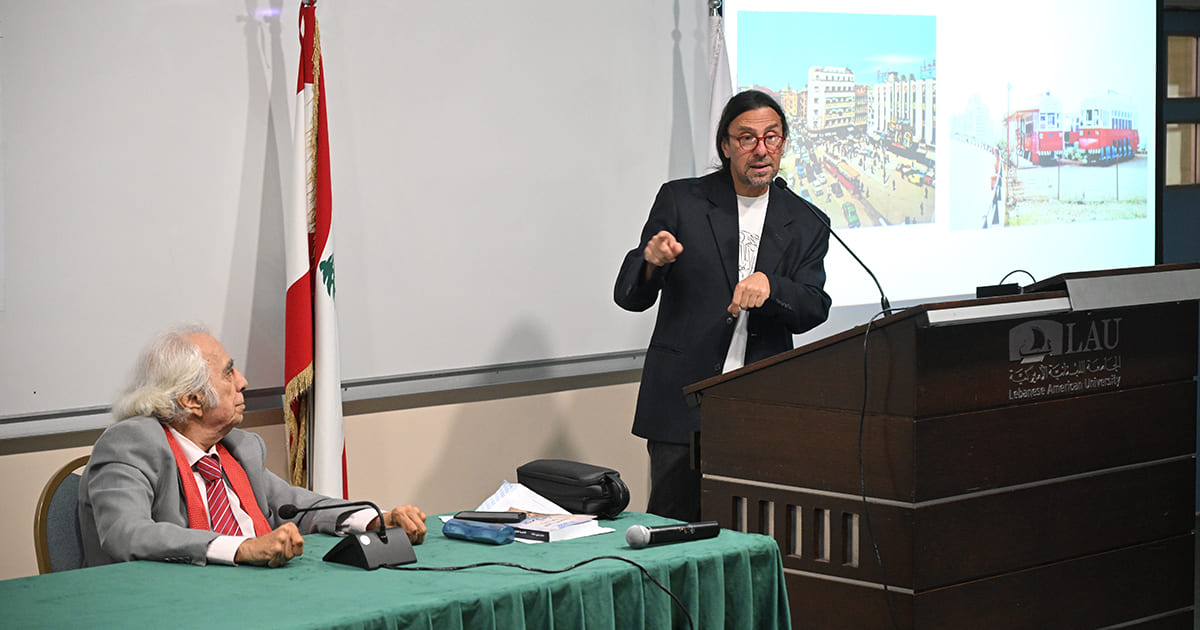
Long before traffic choked its streets, Beirut moved to the rhythm of the tram bell and the train whistle. On October 5, 2026, the Philip A. Salem Academy for Lebanese Heritage brought that era back into view at the LAU Beirut campus with “Once Upon a Time… The Era of Trams and Trains,” a talk by researcher Eddy Choueiry.
The lecture opened the academy’s new season, and poet Henri Zoghaib, director of the academy, used the occasion to announce an initiative aimed at Lebanon’s younger generation. Alongside its regular monthly lectures, the academy is launching “Academia Encounters,” a new series of lectures designed for school and university students that gives them a direct way into the country’s heritage. The program also includes meetings with Arabic language coordinators and teachers from schools across Lebanon on improving how the language is taught.
Mr. Zoghaib then turned to the evening’s theme, reminding the audience that trains and trams were, at one point, part of Beirut’s very pulse.
The question of why that past still matters fell to Dr. Philip Salem, the academy’s patron, who joined virtually from Houston, Texas. “We go back to the past to build the future,” he said. “We go to it to build what is better than it.” A future, he added, cannot be built by those who do not know their past.
With that purpose set, Choueiry took the audience back to the beginning, dividing his presentation into two parts that traced the origins of Lebanon’s transportation network. He placed the railway in its 19th-century context, when British and French colonial powers used rail lines as an instrument of influence across Syria and Lebanon.
Within that contest for influence, he explained, geography more than any other factor determined the role Beirut would come to play in the region. “What pushed for the creation of the Port of Beirut was that it offered the closest route linking Damascus to the sea,” he said. The first line, opened in 1895, connected the port to the Syrian capital.
If the railway tied Beirut to the region, the tram, he argued, left an equally lasting mark on the city itself, one that reached well beyond transportation. “Electricity came to Beirut because of the tramway projects,” Choueiry noted, pointing to the electric tram that appeared in 1909.
Throughout the talk, Choueiry grounded these histories in original photographs and documents, among them images of station buildings scattered across Lebanon. Long out of service, many of these structures survive only as remnants, yet they remain physical evidence of a network that once linked the country’s cities and a silent witness to a chapter of its history now fading from public memory.
That history carries fresh weight today, as interest in reviving Lebanon’s long-dormant rail network returns to public conversation. A look back at how trains and trams once connected the country gives that conversation a grounding in history, purposefully supporting the academy’s mission to view heritage as a resource to plan for the future.


