Kabse Pulls Back the Curtain
This year’s major theater production unmasks Lebanese society and pokes fun at its foibles.
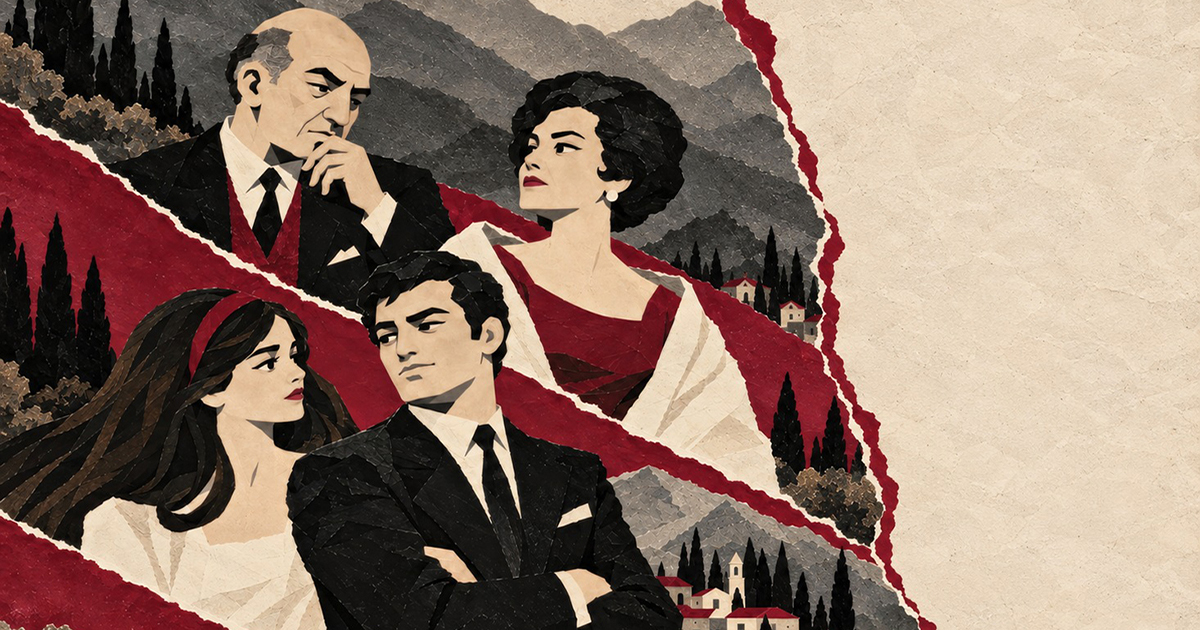
LAU’s latest major theater production conspires to make its spectators laugh at themselves and marks the definitive return of annual performances to the Gulbenkian Amphitheater.
Based on Nikolai Gogol’s The Government Inspector, Kabse is set in a remote Lebanese village in the 1960s. The story unfolds in a tangled web of lies its characters weave and, in turn, are caught in.
Yet the smoke and mirrors extend beyond the stage. A mirror can serve to misdirect, but it’s also the one the play holds up to Lebanese society to expose its rampant cronyism.
“All our systems are broken,” said Kabse’s director, Part-time Instructor and LAU alumnus Omar Moujaes (BA ’12), describing the story as a scathing critique of both corruption at the top and those at the bottom who enable and perpetuate it.
“It’s a constant loop of trauma and pain,” he added, “but I wanted to tackle it through a farcical approach, because everyone deserves a good laugh.”
Moujaes said he likes to “take audiences on a journey outside their reality,” which explains his choice of time period.
“It has become trendy to blame all our woes on the civil war,” he elaborated. “We decided to set the play before that to reveal something more fundamental about the tragedy of the human condition.”
Yet for all the biting satire, Kabse’s characters remain deeply human, warts and all. English Literature alumna Lynn El Amin (BA ’15), who adapted the play, wrote flawed but sympathetic characters that will feel familiar to most Lebanese, and perhaps remind them of themselves; a welcome deviation from Gogol’s one-dimensional protagonists.
Inhabiting the dramatis personae is an ensemble of LAU faculty, staff, alumni, and students who have joined forces with outside talent to bring the director’s vision to life. They include veteran actors like former LAU Clinical Professor Jacques Mokhbat, who repeatedly chews up the picturesque scenery to the audience’s delight.
“They teach us so much about acting,” Moujaes said about his cast. “I love watching them create their own versions of their characters, different from the ones written on the page. It’s a beautiful process.”
Rubbing elbows with such experienced thespians is a boon to Performing Arts students such as Alia Abdel Baki, Natasha Cherfane, Emilia Massou and Imad Taher, who take part in the play at every level of production, sometimes even as performers. They gain valuable hands-on experience in a culturally significant project under the guidance of a master of the craft.
For Moujaes, Kabse represents the culmination of a love affair with the dramatic arts that started in LAU. He credits former Associate Professor of Theater Mona Knio with igniting that passion, which eventually led him to his directorial debut with The Prophet’s Anonym back in 2016. Ten years later, that story has come full circle, in the very place where it started.
“Gulbenkian is one of the most beautiful stages in the country,” Moujaes said of the 56-year-old amphitheater whose walls still echo with memories of performances past. “Its Greek-style layout, the spirit in which it was designed, is simultaneously a creative opportunity and challenge.”
Encircled by the audience, the venue’s semi-circular thrust stage indeed offers unexpected vantage points that both enhance and complicate the scenography, leaving plenty of space to develop the plot but little room to conceal it.
That does not stop the characters from trying. Their various machinations are on a collision course with each other and, inevitably, reality itself, with the audience along for the ride.
The latter, of course, is in on it.
Kabse opens on November 19, 2026, at 8:30 p.m. at the Gulbenkian Amphitheater on the Beirut campus, with additional performances on the 20th, 21st, 26th, 27th, 28th, and 29th. Tickets are available at ticketingboxoffice.com and at Gulbenkian’s ticket booth before the show.


