A New Chapter of Innovation, Civic Partnership and Opportunities
LAU signs an MOU with the Georges N. Frem Foundation, launching a strategic partnership to advance innovation, education and national development.
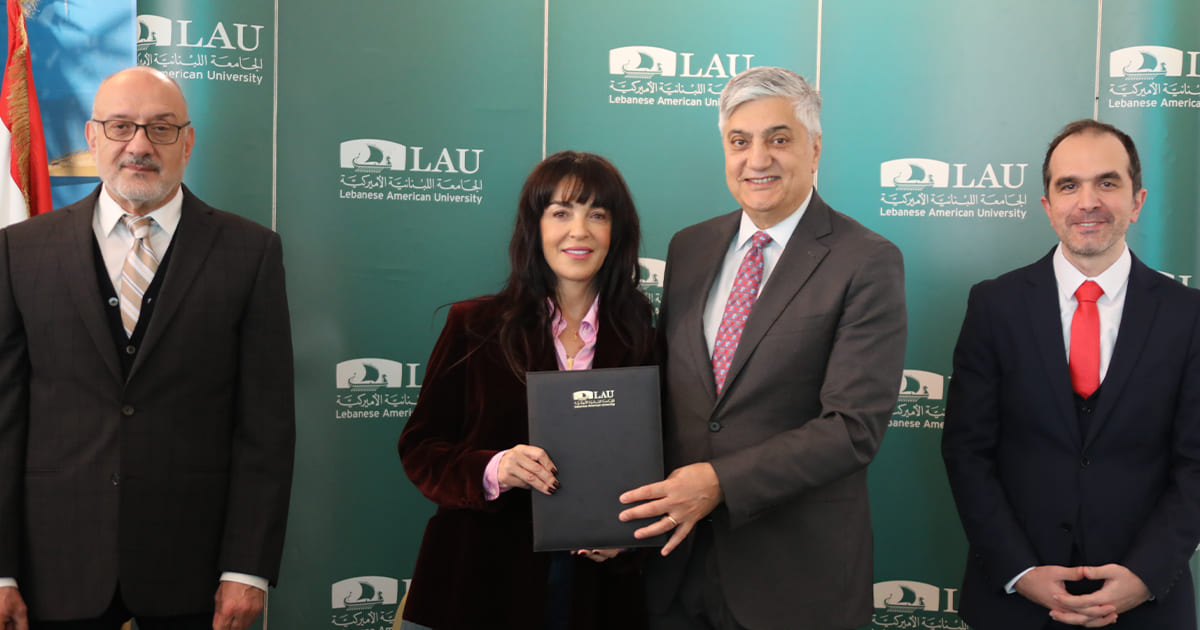
On December 11, 2025, the LAU Byblos campus welcomed the leadership of the Georges N. Frem Foundation (GNFF) for the signing of a landmark Memorandum of Understanding (MOU) that brings together two institutions long committed to empowering Lebanon’s productive sectors, strengthening education, and investing in youth.
The partnership, signed between GNFF and the university’s executing arm, the LAU Industrial Hub (LAUIH), under the direction of LAU Assistant Professor of Practice Ali Ammouri, establishes a multi-year framework centered on digital transformation initiatives, applied learning, and capacity building. The collaboration builds on the foundation’s extensive field experience and LAU’s role in translating academic expertise into tangible societal impact through student-led innovation.
Through this execution model, LAUIH places students at the center of real-world problem solving, enabling them to engage directly with national and community challenges while delivering tangible value to partner organizations.
Welcoming the foundation’s leadership, LAU President Chaouki T. Abdallah underscored the deep alignment between the missions of the two institutions.
“We are honored to have you with us on our campus,” he said, noting that the MOU brings together organizations united by the belief that Lebanon’s renewal must be built on “service, dignity, and opportunity.” He stressed GNFF’s longstanding societal contributions, from agricultural support to youth programs and education, as one of the most impactful models of community-driven development in the country.
He added that LAU sees its own mission reflected in the foundation’s work, particularly in its commitment to empowering youth and expanding access to opportunity through education and innovation.
At the core of the collaboration is a digital transformation agenda led by the LAUIH. Initial work focuses on the development of a mobile application and integrated dashboard for GNFF’s Student Journey Program (SJP), aimed at improving coordination, transparency, and accessibility for students and administrators alike.
This effort will be complemented by the design and implementation of Enterprise Resource Planning (ERP)- and Customer Relationship Management (CRM)-related solutions, as well as targeted AI integrations to streamline operations, enhance data-driven decision-making, and strengthen impact measurement across GNFF’s programs.
Beyond SJP, the partnership extends to several of GNFF’s flagship initiatives, including TAJ, which nurtures youth talent; IRSHAD, which supports farmers and rural livelihoods; and Ento Lebnan, which advances environmental and social development. Through tailored digital tools and system support, LAUIH teams will help these programs operate more efficiently, scale responsibly, and deepen their reach within communities.
For alumna and Executive Director and Vice-Chairman of GNFF Rania Frem El Khoury (BS ’91), the agreement marked the continuation of a relationship deeply rooted in shared values and longstanding institutional ties. She emphasized that the partnership feels organic, explaining that by the time the two sides were shaping the framework of the MOU, “our teams had already rolled up their sleeves and started working together.”
El Khoury noted the personal significance of returning to a campus that has shaped her own experience. She highlighted the complementary strengths that LAU and GNFF bring to the partnership—LAU’s innovation ecosystem driven by faculty and students, and GNFF’s extensive field presence and community trust across Lebanon’s agricultural and educational sectors. She described the MOU as an opportunity to design solutions that strengthen the country’s socio-economic future, stating that the partnership is fundamentally about shaping Lebanon’s renewal through its “most powerful asset: Its youth.”
The Industrial Hub, established to facilitate real-world learning through industry-engaged problem solving, will play a central role in implementing the partnership.
Dr. Elie Badr, LAU vice president for business development and global affairs, explained that the hub was created to address a persistent gap in higher education, namely the “need for graduates to gain practical, industry-ready experience before entering the workforce,” as companies across sectors seek young professionals who can tackle real operational challenges. He expressed his appreciation for El-Khoury’s leadership and thanked the LAUIH team for turning a vision into an actionable plan.
Through the hub, students join supervised multidisciplinary teams that deliver turnkey solutions to partner organizations, solutions they would otherwise seek from commercial consultancies.
“This approach,” said Dr. Badr, “equips students with competencies that no classroom alone can offer and has already attracted partners from more than 50 companies.”


