A Tripartite Alliance for Lebanon’s Digital Future
LAU signs a set of memoranda of understanding bringing together academia, government, and industry to advance digital transformation and public-sector innovation in Lebanon.
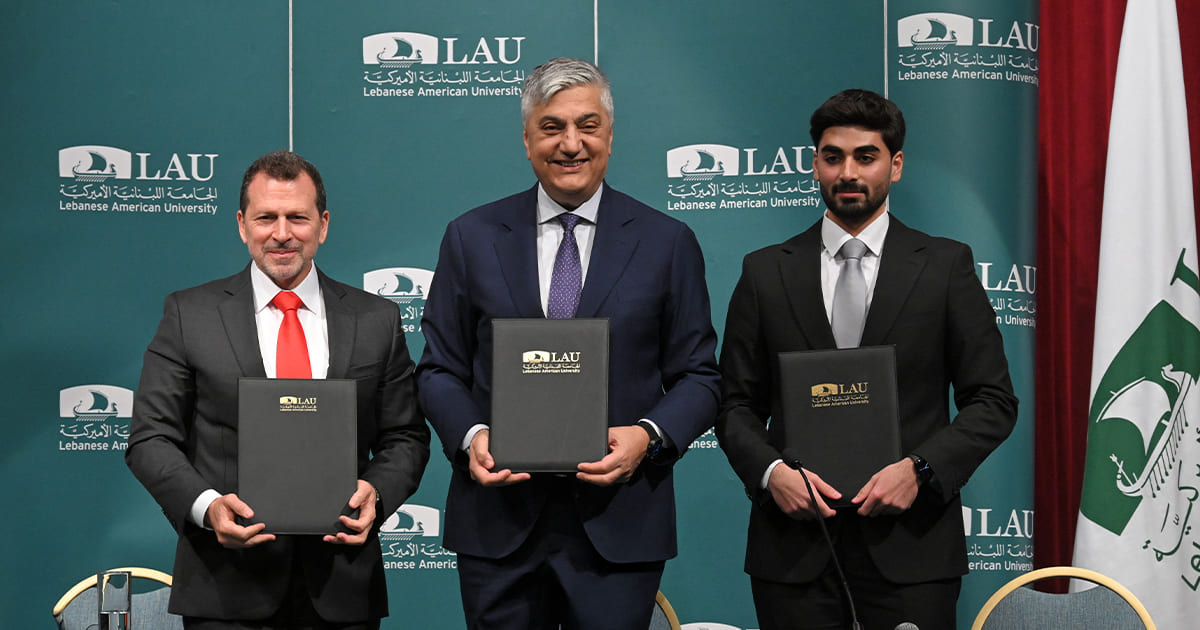
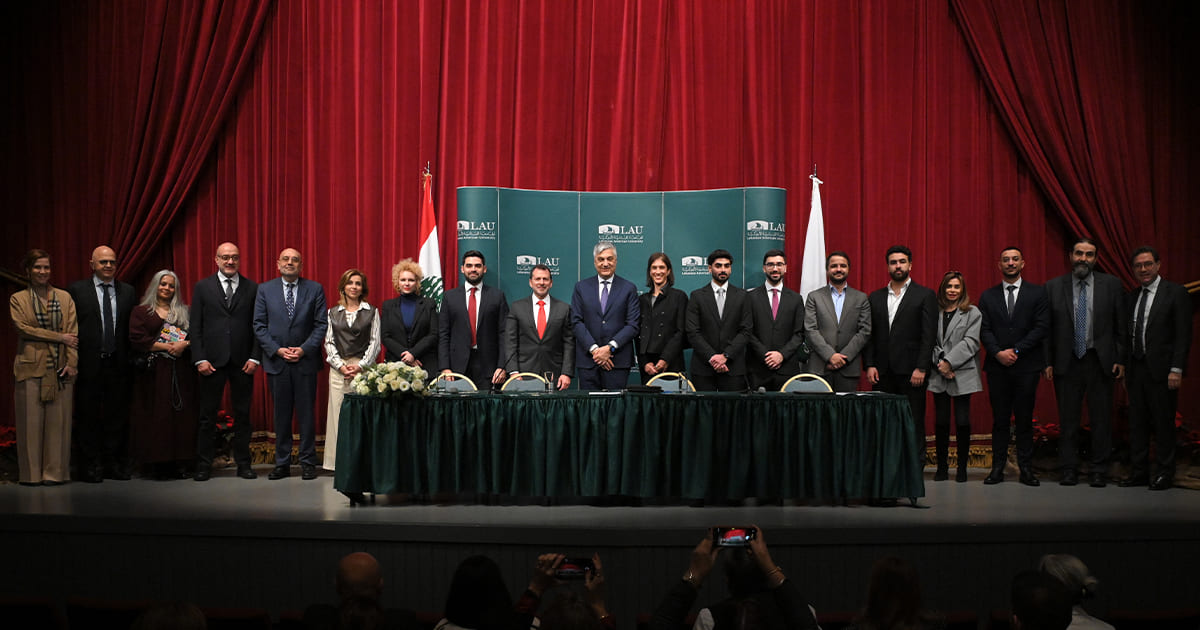
On December 16, 2025, LAU formalized a landmark three-party partnership with the Ministry of State for Information Technology and Artificial Intelligence (MITAI) and HTech on its Beirut campus, marking a strategic step toward advancing Lebanon’s digital transformation and artificial intelligence agenda.
The collaboration reflects a shared commitment to aligning public policy, academic expertise, and industry execution in the service of national priorities. At its core, the agreement establishes a framework for cooperation in research, capacity building, applied learning, and the development of AI-driven solutions that respond to real public-sector needs.
Welcoming attendees, LAU President Chaouki T. Abdallah framed the partnership as both timely and necessary, situating artificial intelligence not merely as a technological shift but as a societal crossroads. Drawing on a powerful metaphor, he described AI as “a foreign country” that every person is learning to thrive within—one filled with promise as well as responsibility.
“In the country of AI, a tidal wave could be fairness, universal access, dignity preserved,” Dr. Abdallah said, underscoring the university’s belief that human values and ethical intent must guide innovation. He emphasized that the signing signals LAU’s resolve to engage directly with Lebanon’s most pressing challenges through knowledge, policy, and practice.
The memorandum between LAU and MITAI outlines collaboration across multiple areas, including research and thought leadership, training and upskilling of public-sector professionals, expert advisory support, and applied learning opportunities for students. Through internships, capstone projects, and supervised research, students will contribute to Ministry-defined challenges while gaining hands-on experience aligned with national priorities.
Minister for the Displaced and Minister of State for Technology and Artificial Intelligence and LAU trustee Kamal Shehadi highlighted the broader vision underpinning the partnership, noting that Lebanon’s digital ambitions hinge on meaningful cooperation between institutions.
“It’s not about technology, and it’s not about AI; it’s when humanity meets the algorithm,” he said, stressing that digital transformation must ultimately serve citizens and strengthen the republic. He added that academia’s role in public service is especially critical at this moment, as universities bring not only technical expertise but also values, credibility, and long-term thinking to policymaking.
Complementing the public and academic dimensions of the agreement, HTech brings industry leadership and execution capacity to the partnership. A Lebanese tech and AI company with projects spanning public institutions and large-scale national systems, HTech will play a central role in translating ideas into operational platforms.
Representing the company, Chief Executive Officer Hussein El Hajj described the collaboration as a concrete response to youth disengagement and the brain drain, positioning technology as a tool for inclusion and national renewal.
“Through this partnership, we want every single Lebanese developer and innovator to know that they have a place here,” El Hajj said, adding that it is never too early for young people to lead, design, and build systems of national importance.
A flagship initiative emerging from the collaboration is Code for Lebanon, launched with the Ministry in partnership with LAU, the American University of Beirut, and Saint Joseph University. The program invites ministries to post real operational challenges, which students and alumni will address by proposing and developing tech and AI solutions alongside industry experts. The initiative aims to upskill youth, reduce brain drain, and modernize public services from within.
Together, the agreements reflect a growing recognition that countries poised to succeed in the age of AI are those that promote strong ecosystems connecting government, universities, and industry. For LAU, the partnership reinforces its mission to couple academic excellence with public impact, ensuring that research, education, and innovation contribute directly to rebuilding trust, institutions and opportunity in Lebanon.


