Armed With a Lens: Documenting Women in War and Preserving Collective Memory
Photographer Maher Attar reflects on his iconic civil war image in a talk at LAU, exploring its enduring impact, ethical questions and the strength of women in conflict.
During a brief ceasefire in the brutal Lebanese civil war, chance brought together two lives on opposite ends of the conflict: Rising photojournalist Maher Attar, then a freelance photographer for Agence France-Presse (AFP), and Samar Baltaji, an amputee fleeing the Palestinian Chatila refugee camp on crutches and holding her daughter’s hand, whose leg was maimed. Their fleeting meeting in 1985 produced one of the most iconic images of the 15-year war.
Featured on the cover of The New York Times, Attar’s photograph captured far more than Beirut’s shattered streets. It documented conflict with unflinching clarity, preserved collective memory, humanized suffering, and ultimately helped define the visual narrative of a nation at war.
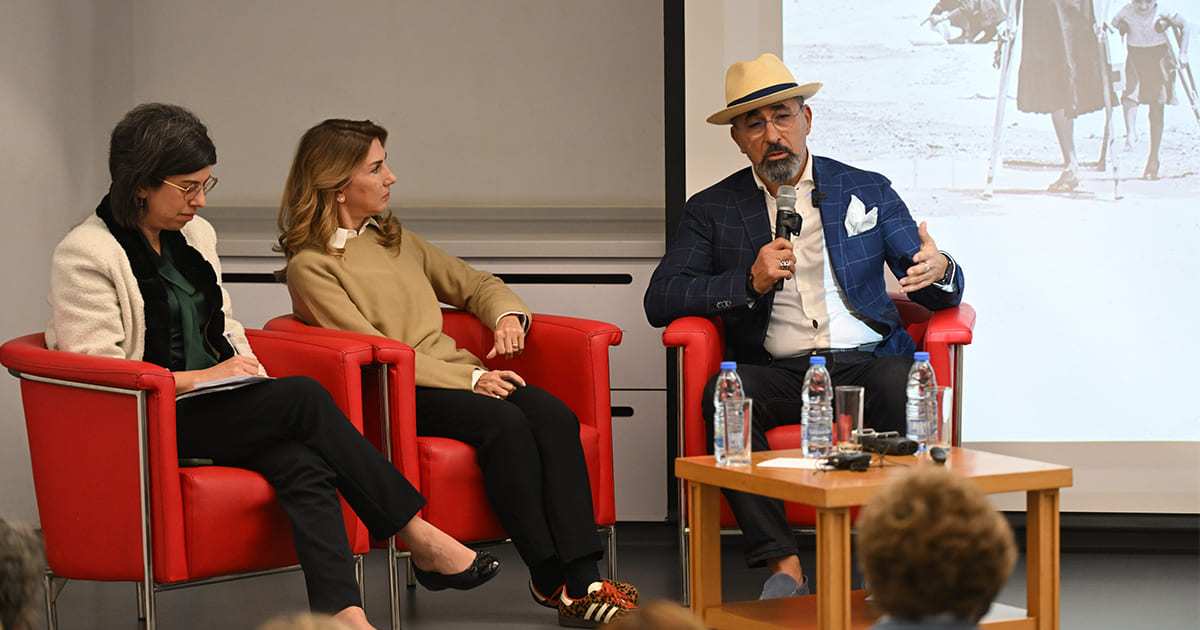
Four decades later, that story—and the enduring significance of the image—was at the heart of Framing Pain: The Civil War in Lebanon in a Photograph, an emotive talk organized by the LAU Institute of Art in the Arab World (IAAW) and the Arab Institute for Women (AiW) at the LAU Beirut campus on November 26, 2025. The talk also marked the first public display of the print, allowing viewers to engage with the image as it was originally captured.
Attar traced the journey behind the photograph that launched his career and reflected on why, 40 years on, it still holds both documentary and aesthetic significance. Building on this reflection, he explained that the evolution of photojournalism into works of art is natural and inevitable because of the reality the images capture. He emphasized that it is the authenticity of the moment— “photography is reality”—that ultimately gives a picture its lasting power.
For the event’s moderator, Yasmine Nachabe Taan, professor at the LAU School of Architecture and Design and director of the IAAW, inviting Attar was essential precisely because he is part of that reality. She noted that it was important to bring him to campus to tell the story behind his seminal photograph.
“It is not common for photographers to speak about their images,” she said, adding that the organizers wanted the audience to experience the photo through Attar’s own lens and narrative, from his unique position as both a witness and storyteller of the Lebanese civil war.
His extensive archive, ethical approach to photojournalism, and firsthand experience documenting some of the country’s most defining moments made him “a primary source,” she stressed. “He is known for bringing authenticity, lived experience, in addition to emotional and historical weight to images.”
Dr. Taan’s emphasis on authenticity and ethical storytelling opened the door to a broader reflection on representation in conflict.
Expanding on this, AiW researcher and event co-moderator Chantal Bou Akl, spoke about the multiple roles women step into in wartime—as breadwinners, homeowners, fighters, medical helpers, activists, writers and journalists. Her remarks set the stage for a discussion on ethics in photojournalism, particularly when capturing vulnerability. Attar responded with characteristic frankness: “Photojournalists document rather than invade privacy, especially war photojournalists. They put their lives on the line, and they are documenting history.”
The discussion then shifted to representation, with Bou Akl asking how photographers might challenge the common portrayal of women primarily as victims. Attar pointed to his own work as an example, highlighting that he has long sought to portray women’s resilience and strength. He also referenced his celebrated image “Marianne Lebanon,” inspired by Marianne—the emblem of the French Republic and a symbol of liberty and democracy—as a way of elevating women as enduring symbols of courage and agency.
Closing the event, Dr. Taan reflected on the broader significance of such images in shaping collective memory: “Photographs stir conversation; that is their important role.” By revisiting the past through these powerful visuals, societies can weave narratives around difficult truths, allowing memory, art, and humanity to converge.
This responsibility, she added, is especially relevant for younger generations who encounter images at an unprecedented pace, yet “rarely pause to understand what it means to document trauma, to frame pain, or to shape memory.”


