Building Bridges: LAU Champions Autism Awareness and Inclusion
LAU hosts a multidisciplinary webinar to embrace inclusion by highlighting the potential and needs of students on the spectrum.
Studies estimate that one in every 66 children in Lebanon is on the autism spectrum—a statistic that speaks not only to prevalence, but to the urgent need for awareness and inclusion.
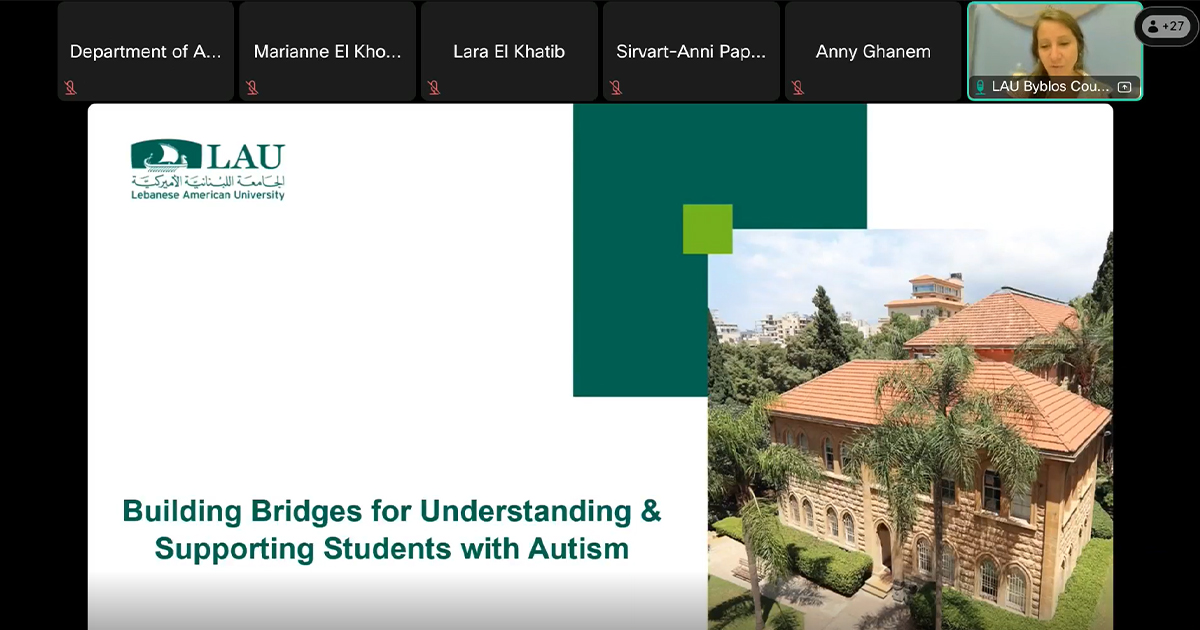
Recognizing this need, the LAU Counseling Services partnered with the Department of Psychology and Education at the LAU School of Arts and Sciences (SoAS) to organize a university-wide webinar on September 24, 2025, titled Building Bridges for Understanding and Supporting Students with Autism.
The session brought together faculty, counselors, and administrators to explore how higher education can better understand and support neurodiverse students as they transition into adulthood and university life.
The webinar began with a brief introduction from Dr. Jad Abdallah, dean of students on the Byblos campus and associate professor at the School of Pharmacy, who emphasized the importance of understanding the autism spectrum to provide better support for students.
Dr. Sahar Obeid, assistant professor of Psychology at SoAS, set the scientific foundation for the discussion by unpacking what autism actually means. Autism Spectrum Disorder (ASD), she explained, is not a straight line from “less” to “more” autistic traits. “Each person with ASD is unique,” she said, “and that’s why we tailor therapy and techniques to each individual differently.”
Accordingly, Dr. Obeid introduced a strength-based perspective—a shift from focusing on limitations to recognizing potential. She highlighted that many individuals on the autistic spectrum possess exceptional attention to detail, strong memory, and creative problem-solving skills. “Meaningful inclusion,” she added, “means seeing the person, not just the diagnosis,” and extending training and resources to reach every student who needs support.
Translating theory into lived experience, Dr. Joumana Haddad, principal counselor at the Byblos campus, illustrated what these differences look like in the classroom. Behaviors often misread as disinterest or rudeness, she pointed out, may actually reflect sensory sensitivities or different cognitive processing styles. “A student may be fully focused on the lecture but find direct eye contact overwhelming,” she said. “Looking down at notes or the wall is their way of staying engaged, not a sign of disrespect.”
That gap in interpretation, Dr. Haddad added, extends beyond the classroom. Difficulties reading body language or sarcasm can easily create misunderstandings, isolating students who already face heightened social and sensory stress.
Picking up on the theme of individual difference, Assistant Professor of Psychology Marie Anne El-Khoury delved deeper into the diversity within the spectrum. “The spectrum of autism is not linear—it’s a map, and that map is deeply individualized,” she explained, urging educators to replace assumptions with curiosity, observation, and dialogue. True inclusion, she said, comes from learning each student’s unique profile—their “map of autism.”
Dr. El Khoury also shed light on the hidden mental load of masking, when autistic individuals imitate social behaviors to fit in. While often seen as adaptability, masking can be exhausting and lead to burnout. “Genuine inclusion begins when educators ask, observe, and accommodate rather than assume,” she emphasized.
Lead Counsellor at the Byblos campus and the webinar’s moderator, Tala Al Noweisser, highlighted the key principles to keep in mind as foundation for inclusion: adopting a mindset of presumed competence to create opportunities for learning and growth; using an individualized approach to appreciate individuals’ unique profile and characteristics; practicing clear, direct communication to facilitate conversation, and ensure flexibility; and understanding routines, expectations, and approaches.
Moving from awareness to action, Associate Professor of Clinical Psychology and Chair of the Department of Psychology and Education at SoAS, Pia Tohme, outlined practical ways to implement inclusive teaching. She recommended “scaffolded assignments” that break complex projects into smaller, structured tasks with clear expectations. “Instead of saying ‘engage critically,’” she said, “we can specify what that means, like comparing two viewpoints and evaluating their strengths.”
On that point, Dr. Tohme remarked that inclusive teaching benefits everyone, not only students on the spectrum, as “the idea of inclusion is really about finding a different way of teaching that will support and engage all students.”
Concluding the webinar, counselors Nour Wakim and Maher El Helou showcased the network of support already in place at LAU. From personalized academic advising and career services that build social confidence to student life resources offering sensory-friendly environments, the university’s model reflects a holistic approach to student success.
“Filling this referral form is not just paperwork,” El Helou noted. “It’s what allows the counseling team to truly understand the student’s situation.”
To view the full webinar, please click here.


