Family Business Leaders Reflect on Succession Planning, Continuity and Governance in Times of Change
A panel at LAU explored the complexities of succession planning and the cultural, structural and human factors that shape the future of family enterprises.
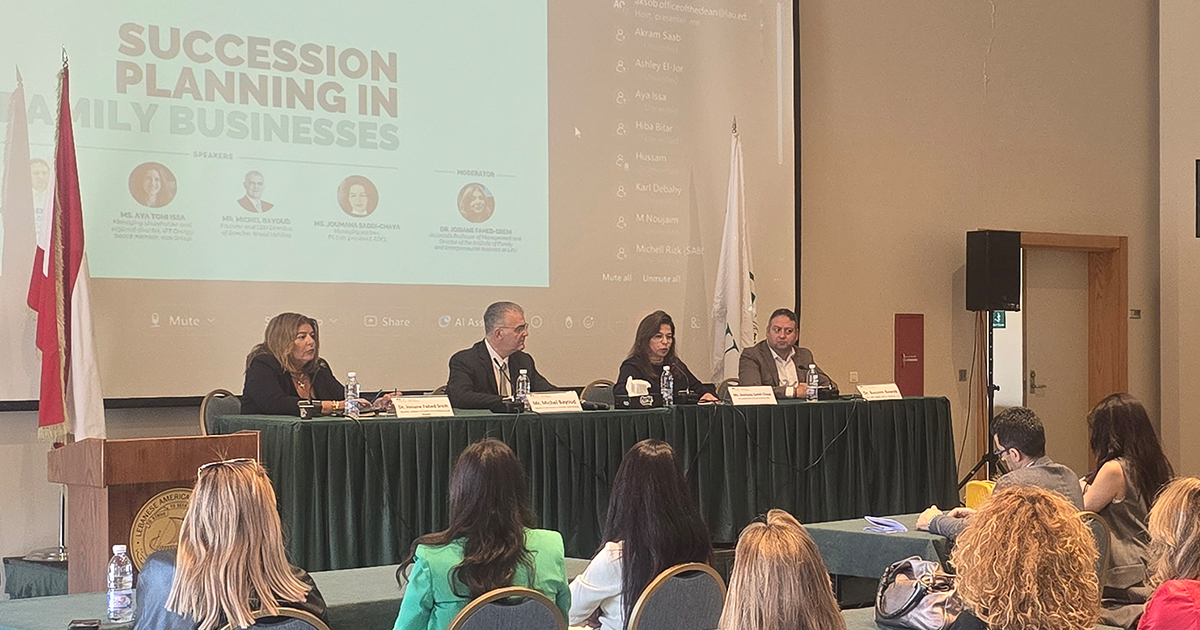
Family businesses carry with them more than commercial legacies; they hold histories, identities and responsibilities that span generations. That delicate balance between honoring the past and preparing for the future shaped the discussion on succession planning, held by the Adnan Kassar School of Business’ Institute of Family and Entrepreneurial Business on November 28, 2025, at the LAU Byblos campus.
Guided by Associate Professor and Institute Director Josiane Fahed-Sreih, the conversation unfolded as an exploration of the preparation, governance and interpersonal dynamics required to ensure continuity in family enterprises.
The panel featured a distinguished group of speakers, who drew on their experiences to underline the importance of cultivating readiness early: Dr. Bassem Bawab, CEO of Rafic Bawab and Co. SAL and chairman of CLE; Michel Bayoud, founder and CEO emeritus of Boecker World Holding and advisory board member at the school; Joumana Saddi-Chaya, managing partner of PS LAB and president of RDCL; and, joining via Webex, Aya Toni Issa, managing shareholder and regional director at IPT Energy and board member of the Issa Group.
Dr. Fahed-Sreih kicked off the discussion with the premise that “Succession is not a moment of transfer; it is a journey of preparation that begins long before leadership changes hands,” inviting the panelists to explore how families can navigate leadership continuity with intention, honesty and long-term vision.
Dr. Bawab described how responsibility gradually shaped his leadership path, recalling that “a successor grows into their role not through titles but through trust, responsibility and the willingness to take ownership long before it is formally given.” He illustrated how, from his experience, early exposure and meaningful involvement foster confidence while anchoring successors to the values of the founding generation.
Complementing this perspective, Bayoud drew attention to the emotional realities behind succession choices, noting that willingness matters as much as preparation.
“A successor must want the role as much as they are prepared for it; without both, succession becomes a burden rather than a bridge,” he said, challenging the assumption that children automatically inherit leadership by default. His reflections on selling his company demonstrated how honoring the next generation’s aspirations can, in itself, be a responsible form of stewardship.
Governance, structure and fairness formed another thread of consensus among the speakers. Dr. Bawab emphasized that clarity creates stability, observing that “a family business matures the moment it chooses clarity over assumption and dialogue over silence.”
Issa expanded on this by stressing the distinction between ownership and leadership, noting that “ownership gives you a voice, not a mandate; leadership must still be earned through competence and credibility.” Her insights reflected the realities of multigenerational enterprises where professionalization and fairness allow both the business and the family to thrive.
Together, their comments reinforced the idea that governance frameworks are not merely administrative, but serve to protect relationships, uphold merit and keep the enterprise aligned with its mission.
Communication—its presence, absence or hesitancy in initiating it—emerged as one of the most defining factors in successful succession.
Saddi-Chaya captured this clearly when she observed that “most family conflicts do not stem from disagreements but from conversations that never happened.” Her call for transparency echoed across the panel, particularly as she highlighted the evolving aspirations of younger generations and the challenges of retaining talent in Lebanon’s shifting economic landscape.
Noting the potential of emerging leaders, she added that Lebanon’s youth were not leaving because they lacked potential, but “because we fail to create spaces that match their ambition. Our challenge is not simply to retain them; it is to empower them.”
Throughout the discussion, the speakers returned to the human dimensions of succession: the trust required between generations, the courage to confront difficult conversations, and the humility necessary for founders and successors alike to evolve their roles.
Issa summarized this balance clearly. “Respecting the founder means honoring what they built,” she said, “respecting the successor means giving them the freedom to evolve it.”
Whether through gradual leadership transitions, governance structures that outlast individuals or conversations that replace assumptions, the panelists agreed that succession succeeds when families view it as a shared journey rather than a single event.
By weaving together stories of responsibility, transition, communication and reinvention, the session revealed that succession is ultimately about people, not just plans. Family businesses endure not because they avoid challenges but because they approach them with openness, structure and a commitment to continuity.
The event offered the LAU community deep insight into the complexities of family enterprise leadership, reinforcing the institute’s mission to prepare thoughtful, capable future leaders who understand both the strategic and human dimensions that shape enduring legacies.


