Future Engineers Meet Industry Experts to Explore Lebanon’s Energy Outlook
The LAU School of Engineering engaged its students in a high-level seminar on Lebanon’s oil and gas industry, featuring insights from leading experts.
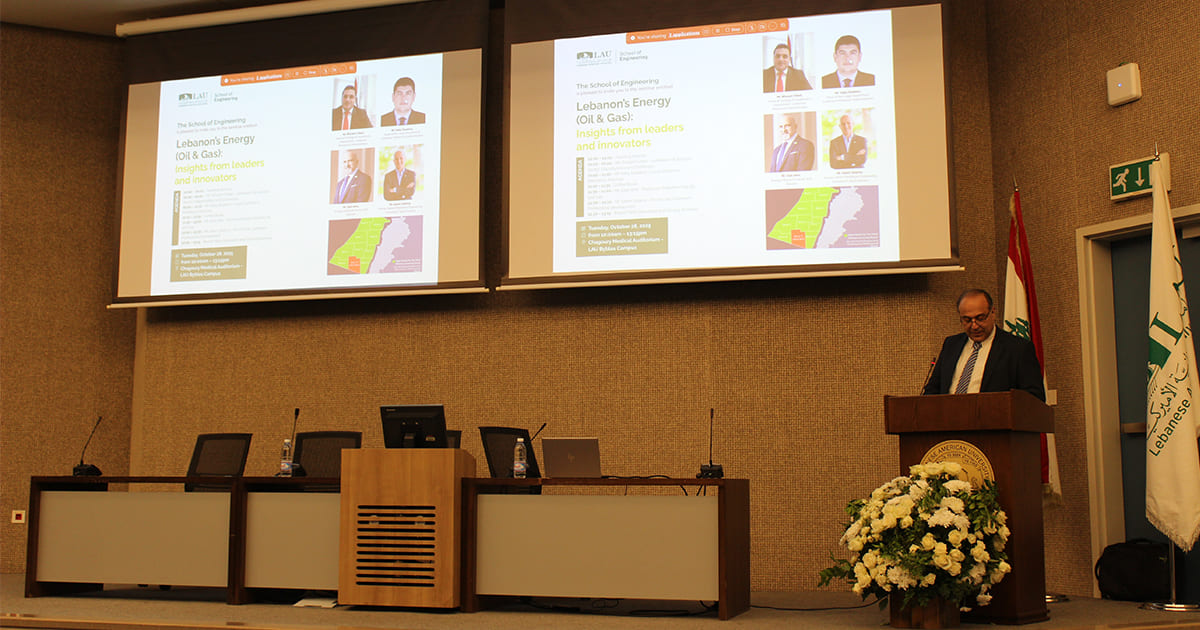
Lebanon’s offshore gas has long been viewed as a potential game changer, though uncertainty remains. At LAU’s School of Engineering (SOE), experts and leaders gathered at the Byblos campus on October 28, 2025, to shift the narrative, from waiting on resources to investing in the people and ideas that can shape the country’s energy future.
Spearheaded by the Petroleum Engineering Program, Program Coordinator and Associate Professor Jean Chatila opened the high-level seminar Lebanon’s Energy (Oil & Gas): Insights from Leaders and Innovators with a call to bridge academia and industry to address Lebanon’s key development priorities. “Knowledge, collaboration, and sustainability are the pillars of a viable energy future,” he said, setting the stage for a morning of rich exchange and forward-looking perspectives.
Dean Michel Khoury welcomed the audience of students, faculty, and guests, reaffirming LAU’s commitment to preparing engineers and future leaders with competence, responsibility, and vision. “At LAU, we equip our students with the knowledge and skills they need to contribute meaningfully to the engineering field,” he noted. “Today’s seminar reflects the kind of engagement we want to see, one that connects classroom learning to real-world impact.” The strong student turnout underscored growing interest in energy-related career pathways among young engineers
Wissam Edmond Chbat, head of the Geology and Geophysics Department at the Lebanese Petroleum Administration (LPA), opened the discussion by offering an expert overview of Lebanon’s offshore exploration prospects. He discussed the country’s geological promise and institutional readiness, pointing to both opportunities and constraints in the sector. He emphasized that long-term strategic planning remains essential despite political and operational challenges.
Acting Chairman and Head of the Legal Department at LPA Gaby Daaboul then turned the spotlight on the institutional side of the sector, specifically highlighting how regulatory transparency, sound procurement practices, and human resource development can drive sustainable growth.
He underscored that Lebanon’s real leverage lies not only in natural resources but in its ability to cultivate expertise and integrity within its workforce.
“The petroleum value chain must benefit the national economy through local services and workforce development,” he explained. “That is how we ensure the energy sector becomes a driver of progress, not dependency.” His remarks drew attention to the crucial role institutions play in building a resilient sector.
Adding an environmental and operational lens, Ziad Jeha, energy advisor and former director at Schlumberger (SLB), addressed one of the most overlooked challenges in oil production: The management of produced water and the byproduct generated during extraction.
The way a nation handles its waste streams says much about its readiness for global partnership and environmental responsibility, he noted. “Produced water management isn’t just a technical issue, it’s a credibility issue,” Jeha said, stressing that sustainability has become integral to energy development worldwide. His insights gave students a clearer understanding of the environmental responsibilities tied to resource extraction.
Rounding off the technical program, Salam Salamy, former senior petroleum engineering consultant at Saudi Aramco, spoke from more than four decades of global experience on the human dimension of energy development.
His presentation on “Upstream Professional Development” underscored that no resource strategy can succeed without an equally robust investment in people. “Human capital is the engine of the energy sector,” he said. “Competence, training, and continuous learning are what ultimately ensure a nation’s energy independence.” Salamy encouraged students to embrace continuous learning as the foundation of long-term engineering excellence.
The day concluded with a panel discussion that brought together all speakers for an interactive Q&A with the audience, a rare opportunity for students to engage directly with experts shaping the region’s energy direction. Together, the discussions highlighted the importance of developing the human and institutional capacity needed to support Lebanon’s energy ambitions.


