Germany is Next for Engineering Students’ Winning Project
Four LAUers are heading to Germany after their innovative diabetes management system swept the national AUT CREATE 25 competition.
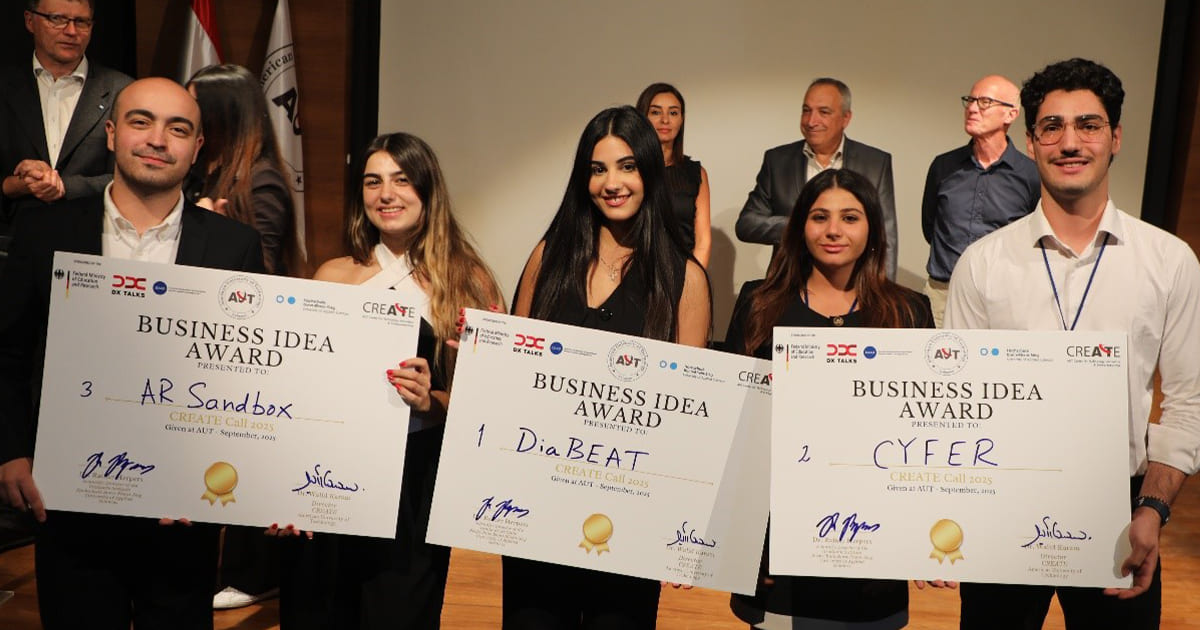
For Valerie Naufal, Elissa Diab, Taline Saad, and Hassan Tfaily, DiaBEAT started as an engineering challenge: How to make diabetes management simpler and more effective. Presented initially as part of their coursework, the project—a comprehensive system combining a non-invasive continuous glucose monitor, an automated insulin pump, and a mobile app—later went on to earn first place at a national competition and secure a spot on the international stage.
On September 23, 2025, the DiaBEAT team claimed first place at the AUT CREATE 25 competition held at the American University of Technology in Halat. Organized in partnership with the German Federal Ministry of Education and Research (BMBF) and in collaboration with Hochschule Bonn-Rhein-Sieg University of Applied Sciences, IEEE Lebanon Sections, Zaka (Beirut AI), and DX Talks, the competition aimed to encourage Lebanese university students to solve real-world problems through technology and innovation.
The first-place victory came with more than recognition: A fully funded trip to Germany this November, where the team will present their innovation to global experts, investors, and fellow innovators.
SOE Dean Michel Khoury praised the students’ achievement, highlighting that “this success reflects the School of Engineering’s commitment to hands-on learning and impactful innovation that serve society.”
But this was not DiaBEAT’s first moment in the spotlight. Earlier in 2025, the project had already claimed first place at LAU’s iCORE Innovation Challenge, proving its potential to make a real-world impact in healthcare. Under the guidance of Assistant Professor Noel Maalouf, the team—representing Computer Engineering, Electrical Engineering, and Mechatronics Engineering—refined their vision and prepared to test it on a bigger stage.
The competition unfolded in multiple phases, starting with an Ideation and Training Day on July 14 that brought together more than 120 students from universities across Lebanon. Through workshops on pitch preparation and design thinking, the DiaBEAT team sharpened their presentation strategy, learning to structure their pitch around market needs, technical innovation, and social impact. By the day’s end, they were among just 14 finalists selected to advance to the final round, which took place in September.
The DiaBEAT team will travel to Germany from November 24 to 29, 2025, to attend advanced innovation workshops, expert mentorship, and meetings with industry leaders and potential investors—opportunities that could transform their project from a promising prototype into a global healthcare solution.
“Winning AUT CREATE 25 was the result of months of teamwork, late nights, and the drive to create something meaningful for patients,” Naufal reflected. Tfaily added, “Representing LAU and Lebanon in Germany is both an honor and a responsibility. It pushes us to take DiaBEAT even further.”


