LAU Brings International Medical Simulation Competition to Lebanon
Partnering with SESAM, LAU launches SimUniversity in Lebanon, fostering collaboration between Lebanon’s medical schools and preparing students for real-world critical care.
As healthcare systems grow increasingly complex, simulation-based learning has become one of the most effective tools for preparing future physicians to deliver safe, coordinated, and compassionate care.
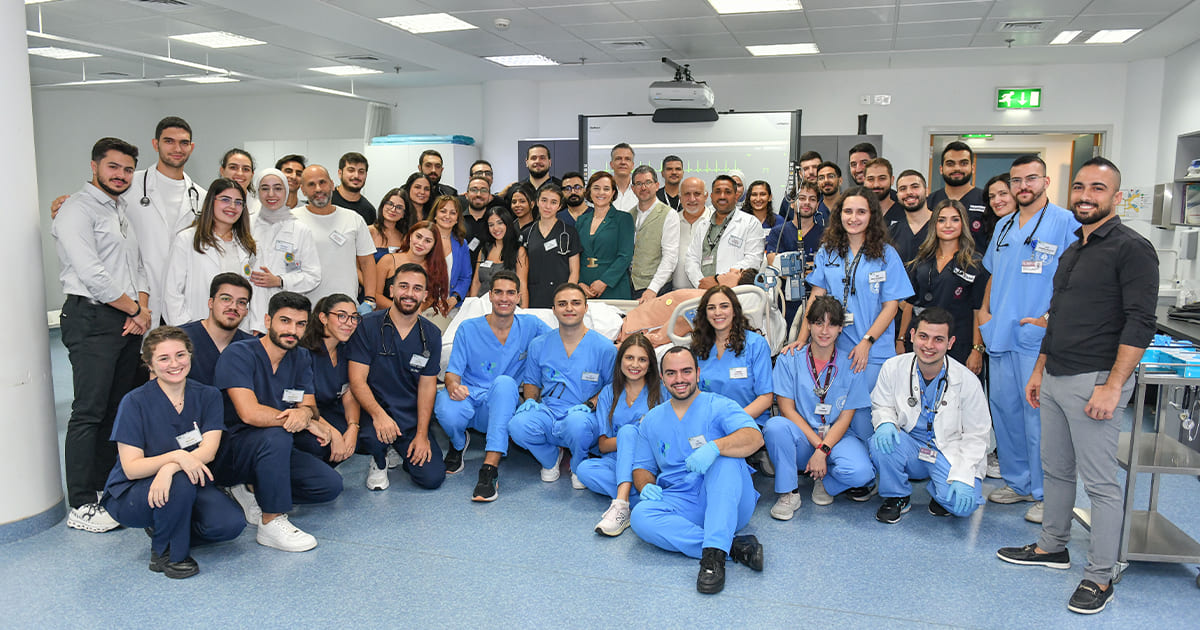
Affirming its leadership in this field, the LAU Gilbert and Rose-Marie Chagoury School of Medicine hosted the first SimUniversity Lebanon competition on September 19 and 20 at LAU’s Clinical Simulation Center (CSC) on the Byblos campus. Based on the concept of SimUniversity by the Society in Europe for Simulation Applied to Medicine (SESAM), the international competition brought together healthcare students from across Lebanon to take part in high-pressure emergency simulations designed to test leadership, teamwork, and clinical reasoning.
“The competition’s core mission,” said Director of the LAU CSC Hanane Barakat, “is to promote excellence in interprofessional collaboration and to prepare future healthcare professionals to act with poise, coordination, and empathy in high-stakes environments.”
Teams from all eight Lebanese medical schools trained for weeks under the supervision of clinical and simulation experts before taking on the challenge. Their performance was evaluated across multiple domains, including crisis management, communication, and decision-making under stress—skills that are essential to effective and compassionate patient care.
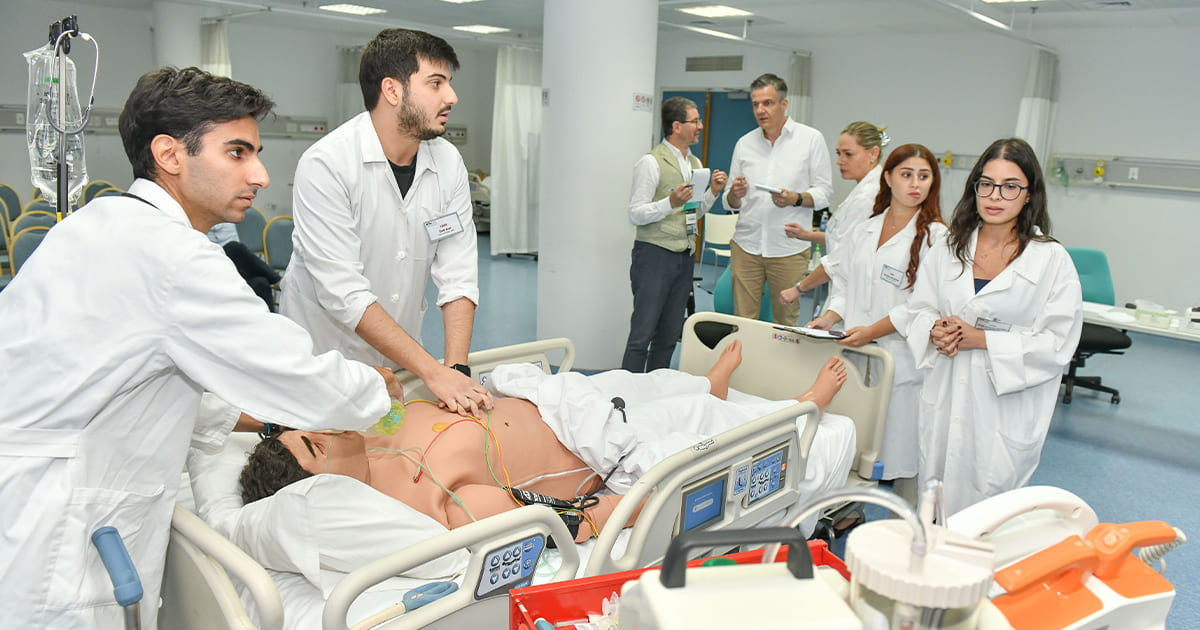
LAU’s team earned first place, a result that reflected the depth of preparation they received at the CSC. From emergency response drills to complex diagnostic scenarios, the center supports health science students with experiential learning opportunities and non-technical skills, equipping them with the mastery needed well before they enter a hospital ward.
Drawing from her extensive experience as a SimUniversity judge and SESAM member, Dr. Abi Raad, chair of the Anesthesiology Department, has seen firsthand the impact that high-quality simulation training can have on students. She highlighted the value of the CSC’s immersive and collaborative environment, noting that through “continuous exposure to high-fidelity simulations, structured debriefings, and interprofessional learning,” students strengthen essential skills such as communication, leadership, teamwork, and situational awareness.
Dr. Abi Raad also observed that this training prepares students to perform under pressure, think critically, and adapt to evolving scenarios—competencies that mirror real-world clinical demands. According to her, this holistic preparation builds the confidence, composure, and collaborative spirit that distinguished LAU’s team during the competition and contributed to their success.
The competition also fostered collaboration across institutions. Dr. Ralf Krage, founder of SESAM SimUniversity and former SESAM President, director of the Khalaf Ahmad Al Habtoor Medical Simulation Center in Dubai, noted that such initiatives help “break silos” among medical schools, encouraging cross-disciplinary learning between doctors, nurses, and pharmacologists.
Similarly, Dr. Marc Lazarovici, head of the Human Simulation Center at Munich’s Ludwig-Maximilians-University Hospital, and SimUniversity international judge, likened the event to performing under real-world pressure, “a kind of stage” that mirrors the intensity of the emergency room.
For LAU’s winning team, the experience was transformative. Team leader and Med IV student Anthony Tannous described it as “a national breakthrough” that would inspire more Lebanese medical students to engage in hands-on learning.
His teammate Ibrahim Khanjy highlighted how the competition tested both their technical and interpersonal abilities. “The trauma case caught us by surprise,” he said, “but it’s exactly this kind of practice that prepares us to be better doctors.”
Fourth-year student Margarita Aoun reflected on how the simulations turned stress into mastery. “At first, you think it’s just a simulation,” she said, “but when you’re thrown into it, it feels real. You’re doing actual CPR, handling a life. The stress turns into confidence when you see your team working well together.”
Following the success of its launch, SimUniversity is set to become an annual event at LAU, uniting medical students all across the country and utilizing simulation to foster excellence in critical care.


