LAU Charts the Path Forward Through its Fourth Medical Education Conference on AI
Bringing together international experts, national leaders, and future physicians, LAU’s school of medicine explored how to align medical education with digital innovation and keep humanity at the heart of practice.
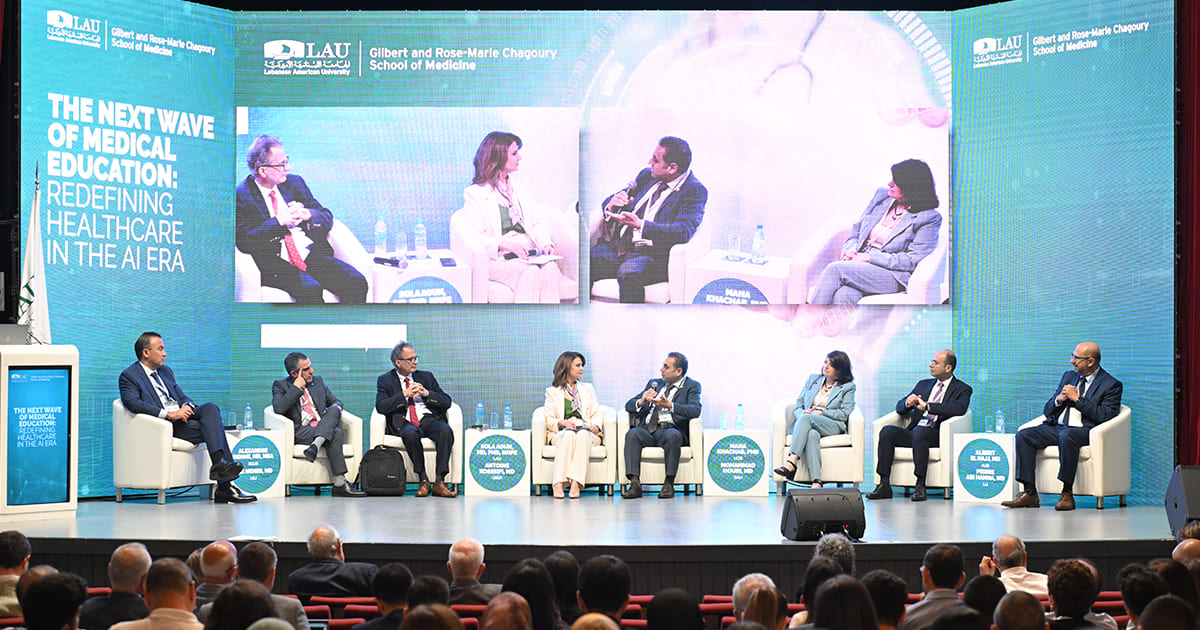
On September 19-20, the Gilbert and Rose-Marie Chagoury School of Medicine welcomed faculty, students, and policymakers from across the country to its fourth medical education conference, titled The Next Wave of Medical Education: Redefining Healthcare in the AI Era.
This nationwide event brought together all eight medical schools in Lebanon to address the matter of integrating artificial intelligence (AI) and simulation technologies into their medical education frameworks, redefining the role of AI in emergency rooms, assessment, and research.
The conference stressed AI and digital health as today’s imperatives. With AI transforming medical imaging, diagnostics, clinical decision-making, assessment methodologies, and curriculum design and delivery, the challenge today becomes building “a resilient, equitable health system [equipped] with physicians who understand the social determinants of health and are trained to work across sectors,” said Minister of Public Health Rakan Nasreddine at the event. “If we are to redefine healthcare,” he added. “We must first redefine those who deliver it.”
What this requires, according to Provost George E. Nasr, is a “bold rethinking of education itself. We must move beyond incremental updates to curricula and instead embrace a paradigm shift: Simulation-based learning, digital fluency, interprofessional collaboration, and lifelong adaptability.”
Dean Sola Aoun Bahous reflected on how the teaching methods are evolving in parallel with these transformations. “Through collaboration and resource sharing, we’re standardizing training, reducing medical errors, and strengthening healthcare outcomes across Lebanon.”
She went on to imagine a medical education with AI built into it; curricula that would center on computational and clinical thinking, courses that would tackle algorithmic bias and digital consent, and simulation labs where students could learn to work alongside AI as naturally as they do nurses and pharmacists.
The goal of this conference, underscored Dr. Vanda Abi Raad, associate dean for Faculty Affairs and Development at LAU’s school of medicine, was to unite “educators and innovators to reimagine medical education in the AI era.”
The heads of Lebanon’s medical schools—at the American University of Beirut, Lebanese University, Saint Joseph University, Holy Spirit University of Kaslik, University of Balamand, Beirut Arab University, and Saint George University of Beirut—also took part in an open dialogue, responding to pressing questions on integrating AI into medical curricula, ethical frameworks, and clinical training.
Dr. Albert El Hajj, head of the AI in medicine program at the American University of Beirut, warned against losing sight of our humanity. “At the end of the day, patients want to be cured, but they also want people—not AI—to deliver that care.” Though AI must be integrated into our curricula, “compassion, ethics, and the ability to critique AI outputs must remain central.”
Ethical responsibility, agreed Dr. Antoine Kosseifi, associate dean at the Holy Spirit University of Kaslik, is at stake, knowing “how to use AI appropriately—with fairness, transparency, and responsibility toward faculty, learners, and patients.”
From the Lebanese University, Dr. Pierre Abi Hanna, head of the infectious diseases department, cautioned against “never-skilling” and “de-skilling” in medical training. He cited studies suggesting that while AI may improve the end-product of learning tasks, it undermines the process of developing critical and analytical thinking skills. “We need to teach students how to see, to memorize, to have long-term memory, and to think critically,” he said. “We don’t want to lose that with AI.”
Alongside the plenary sessions and panels, the conference featured a rich series of workshops designed to equip participants with practical tools for the future of medical education.
A pre-conference session titled “Systems of Assessments and Programmatic Assessment” was led by Dr. Hossam Hamdy, professor of surgery and medical education, and Dr. John Boulet, senior scholar at the University of Illinois at Chicago, College of Medicine, and adjunct professor of medicine at the F. Edward Herbert School of Medicine at the Uniformed Services University.
Involving all participating medical schools, the session focused on aligning assessments with learning outcomes, ensuring fairness and validity, and providing ongoing feedback. The session also explored how AI and new technologies can enhance knowledge assessment, reasoning, and decision-making.
Dr. Nazih Youssef, program director of urology and of assessment at LAU’s school of medicine moderated the session, while Dr. Nadia Asmar, clinical associate professor and assistant dean for Medical Education at the school, who chaired the conference’s Scientific committee, contributed valuable insights from the local and regional context, particularly regarding the integration of assessment systems at the School of Medicine.
Subsequent workshops on a range of topics in medical education, from applying extended reality (XR) to using simulation for disaster preparedness and teaching in the digital age, emphasized cutting-edge technologies, ethical frameworks, and hands-on strategies to reimagine how educators prepare future healthcare professionals.
The conference also marked the launch of SimUniversity in Lebanon, organized in collaboration with SESAM, held at the LAU Clinical Simulation Center
“I was inspired by how this conference fostered collaboration, innovation, and critical reflection on the future of medical education in the AI era,” said Dr. Asmar.
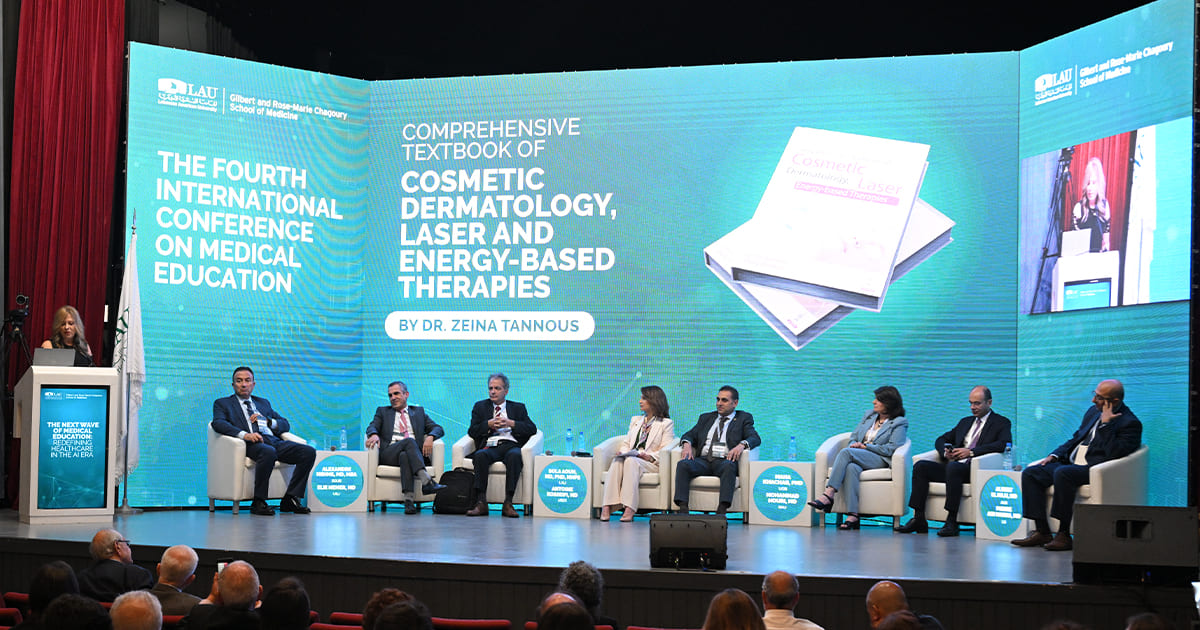
In parallel with the discussions, Dr. Zeina Tannous, chair of the Department of Dermatology at LAU’s school of medicine, shared the significance of her published book, Comprehensive Textbook of Cosmetic Dermatology, Laser and Energy-Based Therapies. As a gesture of collaboration, she donated copies of her book to the libraries of the medical schools in Lebanon, reinforcing the shared mission to enrich medical education.
In a comment on the gravity of the situation at hand, Dr. Bahous said: “If we get this wrong, we’ll create a generation of doctors who are operators, not healers, who trust data more than their instincts, and who see diseases, not people. The wave is here. Will we drown in it, or will we teach our students to surf?”


