LAU Renames the Center for Lebanese Heritage in Honor of Dr. Philip A. Salem
The Philip A. Salem Academy for Lebanese Heritage is poised to amplify its impact through new publications, research initiatives, public events, and digital archives that engage both the Lebanese public and the country’s far-reaching diaspora.
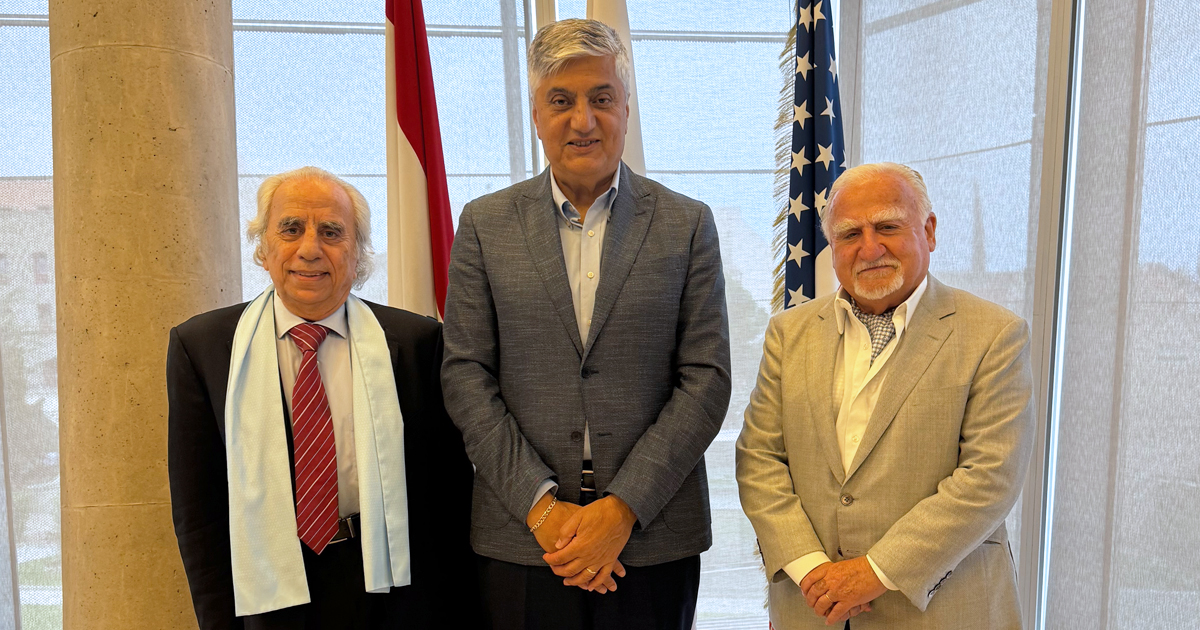
LAU is proud to announce the renaming of its Center for Lebanese Heritage (CLH) as The Philip A. Salem Academy for Lebanese Heritage, in recognition of the generous gift and enduring support of distinguished Lebanese American physician, scholar, thought leader, and former LAU trustee, Dr. Philip A. Salem.
The announcement honors both the legacy of the center, established in 2002 under the stewardship of poet Henri Zoghaib, and Dr. Salem’s lifelong commitment to Lebanon’s cultural, intellectual and national identity.
On behalf of the LAU community, President Chaouki T. Abdallah extended his deepest gratitude to Dr. Salem for his generous gift and the trust it represents.
“We are truly honored to house the Philip A. Salem Academy for Lebanese Heritage at our institution, where it will enrich scholarship, preserve our shared memory, and inspire future generations in Lebanon and across the diaspora.”
The center’s renewed mandate aligns closely with LAU’s mission to educate, empower, and inspire change, added Dr. Abdallah. “Through Dr. Salem’s intellectual leadership and the foundational work laid by Mr. Zoghaib, the center enters its next chapter with renewed purpose and expanded horizons.”
Since its founding, the CLH has served as a beacon for the preservation and celebration of Lebanon’s literary and cultural heritage. Under the leadership of Mr. Zoghaib, it emerged as a one-of-a-kind institution dedicated to archiving, researching, and presenting Lebanese heritage to both scholarly and general audiences. Its conferences, cultural activities, and flagship publication, Mirrors of Heritage, have been produced largely through his singular dedication and vision, contributions which the university recognized by bestowing on him an Honorary Doctorate in Humane Letters in 2024.
A longtime friend of the university and Mr. Zoghaib, with whom he shares a passion for Lebanese heritage, Dr. Salem recognized the opportunity to adopt the existing center at LAU, which has been committed to safeguarding Lebanon’s collective memory and cultural vitality.
Renowned as a global pioneer in cancer research, Dr. Salem has been deeply invested in Lebanese cultural and intellectual life for decades. His advocacy for Lebanon’s sovereignty, pluralism, and civilizational legacy earned him the Khalil Gibran International Award in 2000 from the Arabic Heritage League in Sydney, Australia, and the Arab American of the Year Award, also in 2000, from the Arab Community Center for Economic and Social Services in Dearborn, Michigan, among a slew of accolades. In 2010, he received an Honorary Doctorate in Humane Letters from LAU.
The academy, he said, will primarily serve as a vehicle for national renewal, rather than an archival institution, and “a platform for many functions that address the country’s issues.”
Our heritage “embodies our identity,” he noted, which is equally important to those residing in the country and the diaspora. “A critical challenge in Lebanon today is despair. To conquer despair, you have to tell the Lebanese who they are and that it is not impossible to build a new Lebanon,” he said.
While acknowledging the need to study our Lebanese heritage, to learn from it and be proud of it, Dr. Salem maintains that we should draw on it to inspire and build the future, without becoming “prisoners of the past.”
What the center must strive to preserve and project, he insisted, is the pluralism that has long distinguished the country from its surroundings as a unique civilizational model in the region.
For this reason, he explained, he is committed to making it a place for learning and scholarship. Hence, the choice to name it an ‘Academy,’ “because I would like one day to see the center as an academy where people can learn about Lebanon’s history, and recognize the great pride in being Lebanese,” he said.
He emphasized the need to revive cultural confidence, especially among younger generations. “You cannot preserve culture without preserving the political framework that protects it. If Lebanon collapses, that culture collapses too,” he added.
Mr. Zoghaib reaffirmed this mission, outlining the center’s role “to document and celebrate Lebanon’s literary production, safeguard the contributions of its thinkers, and promote Lebanese culture beyond the nation’s borders.”
“Renaming it,” he added, “represents not only a tribute to Dr. Salem but a commitment to expanding its scope and impact.”
As Dr. Salem reflected on Lebanon’s global imprint, he shared a remark made by a former colleague: “If you go to London, you go to England. If you go to Paris, you go to France. But if you go to Beirut, you go to the whole world.”
In these words lies the vision of the newly named center, a place where Lebanon’s history, culture and heritage are not confined by borders but radiate outward, connecting the nation to its diaspora and the wider world.
The Philip A. Salem Academy for Lebanese Heritage stands as both a guardian of memory and a beacon of possibility, ensuring that the spirit of Lebanon continues to inspire, enlighten and transcend.


