LAU Student Launches Card Game to Challenge Child Marriage
LAU alumna and current MA student Dima Ismail leads “Off Limits: Child Marriage Pack,” a bilingual card game that engages the youth mentally and emotionally on the issue of child marriage to promote social change.
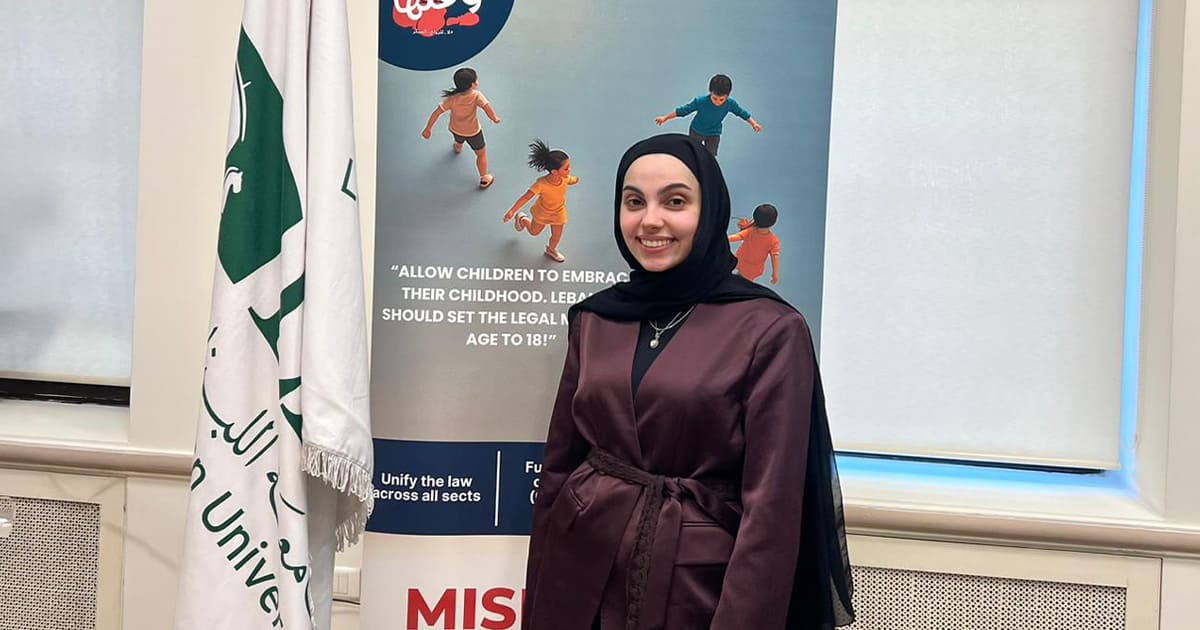
Organized by the Arab Institute for Women (AiW) in collaboration with the Departments of Psychology and Education, and Communication, Mobility and Identity (CMI), “Off Limits: Child Marriage Pack” was launched on October 27, 2025, at LAU’s Beirut campus.
The event was held in partnership with the Mish Waata – مش وقتها campaign, the Governance Lab programme, the UN Global Compact Network Lebanon, Out of the Box, and the British Council.
At the center of the project stands Dima Ismail (BA ’23), now pursuing her MA in Education at LAU. As a delegate of the Governance Lab’s Gender Equality Group, Ismail co-created the youth-led awareness campaign Mish Waata, dedicated to combating child marriage in Lebanon. Together with a team of peers and in collaboration with LAU faculty and entities, NGOs, and the political gamification studio Commence Games, she helped bring the idea of “Off Limits” to life.
“We wanted to build momentum for a civil law that sets the minimum age of marriage at 18,” Ismail said. “But beyond that, we wanted people to feel the issue—to live it, debate it, and challenge their own assumptions. Statistics don’t make people feel the issue; a game does.”
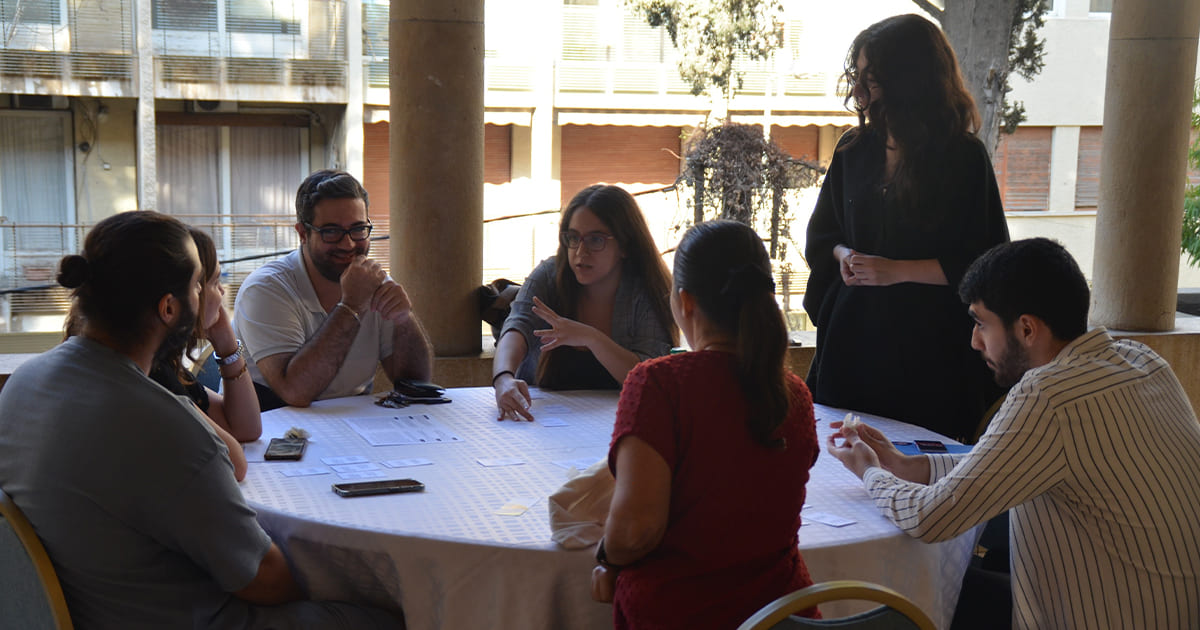
The bilingual card game challenges players to step into the shoes of government officials faced with nine real-world scenarios, from parliamentary debates to community dilemmas in rural and refugee settings. Players must weigh their decisions, defend their reasoning, and earn points for empathy and sound judgment.
For Ismail and her team, the game’s power lies in its ability to spark honest, sustained conversation about a topic too often avoided. “People often listen only to argue back,” she said. “The game gives everyone a structured space to speak and listen, and when it ends, the conversation continues.”
The idea was born during Ismail’s eight-month participation in the Governance Lab program. What began as a lobbying initiative evolved into a creative advocacy project when she and her peers realized that awareness could be more effective than direct persuasion.
“We thought, instead of pushing the law directly, let’s raise awareness creatively,” she recalled. Guided by mentors, Ismail co-developed several prototypes, refining each through classroom testing and feedback from LAU faculty until the cards told a story that spoke to everyone who played.
According to Ismail, AiW played a crucial role in shaping the final product, reviewing the content to ensure it reflected gender-sensitive and rights-based frameworks. “The institute helped us make sure every word carried the right message,” said Ismail.
For Myriam Sfeir, executive director of AiW, the project exemplified the institute’s mission to link academic learning with real-world advocacy. “The initiative shows how classroom knowledge can lead to tangible social impact. We’re proud of our students for transforming a sensitive issue into an accessible tool for dialogue,” she said.
Sfeir added that the project reflects AiW’s legacy of promoting gender equality through education and public engagement. “Child marriage is a violation of human rights,” she said. “Through creativity and persistence, these students are pushing for change that laws alone cannot achieve.”
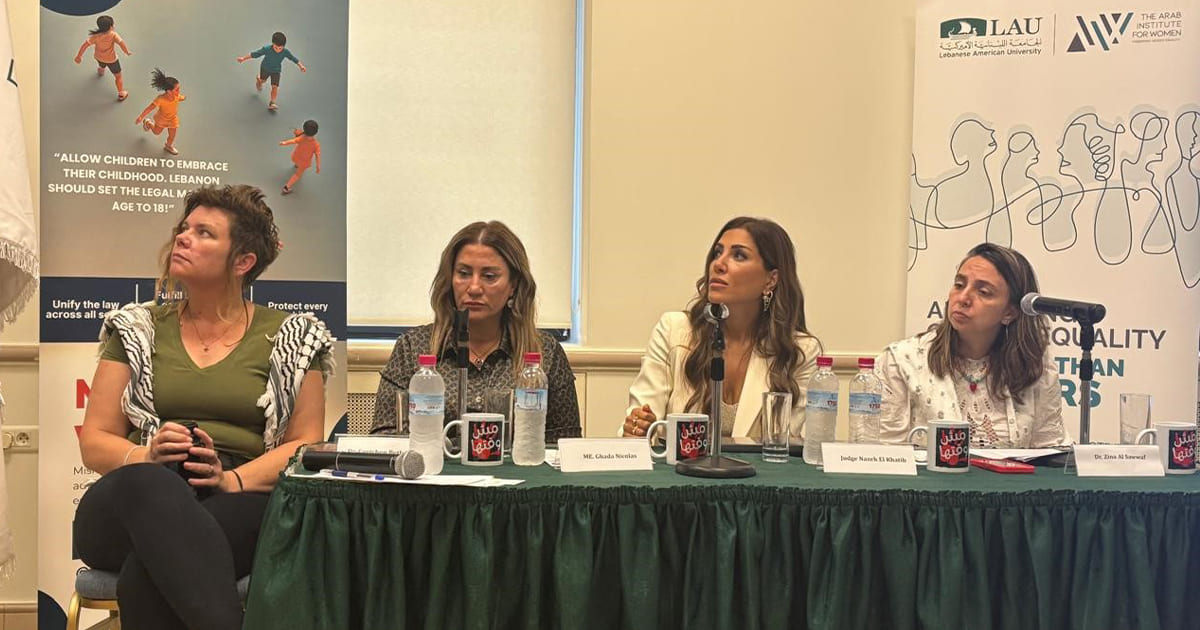
An interactive panel discussion at the event brought together legal perspectives, grassroots efforts from local communities, and academic insights on the gender dimensions of child marriage, offering a comprehensive look at the issue from policy to practice.
Judge Nazek El Khatib, representing the National Commission for Lebanese Women (NCLW) as head of its legal committee, highlighted Lebanon’s obligations under international agreements that protect children’s rights. She noted that the NCLW has actively worked on addressing child marriage through legislative proposals, and that its National Strategy for Women in Lebanon (2022–2030) and Action Plan (2024–2026) include objectives to legally prohibit child marriage and provide protection and assistance to victims of gender-based violence. Her participation reflected the strong alignment between the “Off Limits” project and NCLW’s national advocacy goals.
From a legal advocacy standpoint, Ghada Nicolas, lawyer and legal advisor at The Lebanese Women Democratic Gathering (RDFL), highlighted the challenge of addressing the issue without sufficient national data. “One of the biggest barriers to reform is the lack of comprehensive statistics,” she said. “Without reliable data, it becomes difficult to grasp the full scope of the problem or design effective interventions.”
Adding an academic dimension, LAU Assistant Professor of Gender Studies Zina Al Sawwaf offered a gendered perspective on child marriage, examining how gender norms, social expectations, and structural inequalities sustain the practice. She underscored the importance of framing early marriage within broader discussions of power, patriarchy, and women’s rights. Maysaa Dawi, country director of the British Council, praised the initiative as “a powerful example of what happens when youth are trusted to lead.” “Real progress happens when youth are not on the margins of governance but at its heart,” she said.
From the UN Global Compact Network Lebanon, Executive Director Deenah Fakhoury echoed the sentiment, underscoring the role of youth-led innovation in driving social reform. “True change begins with people, and most often, it begins with youth,” she noted. “They challenge assumptions, bridge divides, and turn ideas into movements. This game is proof that creativity can make policy personal.”
Following the panel discussion, Assistant Professor of Education at the Department of Social and Education Sciences Jo Alix Kelcey and Assistant Professor of Gender Studies Lina Haddad Kreidie offered insightful academic commentaries grounded in their classroom experiences piloting the game. Both highlighted how LAU classrooms served as a critical pedagogical space to challenge existing social cycles, foster active youth engagement in citizenship, and encourage deep reflection on a highly sensitive topic.
Dr. Kelcey reflected on the first version of the pack as launched in her class, drawing on civic education and the interdisciplinary concerns of education, politics, sociology, and history, with a focus on improving education systems for marginalized learners.
Dr. Kreidie, who piloted the final version in two of her classes, examined how gendered norms and power relations surfaced through gameplay and discussion. Referencing gender studies, she emphasized the value of critical dialogue, empathy, and collective reflection as tools for transformation.
Their contributions—along with the efforts of all professors involved in the piloting process—were instrumental in refining the game’s educational framework and ensuring its impact extends beyond the classroom.
Following the launch, participants, including faculty, students, and representatives of NGOs, joined roundtable sessions to test the game.


