Lebanese President and LAU Alumnus, General Joseph Aoun, Speaks to LAU
In an interview for the second edition of the LAU’s alumni podcast, President Aoun revisits his student experience and reveals the responsibilities and constraints of leadership.
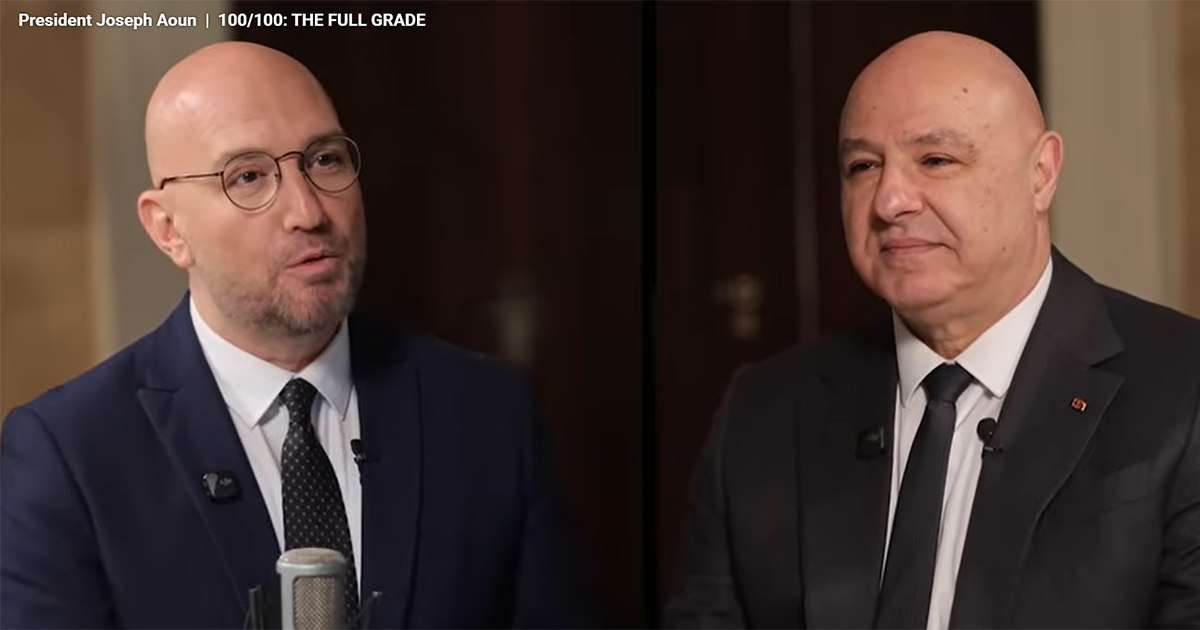
LAU’s alumni podcast, 100/100: The Full Grade, launched its second season with a special episode featuring the President of the Republic of Lebanon, General Joseph Aoun (BA ’07), an alumnus of the Political Science and International Affairs program.
This first-ever personal interview with the president, conducted by renowned talk show host and LAU alumnus Zaven (BA ’92) at the Presidential Palace, offers a rare glimpse into the man behind the title, and the enduring role of education, family, and community in shaping a leader, while celebrating LAU’s lasting impact across generations.
President Aoun speaks candidly about his upbringing in a modest household and his time during the Lebanese Civil War, recalling a childhood shaped by hardship, displacement and discipline.
He describes how these experiences instilled in him a strong sense of responsibility, highlighting a pivotal moment in 1976 when violence struck his village, which deeply influenced his decision to serve the country through state institutions.
In 1983, he joined the Lebanese Army without informing his family, beginning a military career that would span more than four decades. Debunking the popular view of soldiers and officers as armed individuals with heart, President Aoun emphasized that military strength alone is insufficient. “The officer,” he noted, “is a mind, a heart, and a soul.”
This belief led him back to academia. In 1999, while actively serving in the army and raising a family, President Aoun enrolled at LAU, where his wife was employed, to pursue a degree in Political Science and International Affairs. Balancing military duties, family life, and weekend-intensive studies, he completed his degree in 2007 and went on to earn a master’s degree in Strategic Studies and Counter-Terrorism at the US National Defense University.
Reflecting on his LAU experience, President Aoun credits the university with preparing him to excel internationally and spoke of moments abroad when the high academic standards he had received at LAU were recognized by US institutions. He describes Lebanese universities as one of the country’s greatest assets, calling education “the real wealth of Lebanon.”
As President, Aoun highlights the contrast between military command and political leadership. While the army operates with clarity and decisiveness, politics, he explains, is “the art of the possible,” shaped by internal and external circumstances. In both, however, integrity, adaptability, and balance were paramount.
Toward the end of the episode, President Aoun graciously fielded questions from students of the Debating Sustainability class, during which he encouraged lifelong learning and warned against over-reliance on artificial intelligence. While acknowledging AI as a helpful tool, he stressed that reading, critical thinking, and intellectual discipline remain irreplaceable.
On governance, he reaffirmed his commitment to fighting corruption through digital government reforms and an independent judiciary, noting that accountability requires persistence and time. He also called for a citizenship-based vision of Lebanon, emphasizing that the state must protect all communities, and not the other way around.
In conclusion, President Aoun delivered a message of hope and responsibility to the Lebanese people, particularly the youth. He urged them not to lose faith in their country, to reject the language of war, and to work toward building a state of institutions grounded in justice, accountability and unity.
“The future of Lebanon,” he said, “is in your hands.”
His readiness to grant LAU this interview, said LAU President Chaouki T. Abdallah, speaks volumes about his enduring connection to his alma mater and his belief in the transformative power of education.
“President Aoun embodies the values upheld by our institution,” added Dr. Abdallah. “His career path, taking him through his military service and culminating in heading the state, exemplifies our mission to graduate leaders who serve their communities and country with integrity and a deep sense of public responsibility and a desire to improve the human condition.”


