Minister Fadi Makki Engages LAUers in a Town Hall on “Reinventing Government 2030” Project
The minister unveils a bottom-up plan for transparency, accountability and citizen-driven governance, sparking a dialogue on reform and student-led change in Lebanon.
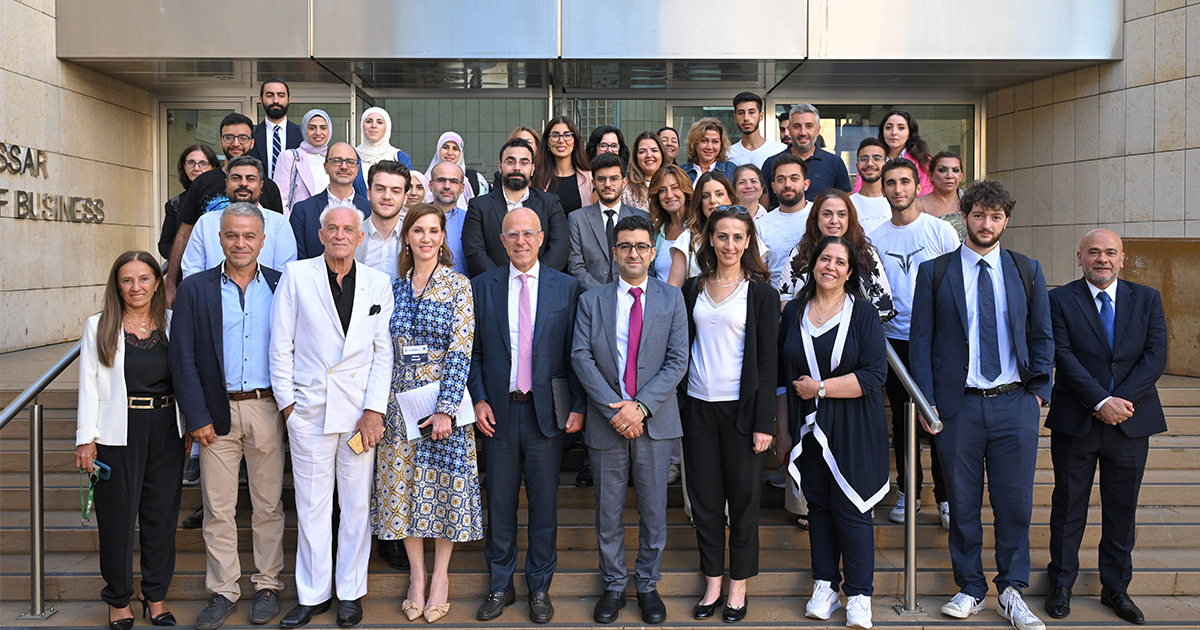
It began with a simple but powerful call: students are not only Lebanon’s future, they are its agents of change. That was the message from Dr. Dima Jamali, dean of the Adnan Kassar School of Business (AKSOB), as she opened the “Reinventing Government 2030” town hall at LAU Beirut campus on September 12.
“We hope to actively engage with the government, private sector and NGOs to bring student involvement to reality,” she said, urging the young audience to see themselves as “ambassadors and architects of the much-needed change in Lebanon.”
The town hall, emceed by Assistant Professor of Operations and Production Management Joelle Nader and moderated by Associate Dean of AKSOB Ali Fakih, quickly evolved into a lively exchange of ideas.
Minister of State for Administrative Reform (OMSAR) Fadi Makki presented the Reinventing Government 2030 project, stressing that Lebanon’s fragmented public sector offers not despair but opportunity.
“Our reform will not be troublesome because we are starting from scratch. The only way to go from here is upward,” he said, calling it a “golden opportunity” for change.
Dr. Makki walked the audience through a historical overview of development efforts dating back to the 1960s, pointing out that no comprehensive restructuring had taken place in more than six decades. This, he argued, is why the country has a rare chance to rebuild on stronger foundations. He outlined pillars for development, such as transparency, accountability, inclusivity, judicial reform, sustainability, digitization and credibility, among others. Central to his vision was the creation of a new social contract that binds citizens and government together through trust, responsibility and shared values.
The minister emphasized that the first phase of this program, Stakeholders’ Aspiration Phase, is to “stop and listen.” To that end, Dr. Makki explained that OMSAR will be proactively engaging the public through interviews, surveys, focus groups and roundtables. “This is the first time reform is approached bottom-up, leaving no one behind,” he noted, inviting students and academics to play an active role in shaping the reform vision.
The event was marked by interactive exchanges between students, faculty members and the minister. Using live polling, the audience responded in real time to questions posed by Dr. Makki, with results projected on screen to guide the conversation. Faculty also engaged directly, raising concerns about governance structures and sustainability and offering suggestions for reform.
The audience challenged the minister on issues of trust, accountability and transparency, asking how Lebanon’s youth can participate beyond the classroom. Dr. Makki welcomed their contributions, stressing that “the energy and ideas of students are essential to building a new Lebanon. This transformation will succeed only if it is owned by the people—and students are at the forefront of that ownership.”
As part of the roadmap, Dr. Makki announced two new initiatives: a Reskilling Academy to equip public administrators with future skills including digital and soft skills, and an Innovation and Behavioral Science Lab to design citizen-centered services.
This lively discussion underscored LAU’s commitment to giving its students a seat at the table in shaping public policy, whereby the town hall served as a model of citizen engagement.


