Revisiting Beirut’s Design Past
LAU students explore Beirut’s design heritage through a hands-on, immersive session with industry veterans.
In a time where design education is increasingly digital, the value of tangible archives and the stories they carry has never been greater.
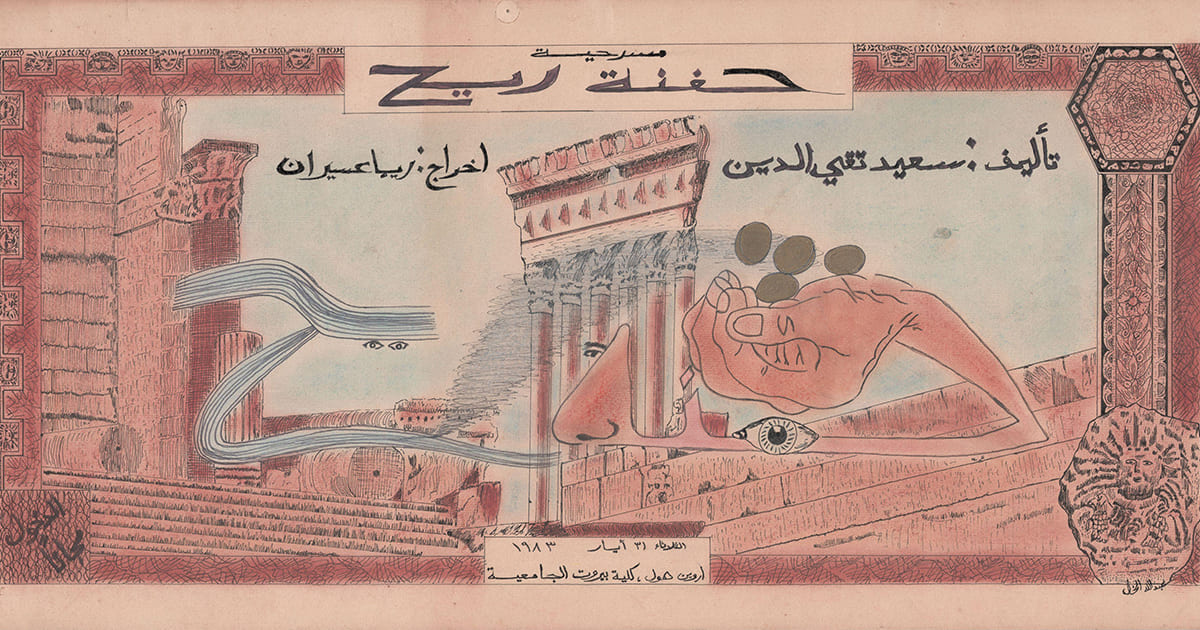
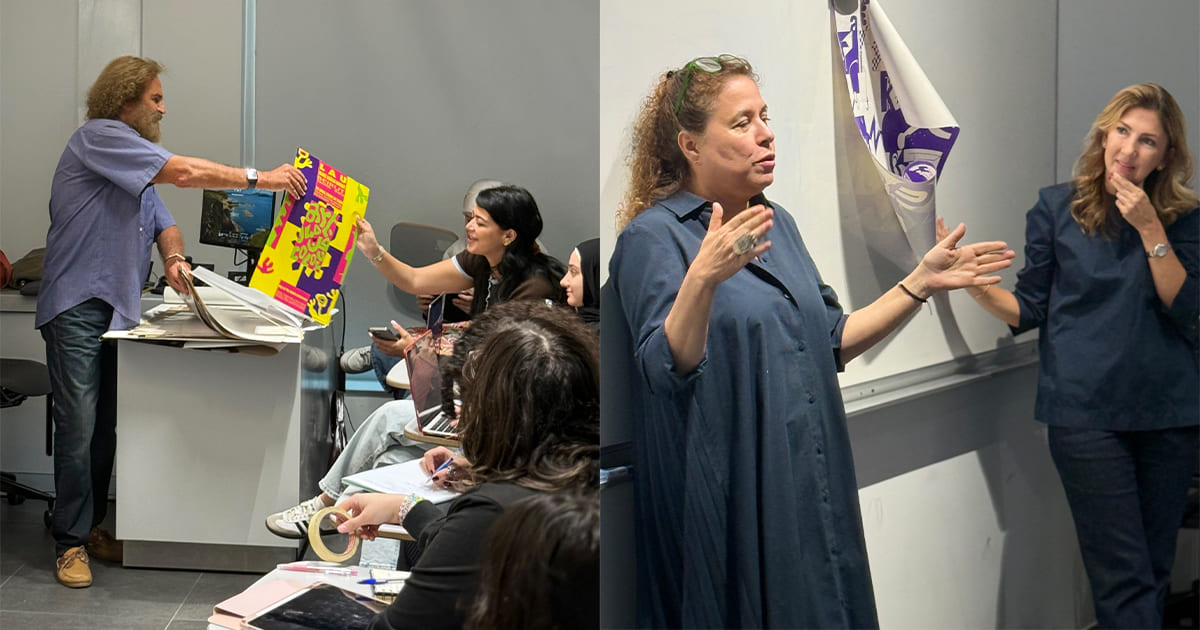
At LAU, a recent graphic design class transformed into a living archive when students came face-to-face with two generations of Lebanon’s creative industry. The session, held on November 12, brought together veteran printer Rami Al Khal and LAU alumna Bettina Mahfoud (AAS ’88; BA ’91), who shared rare insights and original posters from Beirut’s design scene of the 1970s and 1980s, included in a major collection Al Khal recently donated to LAU.
The session, part of the History of Graphic Design course taught by Dr. Yasmine Nachabe Taan, professor at the LAU School of Architecture and Design and director of the LAU Institute of Art in the Arab World, underscored how academic archives, when activated through dialogue and mentorship, can turn static artifacts into tools for critical learning.
The class marks more than an exercise in design history. It is an act of cultural recovery. Through this hands-on exploration, students learn not only how posters were designed and printed decades ago, but how they served as powerful social and artistic expressions amid Lebanon’s shifting landscape.
Al Khal, who ran one of Beirut’s leading printing presses during the 1980s, brought with him more than nostalgia—he brought the craft itself. With each poster he unfolded, he revealed layers of color, process, and painstaking precision.
“You can be the most creative designer,” he told the students, “but if the printing is not done well, your work collapses. In our time, there was no perfect print; if you reached 95 percent, you were a master.”
He explained the arduous method of color separation, where every design had to be broken down into four plates: Cyan, magenta, yellow and black. Each color was printed one at a time, carefully aligned to create the final image. “Imagine the precision needed,” he said, “because if the dots didn’t align perfectly, the poster would come out hazy. Today, you click ‘print.’ Back then, we lived through every millimeter of that process.”
For Mahfoud, who began studying at LAU, then known as Beirut University College (BUC), in 1985, the art of design was inseparable from the art of resilience. “Creativity was through the roof,” she recalled. “There were bombs outside, and we were designing inside. We hung out under the tables sometimes because of the shelling, but we created. That was the mood.”
Her recollections painted a portrait of a generation that found in design not escape, but defiance. Mahfoud’s early work combined bold typography, collage, and color experimentation influenced by her mentor and former Assistant Professor and Coordinator of the Graphic and Advertising Program at BUC Leila Musfy, and the Swiss design movement, infused with local urgency. “If you are a designer,” she told the students, “you need to know how things are made before you make them. You can go crazy with creativity, but if your printed piece isn’t properly produced, it’s not your design anymore. Production is part of the art.”
During the exchange, Al Khal described how posters once formed the backbone of public communication. “Posters were the only way to inform the public about an event,” he said. “There was no WhatsApp or Instagram. You’d print hundreds, hang them in Hamra, Ashrafieh, everywhere. It was how the city spoke.” His donation of this vast collection to LAU’s archive was, in his words, a way “to keep that voice alive.”
Students took notes as Mahfoud encouraged them to view design as both personal and civic responsibility. “A good designer,” she said, “is not just someone who produces what the client dictates. You have a responsibility toward your community. Design is solving problems visually, creatively, intelligently, and with heart.”
Students will also be carrying the experience forward through a project that builds on Al Khal’s donation. Each team will select a poster designer from the archive, reach out to them, and gather firsthand insights to produce a podcast that captures the stories behind their chosen work.
“This project is about discoveries,” added Dr. Taan. “We don’t know where it’s leading, or what stories we’ll uncover. But that’s what makes it exciting—each poster is a portal into Lebanon’s visual memory, and now, our students are helping bring it back to life.”
As she further noted, “When donors like Al Khal share their collections, they’re not just preserving history, they’re creating opportunities for students to analyze, question, and connect with it. An archive only lives when people use it.”
The LAU Libraries welcome poster donations to further expand and enrich their growing collection of vernacular posters.


