Rewriting Women’s Art History in the Arab World: Insights from LAU’s Recent Talk by the Barjeel Art Foundation
LAU’s Institute of Art in the Arab World hosted the Barjeel Art Foundation for a conversation on rewriting women’s art histories in the Arab world and recovering stories often left out of the region’s cultural record.
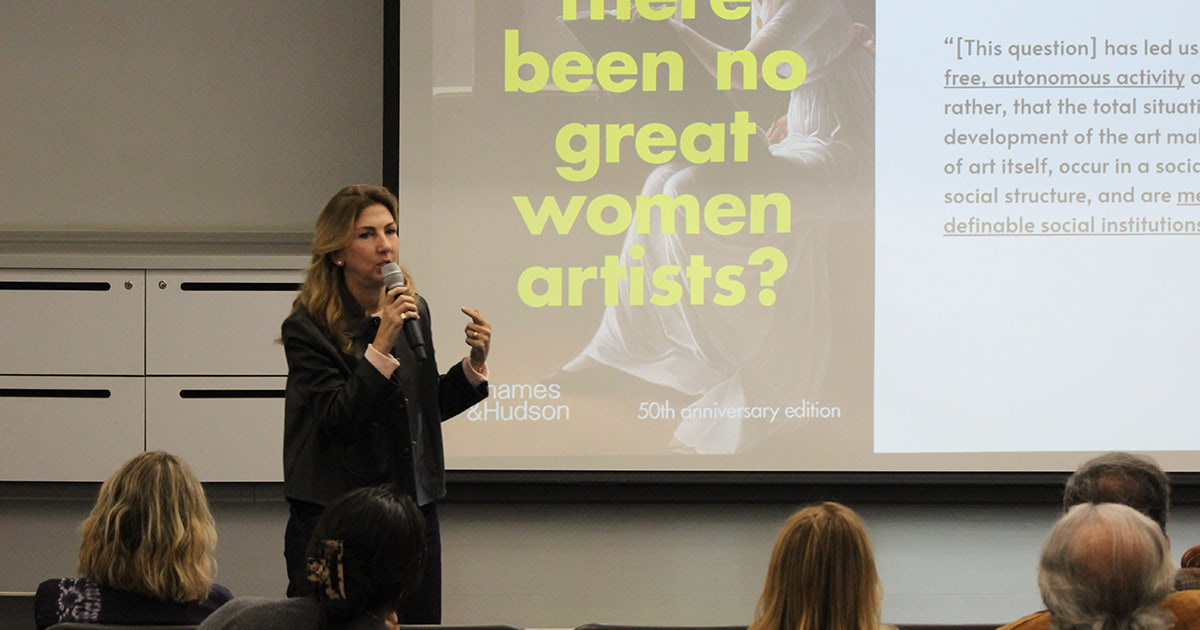
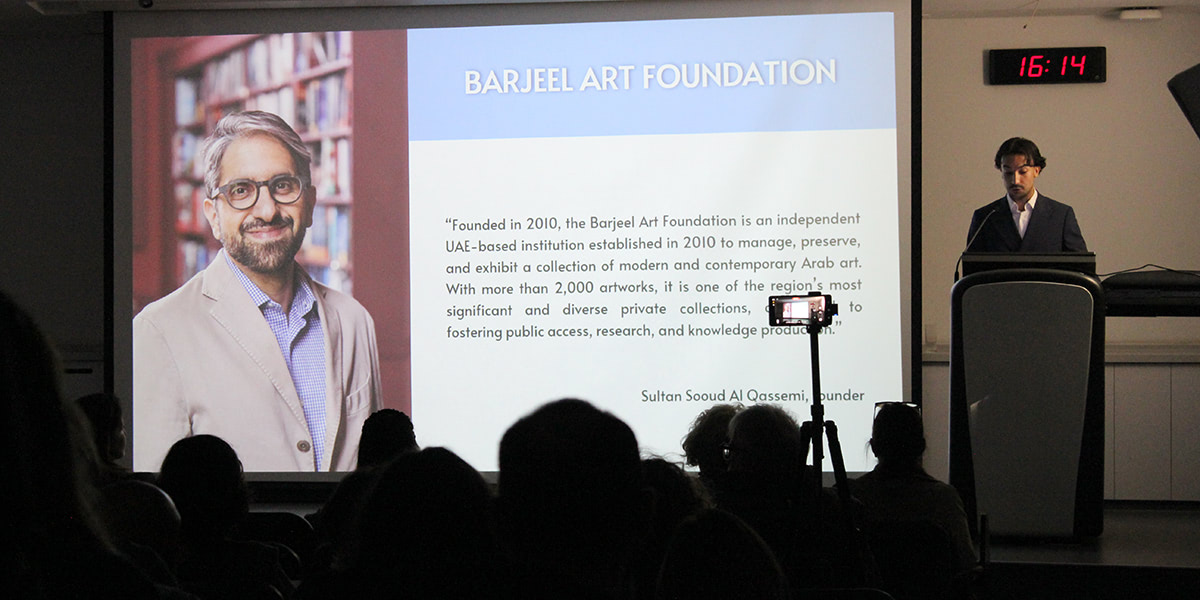
In early December at the Chafic Balaa Auditorium in the Gezairi Building, students and scholars gathered with a shared curiosity: How do we begin to tell a fuller, more honest story of women’s art in the Arab world?
The question set the tone for a conversation with Rémi Homs, curator at the Barjeel Art Foundation, hosted by LAU’s Institute of Art in the Arab World (IAAW) at the School of Architecture and Design, to explore what it means to rewrite art histories that have long marginalized women.
Through conversations that bring overlooked histories to the forefront, LAU, the IAAW, and the Barjeel Art Foundation continue to advance their shared mission: To rethink, research, and retell the region’s artistic stories with greater accuracy, representation, and care.
The talk was part of the institute’s ongoing commitment “to challenge established narratives and ensure that women’s artistic legacies are documented, studied, and valued within the broader story of Arab modern and contemporary art,” said IAAW Director Yasmine Nachabe Taan. Creating a dialogue is central to the institute’s mandate of fostering “a more inclusive and accurate understanding of the region’s artistic histories,” added Dr. Taan.
Homs opened the session by tracing the gaps that shaped much of the 20th century. For decades, women artists across the region produced significant work, yet their names slipped through the cracks of institutional archives and academic texts. The Barjeel Art Foundation has been working to mend these gaps through an acquisitions and research strategy that actively seeks out missing narratives.
Founded in 2010 by Sultan Sooud Al Qassemi, the Sharjah-based Foundation adopted a gender balance policy for its exhibitions and acquisitions in 2019. Homs shared early results of this initiative, highlighting works by women whose practices had long been overlooked, and showing how ongoing research is revealing nearly lost artistic networks and histories.
Curators, noted Homs, play a defining role in this process because the choices they make determine what is safeguarded and remembered. “Through the collection, we have multiple missions: Expanding knowledge, positioning creation from the Arab world within global modernity, and highlighting the region’s diversity,” he said.
Among the foundation’s recent acquisitions was a work by ceramicist and alumna Wasma’a Chorbachi (BA ’66). Born in Cairo in 1944, Chorbachi began her artistic training at the Beirut College for Women (BCW), now LAU, before continuing at the Accademia di Belle Arti in Florence and later completing a PhD in Islamic art history at Harvard University. Her ceramics, rooted in geometry and Islamic artistic traditions, bridge scholarship, craft, and modernity, enriching the Foundation’s collection while resonating with LAU’s own history.
“What is fascinating about Wasma’a is that she is both an artist and a scholar, and her work enters into dialogue with Islamic art heritage in a very powerful way,” Homs said. “She takes ancient and traditional motifs and twists them through ceramics in a modern, striking manner.”
Chorbachi’s inclusion in Barjeel’s collection, remarked Dr. Taan, who moderated the talk, exemplified LAU’s lasting impact on women’s education and artistic practice, describing it as “part of a much longer continuum.”
“LAU has consistently championed women’s intellectual and artistic development,” she added. “This tradition has fostered generations of artists who approach their practice with a strong sense of agency, experimentation, and critical engagement.”
Today’s graduates continue to carry forward this legacy “by engaging deeply with technique, heritage and contemporary concerns, while asserting women’s perspectives within local and global art histories,” she said.
The discussion went beyond individual artists as audience members raised questions about social silencing, class barriers, and the importance of institutional collaboration. Many reflected on how partnerships between LAU, the IAAW, and the Barjeel Art Foundation can create stronger frameworks for recovering missing histories and supporting new scholarship.
Homs urged LAU students to anchor their creative practice in historical understanding. “Learn your history,” he said. “We have endless books on Picasso and Matisse, but it is just as important to know the art histories of our own region. It is our job now to reflect the diversity of our heritage and connect with different geographies.”
At the end of the event, Dr. Taan noted how hosting the Barjeel Art Foundation reflected LAU’s expanding presence and active participation in shaping regional cultural conversations. It signaled the university’s dedication to rethinking established narratives and creating space for deeper, more inclusive engagement with art from the Arab world, she added.
The conversation closed with a sense of purpose, showing that rewriting women’s art history is not only possible but already underway, achieved through one recovered story, one rediscovered artist, and one committed community at a time.


