The Arab Institute for Women Relaunches the Who Is She Online Database
A repository of pioneering women’s profiles, the database sheds light on their achievements across various fields, while serving as a source for inspiration for generations to come.
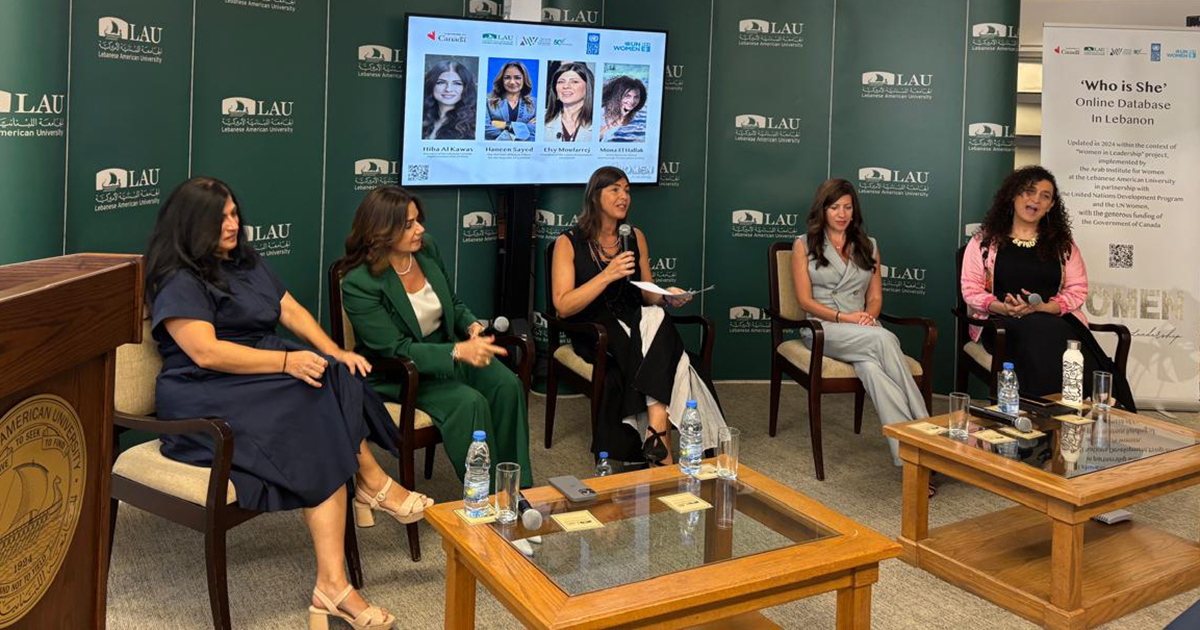
Within the framework of the Women in Leadership project, the Arab Institute for Women (AiW), the United Nations Development Programme (UNDP) and UN Women, with funding from the Government of Canada, marked the relaunch of the Who Is She in Lebanon online database, a digital repository of contemporary Lebanese women pioneers, on September 18, 2025 at the Beirut campus.
LAU President Chaouki T. Abdallah hailed the relaunch as a step that takes the institute’s mission to a new level. “By showcasing these diverse success stories, Who Is She shines a light on untold achievements and increases visibility and recognition for women who have broken barriers,” he said.
The platform, added Dr. Abdallah, doubles as a valuable destination for researchers and “an inspiration for the next generation of girls to see what they can become and aspire to even greater heights.”
Giving an overview of the partnership that led to the relaunch of the platform, AiW Executive Director Myriam Sfeir listed the series of events and activities that were also part of the Women in Leadership Project, which coincided with the institute’s 50th anniversary.
These included organizing TEDxLAU Women, producing two plays—Leila, Latifa Chimamanda and Wadad, An Ant that Digs in Stone—publishing a special issue of Al Raida journal in two languages and completing a book, Our Feminine Memory, initiated by a former AiW director.
Sfeir stressed the importance of how the Who Is She database will serve as a dynamic, interactive and user-friendly space for advocating for women’s leadership and giving them visibility. A key feature of the update, she added, allows users to nominate women who, they believe, deserve recognition.
UNDP Resident Representative Blerta Aliko underscored the value of the database as the Human Development Index in Lebanon remains weighed down by gender justice indicators, despite the country’s wealth of skilled, educated, and accomplished women.
“Initiatives such as the Who Is She platform counter these perceptions and make clear that the issue is not women’s capacity, rather the level of access [to learn about them] and the recognition,” she explained.
Driving this point home, the ceremony shed light on the remarkable achievements of four Lebanese women who have defied social norms and left their mark in music, social justice, preserving national heritage and journalism.
The panel, moderated by Sfeir, included Lebanese Minister of Social Affairs Haneen Sayed, President of the Lebanese Higher Conservatory of Music Hiba Al Kawas, Beirut-based architect and heritage preservation activist Mona El Hallak, and President of the Union of Journalists in Lebanon Elsy Moufarrej.
Minister Sayed reflected on her father’s belief in the value of educating his daughters and encouraging them to pursue careers in male-dominated fields, despite growing up in a conservative environment. Developing an interest in economics, she quickly gravitated toward human development, which led her to pursue a career at the World Bank.
“I had the privilege to be surrounded by both male and female colleagues who acted as mentors and motivated me to take on this role with other colleagues and interns as well,” said the minister, adding that “it is often the intangibles at the workplace that have the most impact.”
Kawas spoke about her passion for Arabic music and the push to preserve it, which led her to become the first Arab woman to compose music.
“Never underestimate the power of collaboration and partnerships,” said Kawas. She gave the example of building a pan-Arab network that remedied the lack of music infrastructure in Lebanon and the region. “I believe that this early spark of daring to form a music platform so that I can compose my own music laid the groundwork for expanding across the Middle East.”
For El Hallak, whose passion centered around preserving old Beirut buildings, the battle was multifaceted and at times, literal. She had gained notoriety for opposing the dismantling of the Barakat Building, also known as Beit Beirut, located in the Sodeco neighborhood. Today, the building houses eye-opening exhibits that tell the stories of the history of Beirut and stands as a testament to one woman’s unwavering commitment to preserving heritage and the memory of the city.
Talking about several moments in her journalism career where she felt isolated in her quest to demand rights for on-ground reporters, Moufarrej pointed out that “obstacles are often imagined, especially as one sets their eye on the target.” Sometimes, she added, “it is best to imagine instead that those opposing you simply do not exist and to keep pushing on.”


