Turning Local Challenges into Global Solutions at LAU’s Environmental Lab
Through advanced instrumentation and interdisciplinary expertise, the Environmental Lab at the School of Engineering tackles water, soil, and air pollution while generating internationally relevant research.
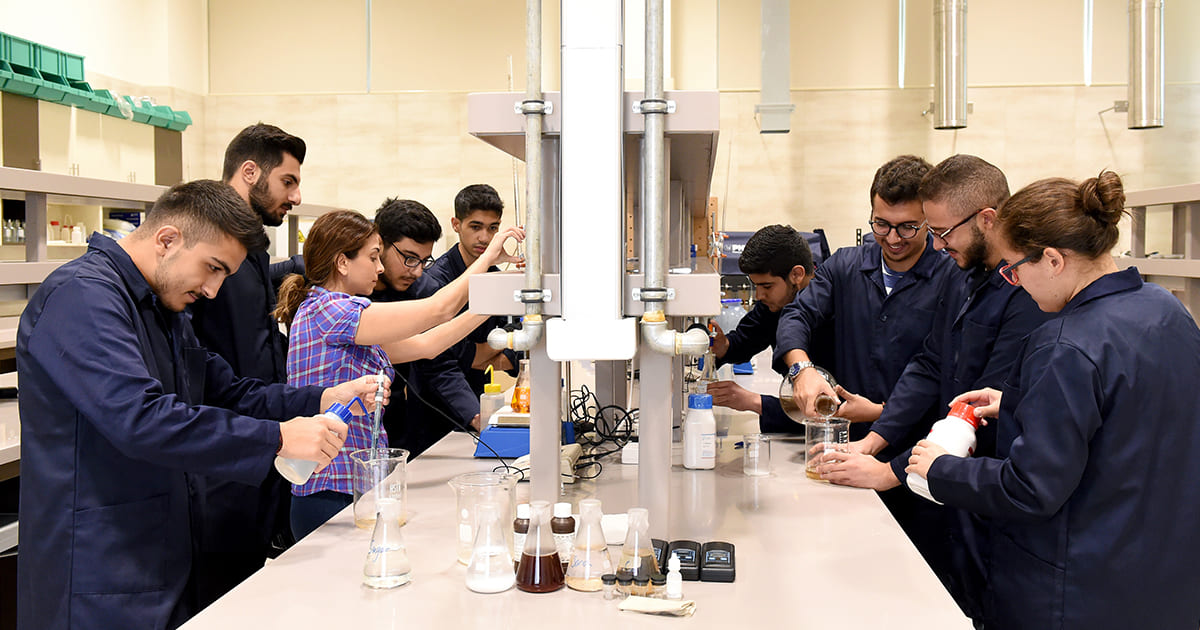
Lebanon is grappling with some of the world’s most urgent environmental crises—rivers burdened with industrial wastewater discharge, soils undergoing severe degradation, and public health increasingly at risk. At the forefront of combating these challenges is the LAU School of Engineering’s Environmental Lab, where cutting-edge research meets practical solutions.
Combining state-of-the-art facilities with hands-on expertise, the lab is transforming local issues into innovations with global relevance. “Our work is about turning challenges into opportunities—helping communities, training students to become the next generation of innovators and problem solvers and contributing knowledge that can make a difference both in Lebanon and beyond,” said Professor and Chair of the Department of Civil Engineering Mahmoud Wazne.
That mission comes to life in the daily work of the lab’s team. Led by Dr. Wazne and in collaboration with diverse engineering faculty and researchers, including Associate Professor Jean Chatila, Associate Professor Grace Abou-Jaoude, Assistant Professor Hamza Jaffal, Assistant Professor Josephine El Alam, Research Associate Stephanie Greige, and a dedicated group of graduate and undergraduate students, this research hub is generating viable solutions to complex environmental problems.
The School of Engineering’s Environmental Lab is a premier research facility equipped with world-class instruments for tackling today’s most urgent environmental challenges. From advanced chemical and structural analysis (X-Ray Fluorescent Spectrometer, Atomic Absorption Spectrometer, X-ray Diffractometer, Quadrupole time-of-flight (Q-TOF) mass spectrometry) to cutting-edge biological and ecotoxicity testing, and from surface and particle characterization to anaerobic and bioreactor systems, the lab offers a comprehensive platform for innovation.
With its unique breadth of capabilities, it empowers researchers and students alike to drive pioneering solutions for sustainable water, soil, and air management.
Much of the lab’s work centers on pollution abatement and mitigation of environmental and natural hazards. The team’s August 2025 study highlights the use of an innovative upflow anaerobic sludge blanket (UASB) reactor—systems that push wastewater upward through dense microbial layers that break down pollutants. By enriching these biofilms using bioelectrochemical methods and refining reactor design, in collaboration with researchers at Washington State University and New Mexico Tech, they accelerated startup of the reactor and improved pollutant removal.
The team has also advanced research in industrial wastewater treatment. Their study on anaerobic co-digestion showed that combining high-strength effluents from multiple factories improves treatment efficiency while producing methane—a renewable energy source. By turning industrial waste into a valuable resource, this approach reduces environmental impact and highlights how pollution can be transformed into energy.
They are also advancing technologies that harness the capacity of specific microorganisms to generate in-situ cementitious materials, thereby enhancing the strength of weak soils and mitigating natural hazards such as soil erosion without the carbon emissions associated with conventional cement. This sustainable approach not only offers a practical solution but also provides a replicable model for regions confronting similar environmental challenges.
Furthermore, the lab recently explored soil cleanup using natural plant extracts, specifically from the cactus Opuntia ficus-indica, which can remove harmful metals like lead, copper, and zinc without degrading soil quality, offering a safe and eco-friendly alternative to chemical treatments. Such innovations illustrate how the lab harnesses natural resources alongside engineering expertise to support sustainable agriculture and urban development.
In its search for eco-friendly methods and cost-effective solutions, the team turned to an unlikely ally back in 2023: Snails. These organisms naturally absorb persistent organic pollutants (POPs) such as polychlorinated biphenyls (PCBs), polyaromatic hydrocarbons (PAHs), and heavy metals, making them reliable indicators of environmental health.
By sampling snails from industrial, suburban, and rural areas, the lab was able to track long-term pollution trends at a fraction of conventional monitoring costs, providing valuable insights for policymakers tasked with protecting public health and regulating industrial impacts.
Currently, the research team is looking into antibiotic resistance in hospital and industrial wastewater. Their research aims to understand how harmful bacteria and chemical residues, like leftover medications and PFAS (Per- and Polyfluoroalkyl Substances)—long-lasting industrial chemicals—, move through water systems. While still underway, the study has the potential to inform public health policies and provide strategies for reducing the spread of resistant infections worldwide.
Beyond producing timely research and monitoring pollution in rivers, coastal areas, and urban sites, the lab’s leadership continues to work closely with national officials to turn findings into real-world impact, as seen in its ongoing collaboration with the Litani River authorities. By combining mobile monitoring stations, stream-testing tools, and advanced lab instruments, the team links field observations with laboratory research to develop solutions that are both feasible for Lebanon and serve as global examples of sustainable environmental management.
Many of the students who trained in the Environmental Lab are pursuing graduate studies at leading universities in the US. Their significant contributions to the lab’s research were recognized through co-authorship on publications in top-tier international scientific journals, providing them with a competitive edge in securing prestigious scholarships and advancing their academic careers abroad.
For Mohamad Abdallah (BE ’19; MS ’23), now a PhD candidate in Bioengineering at Washington State University, US, his experience at the lab was “extremely impactful, both academically and personally,” particularly through his work on enhancing anaerobic digestion of industrial wastewater in the upper Litani basin—an issue he described as “critical to Lebanon’s environment and public health.”
Similarly, Lama Ramadan (BE ’19; MS ’22), a PhD candidate in Biotechnology at New Mexico Tech, US, found that access to advanced equipment and faculty mentorship at LAU “immensely shaped my current PhD journey,” resulting in several research publications and “the technical competence and confidence needed to thrive in a competitive research field.”
Christelle Bou Nehme Sawaya (BE ’20; MS ’22), who is currently pursuing her PhD in Environmental Engineering at the University of South California, US, echoed this sentiment, noting that the lab’s student-focused environment “fostered my curiosity, resilience, and ambition,” and gave her the leverage needed to gain admission to a competitive doctoral program abroad.


