Turning Residency Into Career Strategy
The LAU School of Pharmacy highlights how residency programs launch pharmacy careers through guidance, experience, and opportunity.
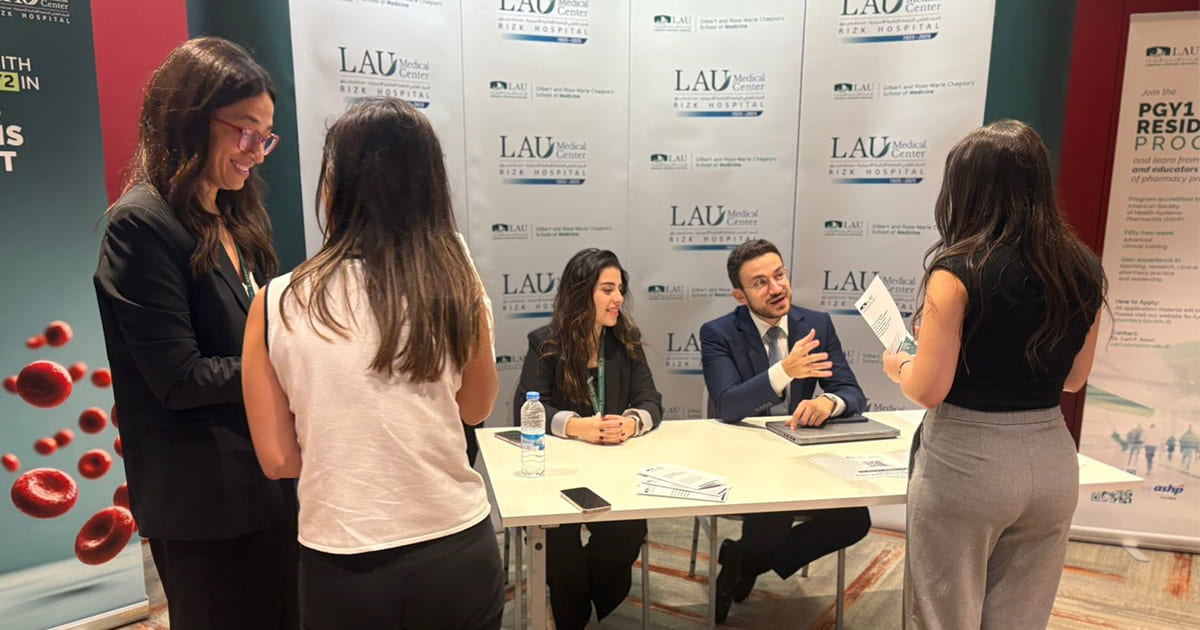
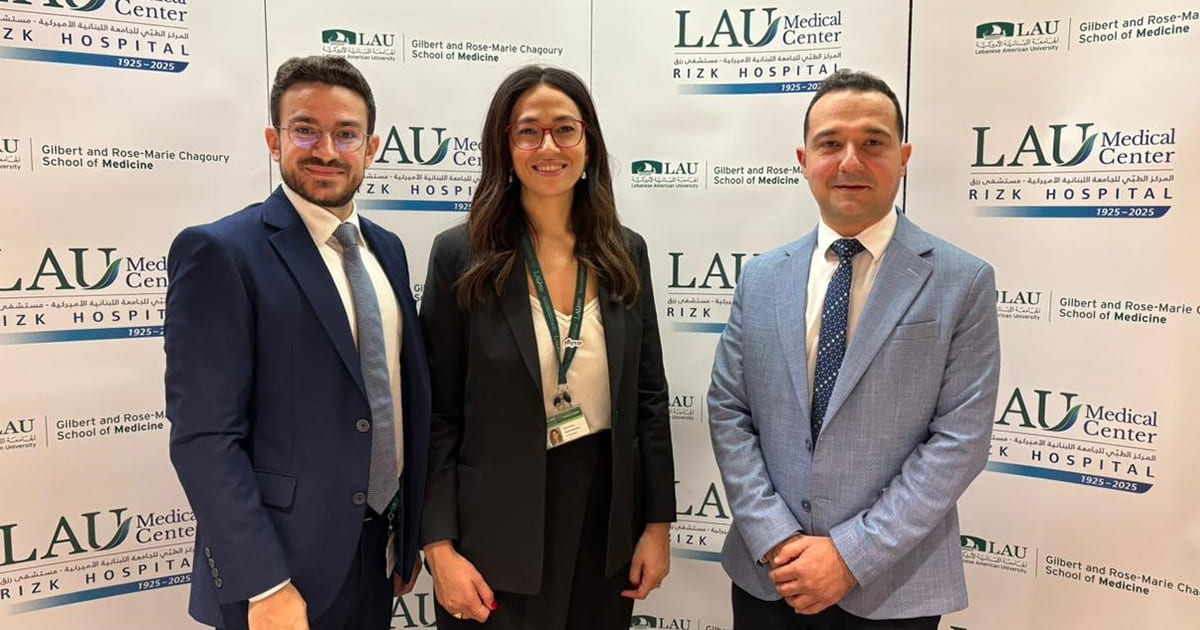
On November 10, the LAU Medical Center–Rizk Hospital opened its doors for the first residency showcase in Lebanon for pharmacy students and graduates in a hybrid event that bridged knowledge, mentorship, and opportunity.
The Pharmacy Residency Showcase, organized by the LAU School of Pharmacy, gathered aspiring pharmacists, alumni, and program directors to shed light on the transformative experience of postgraduate residency training, what it offers, how to apply, and where it can lead.
Designed for Professional Year 3 and Professional Year 4 students, recent graduates, and pharmacists seeking to advance their clinical expertise through Postgraduate Year One (PGY1) and Postgraduate Year Two (PGY2) programs in Lebanon and abroad, the showcase brought together key voices shaping pharmacy education and practice today.
Dr. Nibal Chamoun, clinical associate professor and assistant dean for experiential education and residency programs at the LAU School of Pharmacy, opened the event by walking attendees through the structure of residency programs, explaining how each stage lays a foundation for a career that blends patient care, research, teaching, and leadership. “Each year of residency training is equivalent to three years of working and has profound clinical, professional and personal impact on graduates,” she said.
She took the opportunity to announce the launch of the first PGY2 program in Lebanon that will be offered by LAU, which is the first international PGY2 program in thrombosis and hemostasis outside the US, starting in the summer of 2026, with an application deadline of January 15, 2026.
Following that, Dr. Rony Zeenny, director of the department of pharmacy and founding director of PGY1 Pharmacy Residency Program at the American University of Beirut Medical Center (AUBMC), talked about reframing residency not as a finish line but as a launchpad.
“Residency is not the destination,” he said, “it will open the doors to a whole set of opportunities across both clinical and non-clinical settings,” underscoring it as a foundation for lifelong professional growth and leadership in an evolving healthcare landscape.
Turning the discussion to students’ individual paths, Clinical Assistant Professor and PGY1 Residency Program Director at the LAU School of Pharmacy Carl Aoun invited attendees to view residency applications as opportunities for self-reflection and alignment.
“It’s important to join a program where you see yourself in terms of the culture of the program, the people surrounding you, and where you see yourself growing the most,” he advised. “You do that by assessing the programs you are applying to—looking at their clinical exposure, existing pharmacy services, teaching and leadership opportunities, mentorship quality, and the availability of PGY2 options that align with your interests.”
From guidance to practicality, current PGY1 Pharmacy Residents at the LAU School of Pharmacy and the LAU Medical Center–Rizk Hospital program, Dr. Marie Abi Habib (BS ’23; PharmD ’25) and Dr. Anna Christina Sadaka (BS ’20; PharmD ’21), demystified the process in their session, “Applying for Residency: Do’s and Don’ts.”
Drawing on personal experience, they broke down the Pharmacy Online Residency Centralized Application Service (PhORCAS) system and the ASHP Match Process, offering candid advice on crafting strong CVs, writing authentic letters of intent, and approaching interviews with confidence and professionalism.
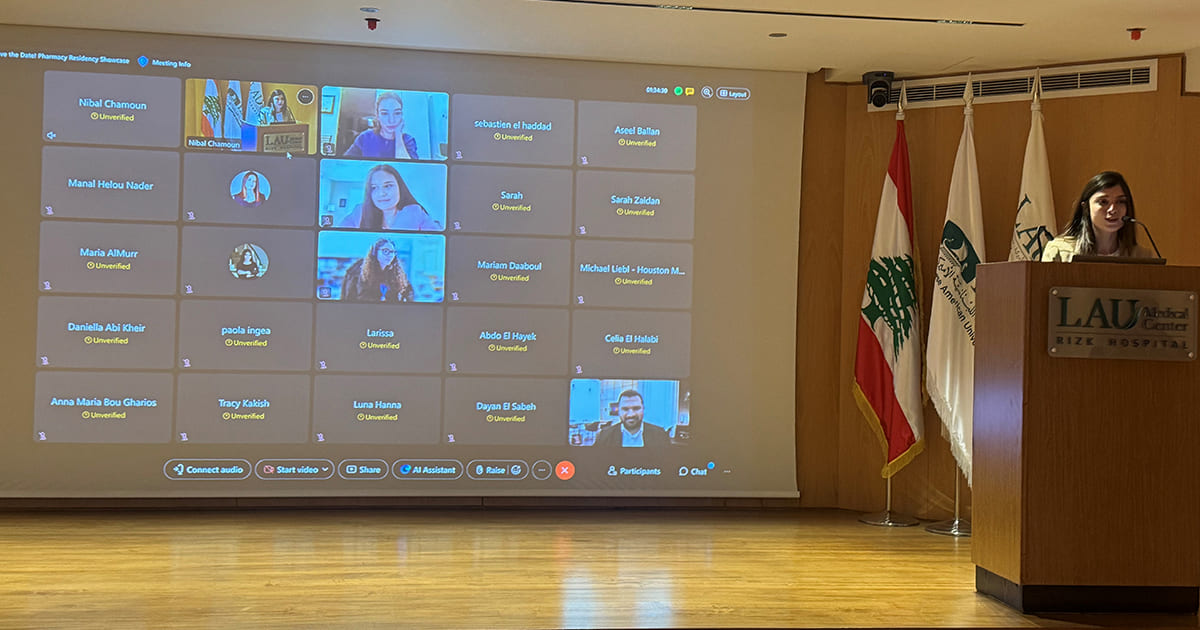
The event culminated in an alumni panel moderated by Dr. Mira El Masri, clinical assistant professor at LAU’s School of Pharmacy, which brought together four distinguished LAU graduates who have charted unique professional paths through their residency experiences.
Dr. Ahmad El Ouweini (BS ’18; PharmD ’19) traced his path from early clinical work to academia. “I was proud to be part of the first batch of residents in the LAU PGY1 Pharmacy Residency program,” he said. “Residency gave me the confidence and structure to move from hospital practice to academia. Today, at Dubai Medical University, I’m helping establish new clinical pharmacy services, something that started with the mindset LAU instilled in us.”
From Dubai to New York, Dr. Maria Serena Chiha (BS ’19; PharmD ’20), now working as a senior medical science liaison at Adaptive Biotechnologies Corp, US, revealed how she bridged pharmacy, policy, and industry.
“After completing my PGY1 at the AUBMC, I pursued a master’s in Health Policy and Economics at Weill Cornell Medicine, US,” she said. “It wasn’t an easy transition, especially with visa hurdles, but I knew that understanding both science and systems would let me shape healthcare beyond the hospital walls. Today, working in medical affairs, I still draw on that clinical foundation every day.”
The discussion then shifted to a more specialized path with Dr. Stephanie Atallah (BS ’18; PharmD ’19), who did her PGY1 residency at LAU, sharing that her passion and perseverance defined her experience.
“I started in community pharmacy before completing my PGY1 Pharmacy residency at LAU and then joined CVS Health, US, and worked in hospital pharmacy in parallel,” she said. “But I kept feeling drawn to oncology. Completing my PGY2 at Memorial Cancer Institute showed me that specialized training doesn’t just refine your expertise; it transforms your sense of purpose. Now, as a clinical pharmacy specialist, I’m exactly where I envisioned myself to be.”
For Dr. Rosy Issa (BS ’21; PharmD ’22), the residency experience opened a door to research and innovation. “During my PGY1 at AUBMC, I developed a strong interest in investigational drug management,” she shared. “That led me to my current role at Brigham and Women’s Hospital, Boston, managing and supporting clinical trials across different specialties. It’s incredibly rewarding to see how pharmacy directly supports groundbreaking research.”
Through their reflections, the panelists echoed a shared belief that residency is far more than a credential; it is a mindset defined by curiosity, adaptability, and the courage to keep evolving.
Doctor of Pharmacy graduates from ACPE-accredited programs may apply to PGY1 Pharmacy Residency training at the LAU School of Pharmacy Program through PhORCAS by January 6, 2026. Additional details about the program are available on the following link.


