Uncovering the Link Between Inflammation and Heart Disease
The LAU Gilbert and Rose-Marie Chagoury School of Medicine brought together experts in rheumatology and cardiology to explore how inflammatory conditions can influence cardiovascular wellbeing.
To that end, the LAU Gilbert and Rose-Marie Chagoury School of Medicine hosted a multidisciplinary symposium, organized by its Continuing Medical Education and Continuing Professional Development (CME/CPD) Office, for national and international experts to explore the intricate ways chronic inflammation in rheumatologic disorders affects cardiovascular health.
Titled From Inflammation to Implication: Where Joints and Hearts Converge, the conference took place at the LAU Medical Center–Rizk Hospital on December 5, 2025.
Welcoming the attendees, Dr. Laure Irani, clinical assistant professor at the school of medicine and event organizer, noted that the symposium “aims to explore emerging diagnostic and therapeutic advances, and reinforce collaborative, patient-centered care.”
The full-day program blended expert lectures, interactive discussions, and the latest research with practical clinical insights, equipping physicians, fellows, residents, and medical students to better integrate care for both joints and the heart. As a CME-accredited activity organized by the CME/CPD Office, the symposium further highlighted LAU’s commitment to continuous professional development, lifelong learning, and medical innovation.
The program opened with a foundational lecture by Dr. Youssef El Fakhry from the Lebanese University, who explored the spectrum of immune-mediated diseases, distinguishing between autoinflammation and autoimmunity. Autoinflammation arises when the body’s first line of defense overreacts, while autoimmunity occurs when the immune system mistakenly attacks the body’s own tissues. Many common conditions, he noted, occupy the space between these two extremes.
Dr. El Fakhry highlighted that persistent inflammation, regardless of its origin, can accelerate damage to blood vessels and the heart, hence the importance of timely intervention.
“Better immune profiling and early control of inflammation are reshaping long-term survival,” he said, adding that targeted treatments today not only alleviate joint pain and fatigue but also improve heart health and life expectancy in diseases such as lupus and rheumatoid arthritis.
The discussion then shifted to a condition that is endemic to Lebanon and the surrounding region: Familial Mediterranean Fever (FMF). Professor and Chair of the Department of Human Genetics at the LAU’s school of medicine Andre Megarbane traced its history from early Mediterranean descriptions to its genetic definition in 1997. FMF typically begins in childhood with recurrent fever, abdominal or chest pain, and joint inflammation. Left unchecked, it can cause serious complications, including organ damage.
However, effective treatment does exist, noted Dr. Megarbane. Daily colchicine, a plant-based medication, he said, is “part of life, like brushing your teeth,” preventing attacks and serious complications when taken consistently. For patients who cannot tolerate the medication, newer biologic therapies targeting inflammation now offer effective alternatives. Early diagnosis and treatment adherence, he emphasized, are essential to preserving quality of life.
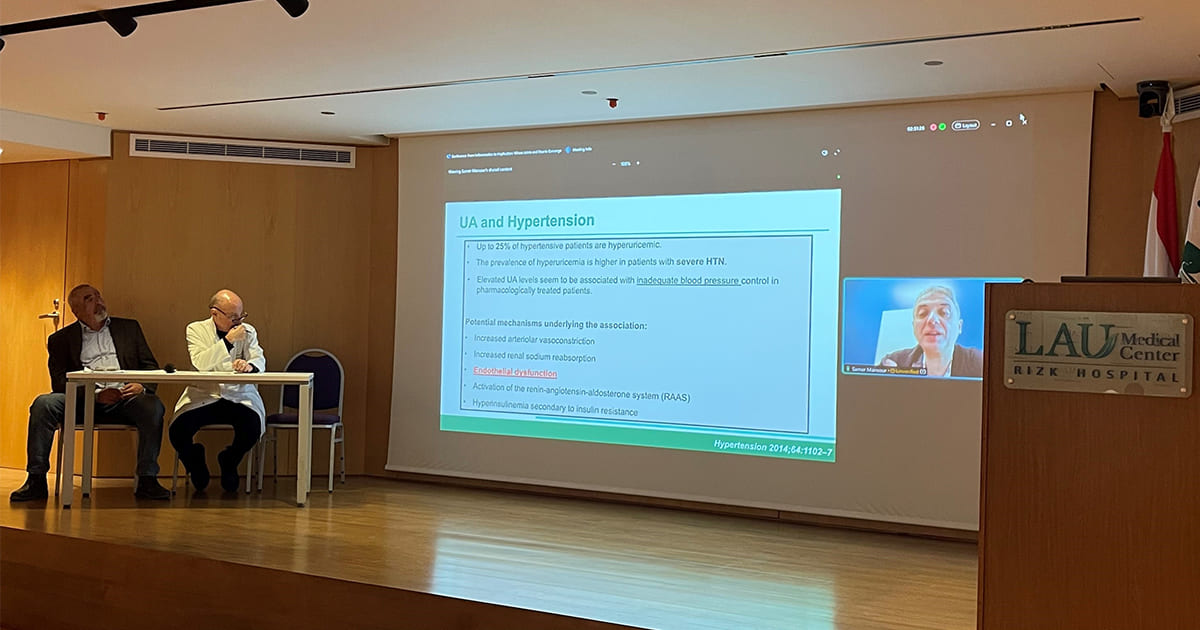
Following that, Professor at the University of Montreal Samer Mansour explored the link between high uric acid levels (hyperuricemia) and heart disease, addressing the ongoing question of whether lowering uric acid truly improves heart health. While some studies suggest that reducing uric acid may have positive effects on early warning signs of disease, there is no clear proof that it leads to better long-term outcomes.
High uric acid, he explained, is often seen in people with conditions such as high blood pressure, kidney disease, heart failure, irregular heart rhythm, and blocked heart arteries, making it a useful marker for identifying patients at higher risk. However, whether uric acid is a direct cause of these problems or a warning sign remains unclear, requiring further research.
Building on that, Dr. Pascal Richette, professor of rheumatology at Hôpitaux de Paris, examined whether uric acid is an active driver of cardiovascular risk in his presentation on gout from a rheumatologic perspective. He explained that lowering uric acid prevents painful gout flares and may reduce heart risks. “We now have a good level of confidence that flares expose patients to cardiovascular events,” he said.
Still, Dr. Richette noted that treating asymptomatic high uric acid remains controversial. While epidemiological studies show an association with heart disease, causality is not confirmed. Current European and American guidelines do not recommend treatment without symptoms, though some Asian guidelines set thresholds for intervention. Emerging research, he added, suggests that colchicine may protect the heart even in patients without gout, highlighting the growing recognition of inflammation’s role in cardiovascular disease.
One of the most sensitive topics discussed was resuming biologic therapies in patients with a history of cancer. Dr. Jacques Eric Gottenberg from the department of rheumatology at Strasbourg University Hospital, France, joining online, explained that, in the past, a five-year delay after cancer remission was recommended, often leaving patients undertreated.
Reviewing data from tens of thousands of patients, Dr. Gottenberg demonstrated that targeted therapies, particularly anti-Tumor Necrosis Factor (TNF) agents—biologic drugs that block the inflammatory protein—do not increase cancer recurrence when managed carefully.
“There is no reason to choose a systematic delay after diagnosis,” he said, urging individualized, shared decision-making with patients and oncologists. He also stressed the need for balanced treatment strategies as uncontrolled inflammation itself can increase cancer risk, particularly in rheumatoid arthritis.
Joining in person, Professor Thomas Bardin from Lariboisière Hospital, France, presented on Transthyretin Amyloidosis (ATTR) and the latest therapies for this condition, in which a normally stable blood protein becomes unstable and deposits in organs, most critically the heart. He explained that ATTR has two forms—hereditary and age-related—and highlighted that musculoskeletal symptoms, such as carpal tunnel syndrome, spinal stenosis, and tendon injuries, often appear years before cardiac involvement.
“Over 50 percent of patients treated for ATTR cardiomyopathy have a prior history of musculoskeletal disease,” Bardin noted. Therefore, early recognition, targeted biopsy, genetic testing, and close collaboration with cardiology are crucial for optimizing treatment outcomes.
Clinical Assistant Professor at LAU’s school of medicine Righab Hamdan then brought the heart into sharp focus, describing cardiac amyloidosis, a heart condition where misfolded proteins (amyloid) build up in heart tissue, making it stiff and preventing it from pumping blood effectively. This can lead to heart failure symptoms like fatigue, shortness of breath, and swelling.
She outlined warning signs doctors should never ignore, from unexplained heart failure in older adults to abnormal heart rhythms and inconsistencies between heart thickness and electrical readings. Early diagnosis, she stressed, can be life-saving, and managing the disease requires dedicated multidisciplinary teams. “This is never a one-man show,” she said, highlighting the importance of collaboration across specialties.


