Understanding Entrepreneurship in the MENA Region: AKSOB Research Highlights New Pathways for Innovation
Dr. Josiane Fahed-Sreih examines how collaboration and culture shape the region’s evolving entrepreneurial landscape.
Entrepreneurship in the Middle East and North Africa (MENA) is entering a pivotal phase. Industries are shifting, young populations are driving demand for change, and national economies are seeking sustainable futures beyond traditional models.
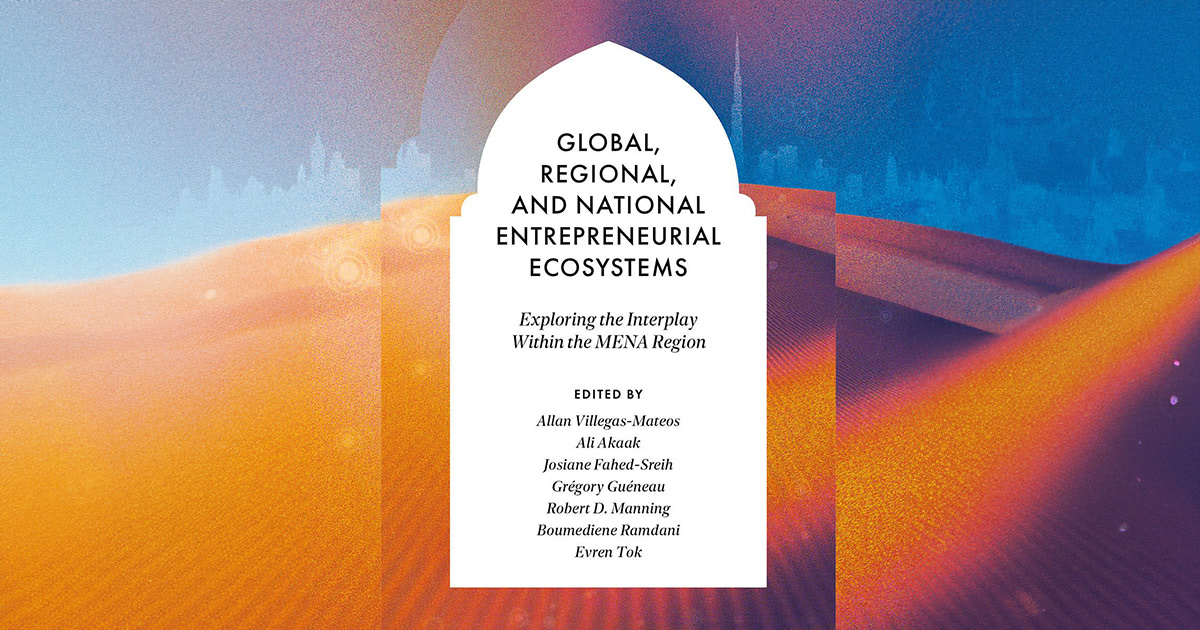
Investigating this transition, Dr. Josiane Fahed-Sreih, associate professor and director of the Institute of Family and Entrepreneurial Business at the Adnan Kassar School of Business (AKSOB) reveals how the region’s entrepreneurial ecosystems are reshaping themselves from within, in a book chapter, recently published in the volume Global, Regional, and National Entrepreneurial Ecosystems: Exploring the Interplay Within the MENA Region (Emerald Publishing).
Her research highlights a key turning point: Innovation in the MENA region is no longer driven solely by technology or investment, but also by culture, collaboration and the expectations of a new generation.
The volume brings together diverse perspectives on how entrepreneurial ecosystems function at the global, regional and national levels, “to advance academic understanding while offering insights that can guide policy and strengthen entrepreneurship in an increasingly interconnected world,” said Dr. Fahed-Sreih.
“The range of viewpoints reflects both the complexity and the promise of entrepreneurship today,” she added, “and I am proud to have contributed to a timely publication that supports students, researchers, policymakers and practitioners alike.”
In the chapter, Dr. Fahed-Sreih describes the MENA region as a testing ground for economic transformation. Countries including Saudi Arabia, the United Arab Emirates, Egypt and Jordan are actively diversifying and empowering young entrepreneurs through targeted national strategies.
With more than 60 percent of the population under 30, the region has one of the world’s largest youth talent pools. Yet this advantage comes with its challenges, such as limited access to early-stage funding and hesitancy toward risk. Her findings show that these constraints are driving entrepreneurs to become more resourceful and more aligned with local market needs, rather than simply adopting foreign models.
One of the strongest differentiators she highlights is the government’s role in shaping the ecosystem. Unlike Silicon Valley or Europe, where private investors dominate, governments across the MENA region hold central responsibility for enabling innovation. They set policy, invest directly in startups and build infrastructure that accelerates development.
At the same time, societal attitudes toward entrepreneurship in the region are evolving: Failure is gradually being understood not as a setback but as part of the learning process that leads to growth. This shift, along with the rise of venture capital firms and accelerators, signals that the ecosystem is becoming more confident and better equipped to scale.
Entrepreneurial success also hinges on the “interplay of stakeholders.” Entrepreneurs cannot advance alone, nor can investors, universities, or policymakers. Success emerges when these groups communicate openly and align efforts. To illustrate, Dr. Fahed-Sreih points to recent progress in Saudi Arabia, where cooperation between public and private sectors has strengthened support systems for startups.
“No single stakeholder can drive progress alone,” she said. “It is the strength of the connections that builds resilience.” The ecosystems that thrive are those where leadership is shared.
Entrepreneurship in the region, according to the research, is not only an economic initiative but a social movement, shifting expectations about careers, inspiring creativity among young people, and encouraging a culture that rewards problem-solving and resilience.
By providing insights to students into how entrepreneurial thinking can shape industries, and highlighting opportunities for policymakers to build stronger support systems, Dr. Fahed-Sreih’s study demonstrates how LAU faculty directly shape understanding of entrepreneurial ecosystems in the region. It reinforces the university’s dedication to producing research that informs policy, supports economic development and addresses real challenges facing MENA’s innovation landscape.


