A New Cohort Completes LAU’s Gender and Humanitarian Diploma
Thirty-four mid-career professionals completed the Gender in Development and Humanitarian Assistance associate diploma, translating knowledge into strategies to advance humanitarian response and women’s rights across Lebanon and the Arab region.
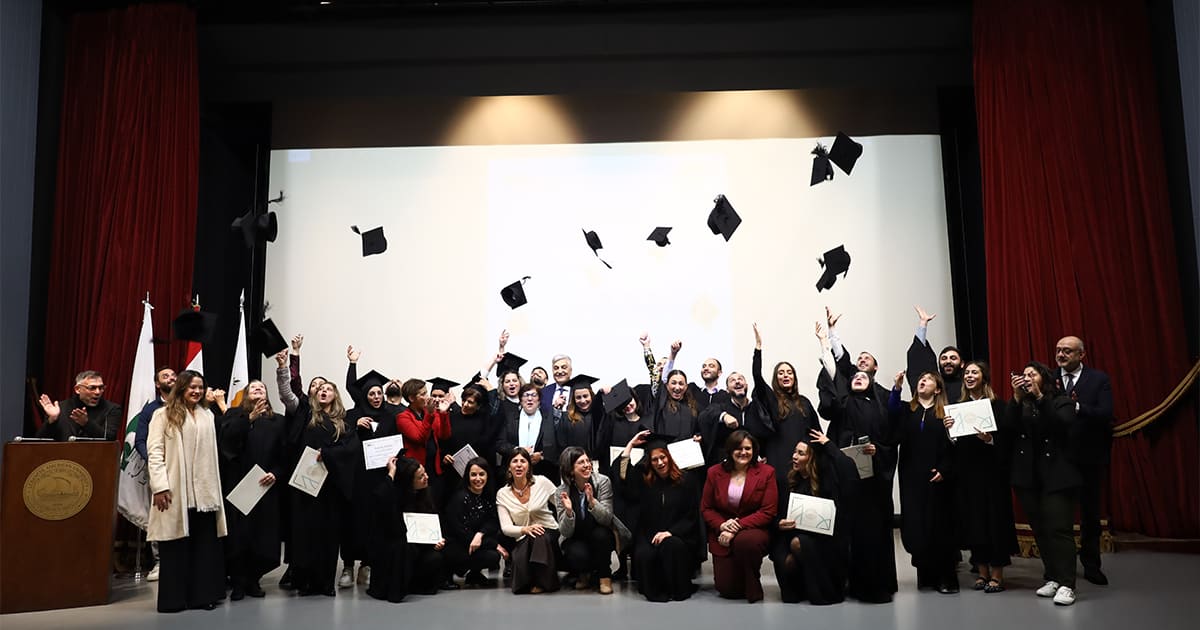
The Arab Institute for Women (AiW) at LAU, in collaboration with the LAU Academy of Continuing Education (ACE), hosted a landmark event on December 16, 2025, at the LAU Beirut campus, celebrating the graduates of the Associate Diploma in Gender in Development and Humanitarian Assistance (GDHA).
Funded by the Ministry of Foreign Affairs of the Republic of Cyprus, the program is designed to strengthen the capacity of women’s organizations and professionals across Lebanon and the Arab region to integrate gender perspectives into development and humanitarian work.
The GDHA diploma, a six-month, technical training initiative, equips professionals with practical tools to address gender in conflict-affected contexts, advance the Women, Peace, and Security agenda, mainstream gender in development programs, and prevent and respond to gender-based violence.
From over 100 applicants, 34 participants were selected across two cohorts, ensuring diverse regional and professional representation. The program’s holistic approach, from gender-based violence prevention and response to peacebuilding and post-conflict recovery, trained participants as a networked cohort ready to implement context-sensitive change.
Opening the ceremony, LAU President Chaouki T. Abdallah praised the graduates’ commitment to advancing social impact, noting the balancing act many performed between demanding careers, family responsibilities, and rigorous academic engagement.
“To each of our 34 graduates, congratulations. You came to this program as mid-career professionals with demanding jobs, families, and responsibilities, and still you chose to invest in your learning, your leadership, and your ability to make a difference,” he remarked. Dr. Abdallah further underscored the importance of education as a bridge between Cyprus, Lebanon, and the wider region, strengthening inclusive and equitable societies.
Representing the Government of Cyprus, Ambassador Maria Hadjitheodosiou reaffirmed her country’s commitment to gender equality and capacity building. She praised the graduates for pursuing training that demands both intellectual rigor and deep humanity.
By supporting this training program, said Ambassador Hadjitheodosiou, “Cyprus demonstrates its commitment to empowering professionals who can integrate gender perspectives into development, planning, and humanitarian response.”
This financial support, noted AiW Executive Director Myriam Sfeir, who emceed the event, “ensured equitable access to advanced gender-focused technical training at a time when economic barriers continue to exclude many professionals from capacity-building opportunities.” She pointed out that the GDHA program equips participants with the skills to respond effectively to complex challenges, promoting a gender-responsive, rights-based approach in both humanitarian and development interventions.
Dr. Elie Badr, LAU’s vice president for business development and global affairs, celebrated the successful partnership between the AiW and ACE, describing it as a “natural alliance” where expertise and practical application converge.
“Together, we didn’t just add years of experience. We multiplied impact,” said Dr. Badr, noting that the program not only builds knowledge but ensures that graduates are ready to translate it into policies, programs, and community initiatives.
Reflecting on the program’s founding vision, Dr. Lina Abirafeh, former executive director of the AiW, addressed graduates through a recorded video message, emphasizing the importance of applied learning in humanitarian settings. “Too often, we expect people in this field to improvise and learn as they go. This program was created to ensure they have the practical skills, the tools, and the confidence to know what to do from day one,” she said.
The cohort’s instructors—Joumana Merhi, Julia Bou Karroum, and Chantal Bou Akl—then took to the stage and highlighted the rigor and quality of the participants’ work, commending their dedication to completing the diploma alongside demanding professional responsibilities. Manar Zaiter, also part of the teaching team, was unable to attend the ceremony.
Speaking on behalf of his cohort, Rawad Feghali described the diploma as more than a series of courses. “It was a shared experience,” he said. “We learned from our professors, but equally from one another. Each of us came from a different professional background…And together, we created a rich environment of dialogue and exchange.” His remarks highlighted the program’s interdisciplinary approach and the value of diverse perspectives in tackling complex humanitarian challenges.
For Maria Assal, another graduate, the GDHA diploma helped to integrate gender perspectives into her professional law practice.
“One of my proudest achievements today is translating the knowledge that I gained from this diploma into my professional environment,” she said. “We are currently developing a new practice area aligned with the UN Agenda 2030, with special focus on Goal 5, gender equality, and the UN Security Council Resolution 1325 on Women, Peace and Security.” Assal went on to illustrate how the program empowers graduates to act as catalysts for gender-sensitive initiatives within their organizations.
Prior to the graduation ceremony, the final papers produced by the cohorts were presented and rigorously evaluated by the program’s instructors.
The presentations entailed months of intensive learning and applied research, showcasing the participants’ ability to translate theoretical knowledge into practical proposals and policy recommendations relevant to Lebanon and the wider Arab region. Several of these projects are now slated for further review and potential publication to ensure that the cohorts’ work extends beyond the classroom into meaningful community impact.
As Sfeir concluded, the program stands as a model of collaboration, resilience, and innovation in the Arab region. The graduates leave with not only certificates, but also the knowledge, skills, and networks needed to drive meaningful change.


