LAU Engineering Students Driving Change
LAU engineering students turn classroom learning into community-driven solutions, partnering with the Municipality of Monsef to tackle real public challenges through applied design.
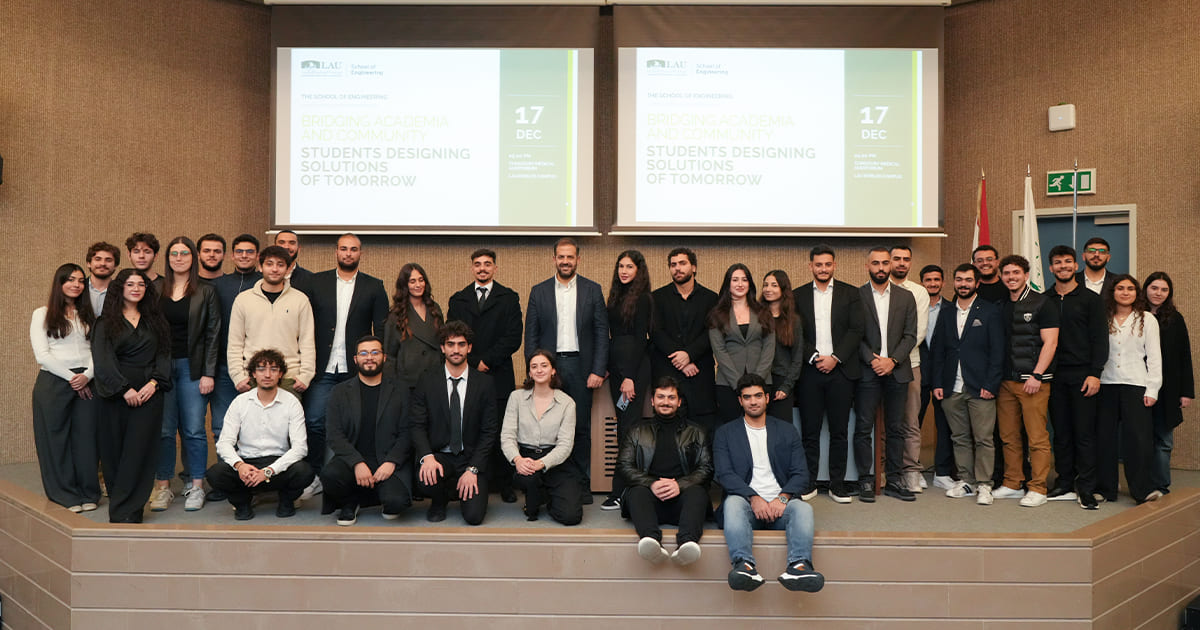
On a winter evening at LAU’s Byblos campus, engineering was not framed as equations on a board or designs on paper, but as an ongoing conversation between School of Engineering students and the community beyond the university’s gates.
Faculty members, municipal leaders, community partners, and students gathered to witness the culmination of months of work by undergraduate students enrolled in the Civic Engagement for Engineers course, which is built on a simple but powerful idea: What happens when engineering education begins with listening to society’s needs?
This year’s showcase brought together seven multidisciplinary student teams, each composed of five to six students from different engineering majors, tasked with creating impactful solutions for challenges faced by the Municipality of Monsef. Their proposed solutions, conceptual yet grounded in feasibility, focused on public services, infrastructure, sustainability, and community wellbeing, aligning closely with several United Nations Sustainable Development Goals (SDGs).
For course instructor Elie Elias, the significance of the event lies in the evolution of the course since fall 2024 from theoretical discussions of civic engagement to hands-on collaboration with municipalities and local partners.
“We didn’t want civic engagement to stay theoretical,” he said. “We wanted students to apply these ideas to real challenges, outside the campus, where their engineering skills actually matter.”
By working directly with municipal leaders, following earlier collaborations with other local partners and now with Monsef, students were exposed to the constraints, priorities, and realities of public-sector work. Nearly 40 students were randomly grouped into interdisciplinary teams, ensuring that diverse engineering perspectives intersected within each project.
The resulting concept designs reflected not only technical thinking, but also social awareness and environmental sensitivity. One team, for instance, explored a nature-based water filtration system using locally available organic materials to address issues of water quality, sustainability, and accessibility.
For the Municipality of Monsef, the collaboration offered fresh perspectives on long-standing challenges. Municipality President Khaled Sadaka emphasized the mutual value of the exchange, noting that the initiative introduced new ways of thinking about improving municipal services while exposing students to the realities of public governance.
Speaking on behalf of the School of Engineering, Associate Professor and Associate Dean Caesar Abi Shdid framed the initiative as part of a broader commitment to civic responsibility. “Civic engagement is more than community service,” he said. “It is about understanding the issues that face our society and taking purposeful action to make positive change.”
At the heart of the evening were the students themselves. Each team demonstrated creativity, technical rigor, and an ability to respond thoughtfully to community needs.
For third-year civil engineering student Charbel El Khabbaz and his team, the focus was on improving everyday interactions between citizens and local government. “We developed a fully digital e-municipality platform that replaces paper-based municipal processes with an integrated website and chatbot,” he said, aiming to make municipal services more efficient, transparent, and accessible.
Other teams addressed infrastructure challenges with an emphasis on practicality. Senior civil engineering student Elio Halaby explained that his team designed a smart waste management application that optimizes garbage collection routes, allowing municipal trucks to operate more efficiently while reducing operational costs through a low-cost, scalable solution.
Together, the projects reflected a broader shift in engineering education, one that values empathy alongside efficiency, and collaboration alongside innovation.
As the presentations concluded, one message resonated clearly: When engineering education is rooted in civic engagement, students graduate not only as problem-solvers, but as socially responsible leaders.


