LAU Graphic Design Students Explore Animation Beyond the Screen
Students at LAU’s Department of Art and Design transformed personal stories into large-scale animations during an immersive workshop led by London-based animation designer Haemin Ko.
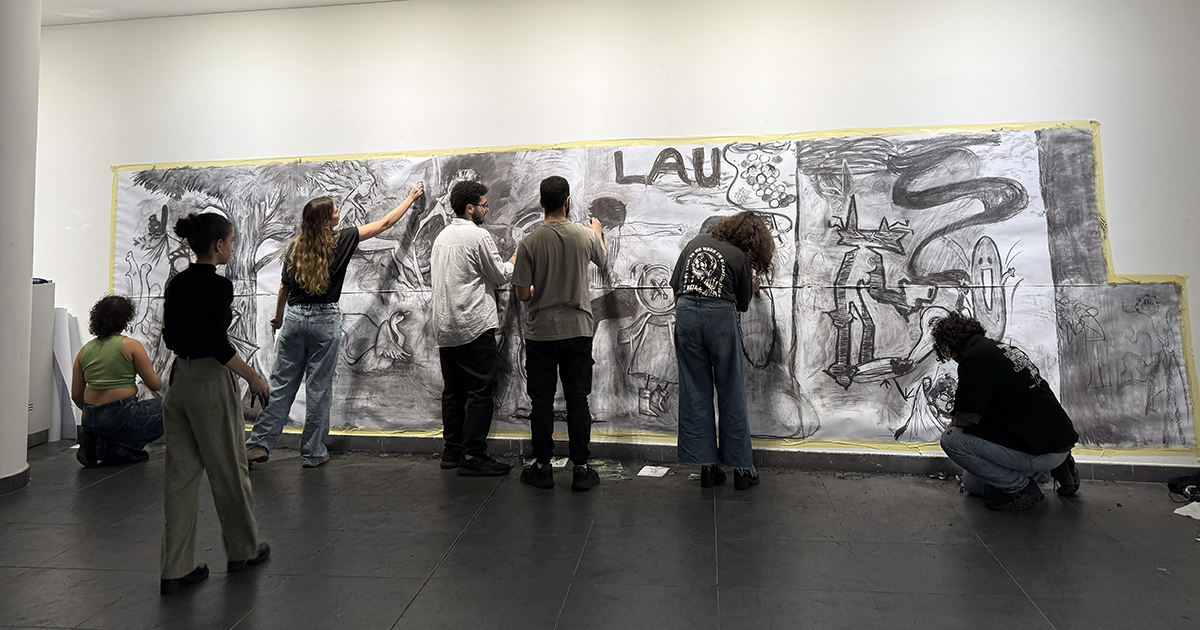
When students stepped into the studio on a late November afternoon, they expected a typical animation workshop. Instead, they found an environment that prompted them to move and think differently, and reconsider what animation could be.
Led by Haemin Ko, animation director, PhD researcher, and lecturer at Central Saint Martins College of Art and Design in London, the two-day workshop became a space for experimentation. Open to graphic design students from diverse backgrounds, it encouraged LAU’s School of Art and Design (SArD) students to collaborate and exchange ideas from the start.
The first day introduced core animation principles, but the emphasis went beyond technique. Ko encouraged students to draw inspiration from their own lives, hometowns, and everyday experiences to create short animation loops. The result was meaningful sequences that translated memory and emotion into movement, turning animation into personal storytelling.
By the second day, students were challenged to expand their work. They reimagined their animations as life-sized charcoal drawings on the studio wall. For many, accustomed to smaller scales, the shift demanded physical endurance, coordination, and a willingness to relinquish control.
LAU Graphic Design Senior student Rhea Assaf reflected on how the experience challenged her and her peers. “Working on a large surface required careful pre-planning to visualize how the animation would work as a whole. It deepened my understanding of the importance of preparation and structure,” she explained.
As the wall filled, the process became performative. Students moved across the space, choreographing gestures and negotiating where one drawing ended and another began.
“Animation is often a very individual process,” added Assaf, “so working collectively was both refreshing and exciting. It made the experience more engaging and enjoyable.”
The completed wall animation united fragments of personal narratives into a single, collective work, challenging habitual ways of working and expanding students’ understanding of animation as social, spatial, and alive—shaped as much by collaboration as by intention.
Chair of the Department of Art and Design Chahid Akoury noted that workshops like this connect technical skill with storytelling, collaboration, and critical thinking, helping nurture creativity, resilience, and curiosity.
Mabelle Sawan, SArD Assistant Professor of Practice, highlighted the value of discovery over polished outcomes. “The workshop emphasized experiential learning through making, performance, and collaboration,” she said. “It encouraged students to experiment with scale, material, and collective process rather than focus solely on a finished result.” She also noted how the experience helped students see animation as a spatial practice, rather than something confined to a screen.
For many students, the workshop opened a space to step outside their comfort zones and discover how their ideas could connect with others. “Watching our separate drawings become one animation showed me the power of collaboration and patience,” said Jad Bou Mjahed, LAU Graphic Design student minoring in Animation and set to graduate in 2028. “The outcome truly felt collective,” he added.
Ultimately, the workshop served as a reminder that learning at LAU extends beyond the classroom, in moments of experimentation, uncertainty, and collaboration. Through this experience, students encountered animation not only as a discipline but as a way of thinking, making, and engaging with the world.


