Abou El Zeus: LAU’s Major Theater Production Returns to Gulbenkian with a Bang
The play, directed by Assistant Professor of Practice Lina Khoury, features an all-alumni cast and production team and revives a long-standing theater tradition at LAU.
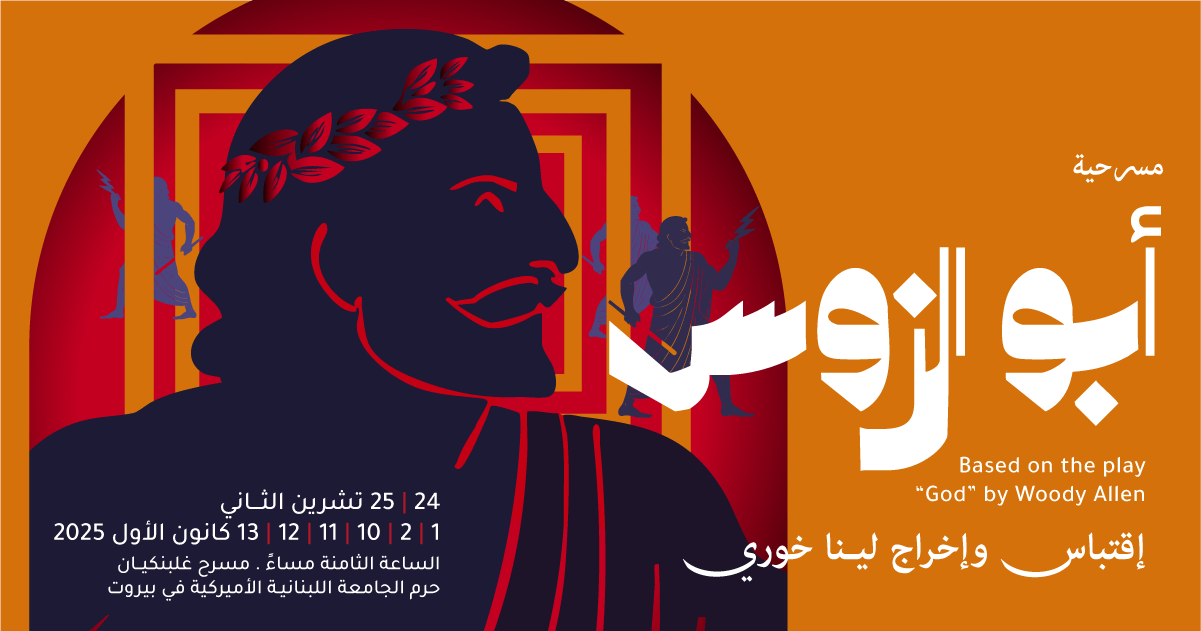
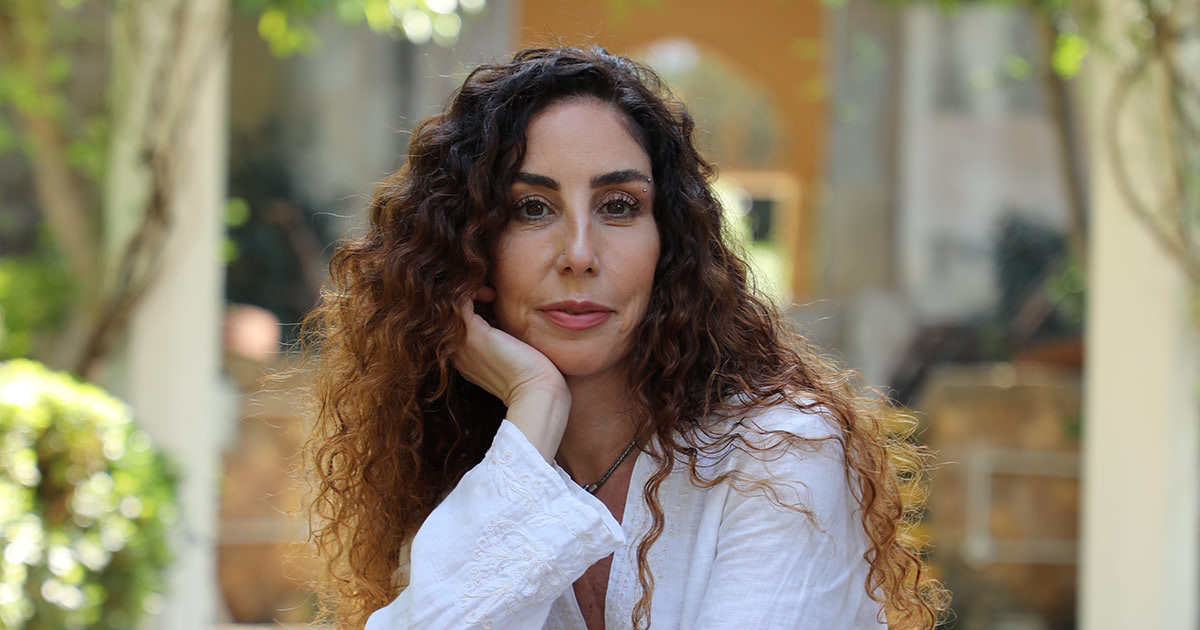
After a six-year hiatus, LAU’s famous Major Theater Production is returning to the Gulbenkian Amphitheater on November 24 with Abou El Zeus, an adaptation of Woody Allen’s 1975 play, God, directed by Assistant Professor of Practice Lina Khoury and featuring an all-alumni cast and production team.
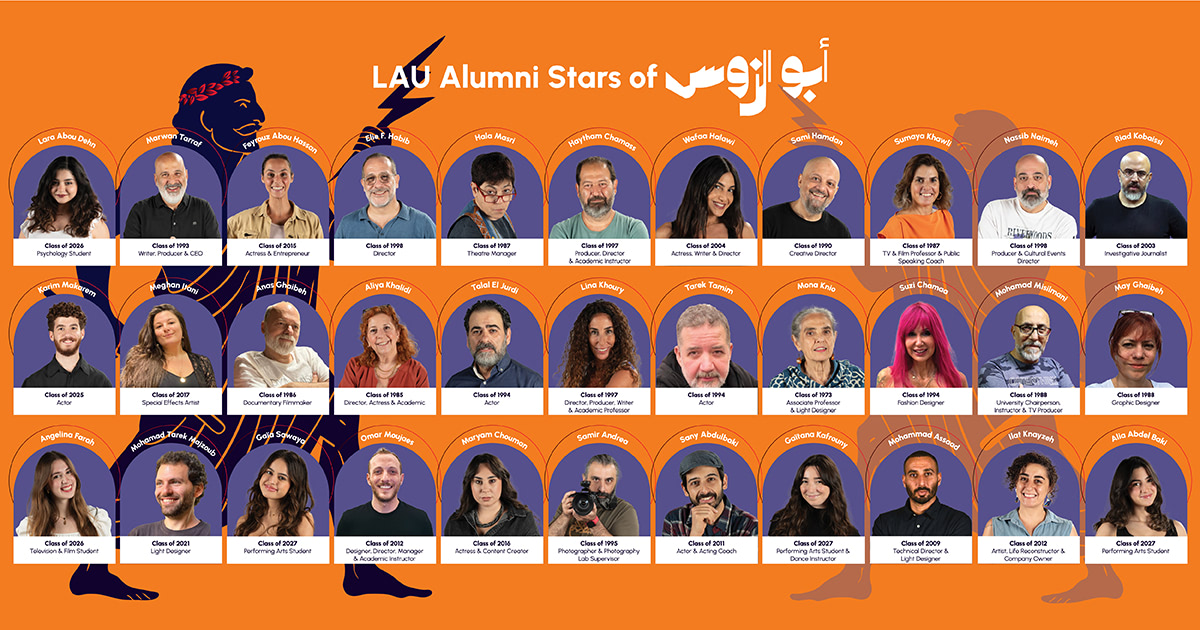
The more than 40 alumni—volunteering as actors, designers, managers and technicians in the play—are all graduates of the Communication Arts, Theater, Television and Film, and Fine Arts programs, in addition to current students enrolled in Khoury’s Performance Repertoire course.
The cast and production team includes renowned actors, producers, graphic designers, directors and journalists, including Tarek Tamim (BA ’97), Talal El Jurdi (BA ’95), Sany Abdul Baki (BA ’11), Riad Kobeissi (BA ’04; MA ’12), Wafa’a Celine Halawi (BA ’04), Marwan Tarraf (BA ’93), Elie F. Habib (BA ’98), Mohamad Mislimani (BA ‘88), Sami Hamdan (BA ‘90), Haitham Shamass (BA ‘97), Suzi Chamaa (BA ‘94), and May Ghaibeh (BA ‘88), in addition to former Associate Professor of Theater Mona Knio (BA ’73), LAU Professor of Theater Aliya Khalidi (BA ’87), and Senior Performing Arts Theater Manager Hala Masri (BA ’87).
Set between Athens and Beirut, ancient and modern times, the play blends several theater genres from play within a play, theatricalism, epic theater realism, drama, comedy, and satire, and tackles philosophical themes.
The play’s satirical tone is made all the more poignant by the chemistry among cast members and accentuated through Lebanese biting sarcasm against the backdrop of a country that has witnessed everything from an economic collapse to the Beirut port explosion and a war.
“It’s a comedy but it tackles serious themes that relate to our existence, what is real and what is not, how we define our existence, and the meaning of our lives,” Khoury said. “These serious questions are presented in a light-hearted manner, Woody Allen style, and my adaptation through its Lebanization.”
“I want the audience to leave the play pondering and asking themselves questions. Theater doesn’t offer solutions; it entices people to reconsider matters that seem set in stone,” she added.
The plot revolves around a writer and an actor trying to come up with a suitable ending for their play. True to Allen’s style, the play includes wit, self-referential humor and neurotic characters all molded in Khoury’s adaptation. Written in colloquial Lebanese, the play is set in Beirut instead of New York to reflect modern times, while Athens is retained as a reference to ancient times.
“The Lebanization is not just in the place and time. It is also in the sentence selection, certain words that we use. There are a lot of references to LAU, the community, names and current affairs. We will laugh at ourselves,” she said.
The major production, however, carries a deeper meaning and greater cause for Khoury, whose passion for theater and LAU has been a driving force behind her efforts to revive the decades-old tradition and ensure that students are part of a well-rounded learning experience.
“This is a very personal endeavor. My first play was set in the Gulbenkian Amphitheater, and it has special meaning to me and everyone who once acted on its stage. LAU has always been famous for its theater productions,” she said.
“I want to express my appreciation for Dr. Haidar Harmanani, dean of the School of Arts and Sciences, and Dr. Dany Badran, chairperson of the Department of English and Creative Arts, for their efforts and support in making all of this happen,” she added.
For the comeback, Khoury wanted a play with a large cast to involve as many students as possible and increase publicity. The production is part of Khoury’s Performance Repertoire course, which requires students’ participation.
“It had to be a comedy, because people are weary, and it had to be a smart, black comedy. But I still needed another idea for this big comeback. That’s when I thought about bringing all the alumni who graduated from the Communication Arts program,” she explained.
That combination led her to Allen’s play God, which includes 24 characters portrayed by 23 actors, among them four performing arts students, 31 alumni and students in the overall production crew, and an all-alumni design team.
Major theater productions have always presented LAU students with a unique opportunity for multidisciplinary collaboration and hands-on learning that enriches their experience and enhances their artistic, technical, management and communication skills.
“The students have the opportunity to work with professionals, as actors, stage managers, house managers, technical operators, designers, producers, and media and management crew. They are involved in a professional production from A to Z,” she said.
Performing Arts student, Alia Abdel Baki, who is a cast member and stage manager, found the chance to work alongside alumni a great learning opportunity.
“It has taught me so much, be it about acting or creative input as a whole. By observing their skillset and understanding their way of thinking as actors, I’ve learned more about the craft and experience of what it means to be an actor,” she said.
“The way they bring the script/line to life with the direction of Professor Khoury amazes me and has truly stirred my interest in the art of theater and stage performance in general,” she added.
On set, the play organically turned into a get-together of friends and former colleagues. Alumni from the Class of ’74 reunited with former students, classmates, mentors and current students, completing a circle of generational sharing of knowledge, expertise, collective memory, and the place that binds them all: LAU.
“It is a great pleasure to watch my current students mingling with my previous students from the ’90s,” said Dr. Khalidi. “They will learn a lot from this experience and will benefit from being able to work in a major production during their university years.”
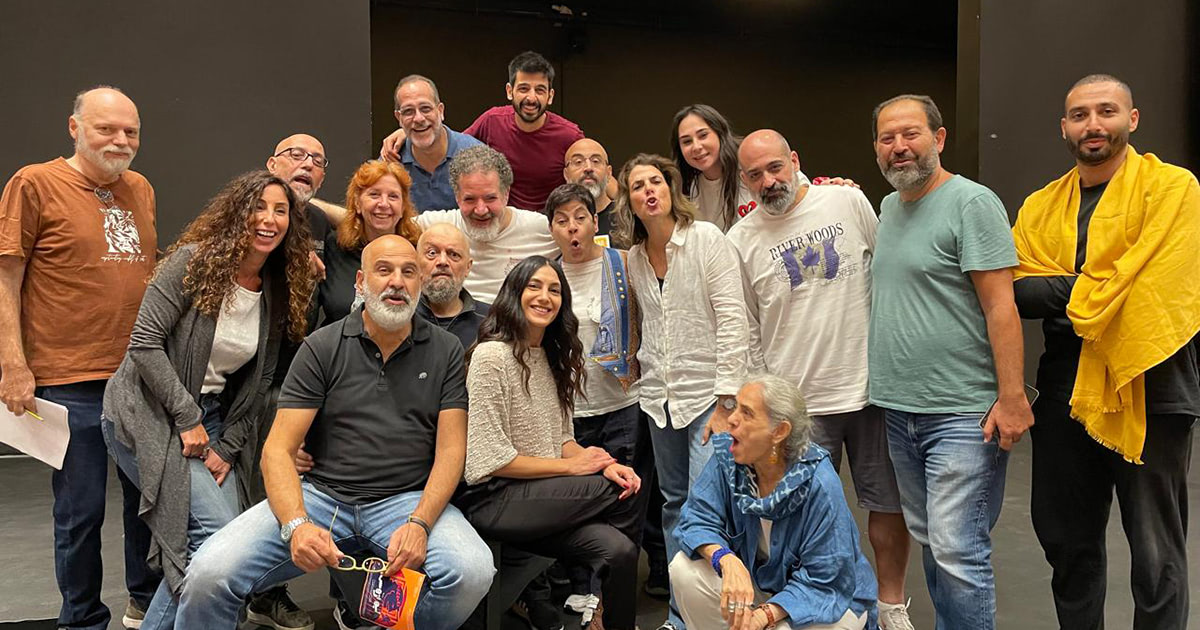
Behind the scenes, the dynamic is warm and comical, bordering on the chaotic as the alumni catch up and share jokes amid Khoury’s attempts to restore order, much as if everyone were once again a student. This connection and shared memories, said Dr. Khalidi, will be deeply felt on stage as well.
“Many of us have collaborated at different stages of our lives, and we share an enduring affection for this space. I hope that, when people watch the play, they will sense that connection. It is visible not only in the on-stage dynamics but also in the relationships that sustain the production behind the scenes,” she added.
Once the idea for the play was set in motion, Khoury had no trouble convincing the alums to participate despite the challenge of aligning the rehearsals with their various work commitments and conflicting schedules.
Alumna and former Instructor of Theater, TV and Film at LAU Sumaya Khauli Kubeisy (BA ’87) didn’t hesitate for a moment when she got Khoury’s call. It was a chance to relive what for her was the best era of LAU, or BUC, as it was known when she was a communication arts student.
“It’s an absolute dream to be back at Gulbenkian. It took me back almost 40 years. It’s where my love for theater was ignited,” she said.
Although her emphasis had been Radio/TV/Film, Kubeisy immersed herself in LAU’s theater scene. Participating in student-led and major productions, she reaped what she described as a global understanding of communication and artistic expression.
Tracing her steps back to the Safadi Fine Arts Building and the Gulbenkian Amphitheater, Kubeisy can’t help but relive the vibrant artistic life on campus against the backdrop of a brutal civil war.
“Although the war was raging and there were many challenges, the theater was our escape, our happy place,” she said. “When we put on some of those productions, and there was shelling outside, we would cut the intermission short and turn up the music volume so that the audience wouldn’t rush back home. We wanted them to stay and watch what we had prepared to the end.”
Kubeisy credits her former teachers, particularly Dr. Leila Debs, for instilling in her generation a deep respect for theater in all its forms and igniting a passion that continues to impact her life to this day. “Our teachers loved the theater, they understood it, they had a passion for it, and they were continuing a legacy that had started by Dr. Irene Faffler,” she added.
Dr. Faffler was the creator of the institution’s Department of Communication Arts more than 50 years ago. The Gulbenkian Amphitheater was completed under her leadership in 1971, after which all Communication Arts majors were required to produce one-act plays from script writing to casting and set design. When she launched the annual major theater production at a later stage, she offered the Lebanese community in Beirut an artistic respite from the violence.
“There was a time when LAU stood as the central hub for the arts in Beirut—performing arts, theater, and music all found a home within the Communication Arts Department. It is therefore deeply unfortunate that today, few people remember its rich legacy,” Dr. Khalidi said.
She underlined the importance of supporting student-led and major productions as a cornerstone of LAU’s interdisciplinary ecosystem.
“Art students designed costumes, sets, and makeup; architecture and engineering students built set structures; business students managed marketing; graphic design students created posters and programs; and actors came from every academic discipline,” she said.
In addition to pedagogy, Dr. Khalidi sees an urgent need to reclaim the university’s role as Beirut’s “primary artistic hub and a key contributor to the cultural and artistic life of the community.”
“The [Communication Arts] department was, quite literally, the heartbeat of the Beirut campus. We remain committed to restoring its vitality and ensuring that its legacy endures. Theater will always be a major form of artistic expression, and whoever says that it is a dying art form is greatly mistaken,” she added.
One thing is for certain. The alumni, driven by camaraderie, a passion for the theater and a sense of purpose, have all converged on the Gulbenkian stage to carry the torch and continue the path carved by their teachers many years ago.
“What I really want from this whole production is to bring back the hype and legacy that LAU had, the great productions that have passed through this campus,” Khoury said.
Abou El Zeus will be performed at the Gulbenkian Amphitheatre on the Beirut campus, on November 24 and 25, December 1 and 2, and December 10, 11, 12, and 13 at 8:00 p.m. Tickets are available at all branches of Antoine’s Library, Antoineticketing.com, and at Gulbenkian’s ticket booth before the show.


