Redefining Patient Care with AI: Insights from Stanford’s Marc Ghanem (BS ’19; MD ’23)
From his early training at LAU to his groundbreaking work at Stanford, Marc Ghanem (BS ’19; MD ’23) talks about his roots, harnessing AI to disrupt traditional medicine, and building predictive models that bring more precision and personalization to patient care.
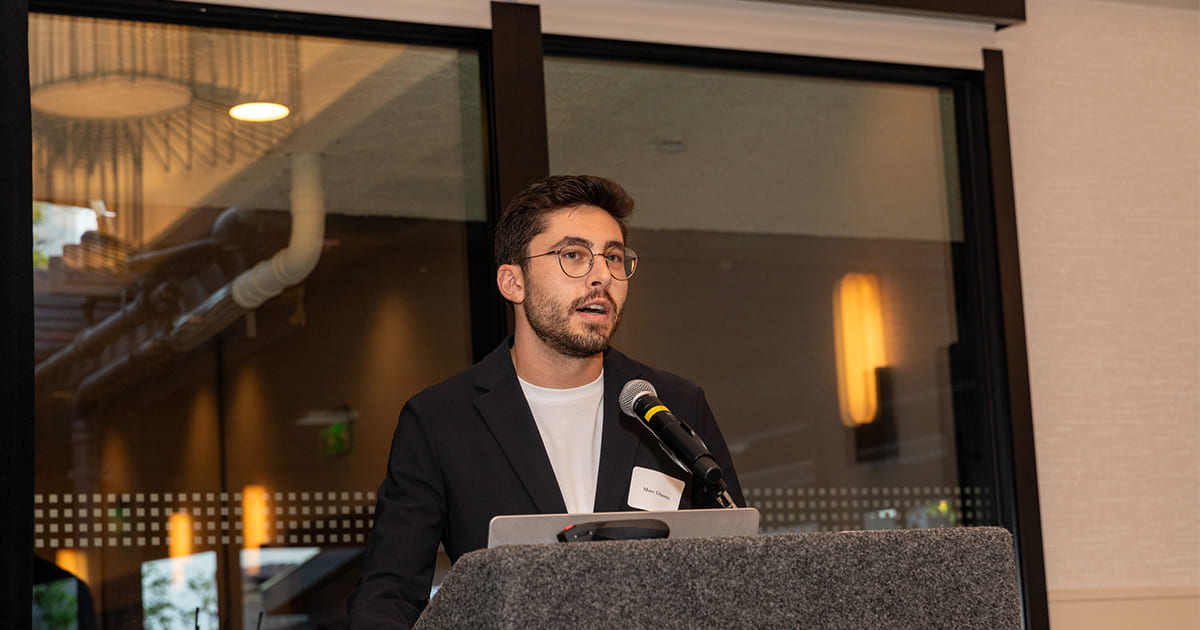
Alumnus Marc Ghanem’s path from LAU to Stanford University reflects a lifelong curiosity and a passion for blending medicine with technology. He earned a dual degree in Biology with a focus on bioinformatics in 2019 and his medical degree in 2023, laying the groundwork for a career that bridges computation and patient care.
During his time at LAU, Dr. Ghanem was recognized with both the Excellence in Innovation Award and the Outstanding Researcher Award in May 2023, reflecting his dedication to research and early contributions to applying technology in medicine. Building on this foundation, his research applying Machine Learning (ML) to clinical medicine opened doors to collaborations with the Mayo Clinic and Thomas Jefferson Hospital, experiences that would shape his vision for transforming healthcare.
Today, as a postdoctoral scholar at Stanford’s Aghaeepour Lab in the Department of Anesthesiology, Perioperative, and Pain Medicine, Dr. Ghanem develops deep learning models that uncover patterns in large medical datasets, aiming to make care more predictive and personalized.
In this interview, he shares how his early clinical experiences, international collaborations, and innovative research continue to inform his mission to personalize patient care and inspire medical transformation.
You earned both your undergraduate degree in Biology, focusing on bioinformatics (using computers to analyze biological data), and your medical degree at LAU. How did this unique combination influence your interest in using technology to enhance healthcare?
We are living in extraordinary times, where fields that were once isolated are beginning to converge, opening new ways to understand the world while also raising deeper questions. My trajectory into this intersection of science and technology began early.
By the age of 17, I was serving as a volunteer emergency medical technician with the Red Cross. At the time, I didn’t fully understand it, but constantly seeing patients suffer up close left a lasting impact on me. It gave me empathy, perspective, and a kind of rebellious attitude toward simply accepting things as they are.
My undergraduate training in biology grounded me in the scientific method and the complexity of living systems. At the same time, I had always been drawn to computer science, and when I first started using computational tools, I immediately saw how powerful they are in making sense of biology, which is otherwise too intricate to fully grasp.
A couple of years later, I began my medical training and realized that the gap between technology and clinical practice was even wider than I thought. Many brilliant physicians were not comfortable with computational approaches, and many outstanding computer scientists had little interest in biology or patient care. That gap gave me a clear sense of purpose: By combining my training in biology and medicine with the computational skills I had taught myself along the way, I could help bridge these worlds, using predictive analytics and data-driven discovery to contribute to the transformation of modern medicine.
During your time at LAU, you earned awards for innovation and research. Was there a particular project or moment when you realized that research could make a real difference for patients?
As an undergraduate just starting, the focus is often mainly on earning a degree. Without much early exposure to researchers, many students don’t fully understand what research is or how it works. That’s why LAU’s research awards are so important; they spotlight research, make it visible, and encourage students to become more curious about this path. It was rewarding to have my work recognized because meaningful research demands so much time and effort, and at times, that commitment can even come at the expense of grades.
Growing up, you tend to believe that things are done a certain way simply because that is the right way. But as I advanced in my medical studies, I realized that much of how we treat patients is based on what we know works best on average, rather than on continually questioning whether it can be done better. Patients are fragile, so we can’t simply experiment freely; we fall back on safe protocols that usually work.
That realization opened my eyes, and I felt it wasn’t enough. I came to see that research is the only way to move beyond those limits. And once you bring computation into that process, it becomes possible to predict outcomes, optimize decisions, and move past averages toward individualized care.
That was the moment it clicked for me: If I dedicate myself to this path, I can contribute to creating the knowledge and tools needed to transform how we care for patients.
You worked with major US institutions like the Mayo Clinic and Thomas Jefferson Hospital even as a student, and later continued your research at world-class centers such as Stanford. How did those opportunities come about? What challenges did you face along the way, and in what ways did your LAU experience prepare you to collaborate with international teams so early in your career?
Dr. Mohamad Bydon from Mayo Clinic was kind enough to offer a collaboration opportunity to an LAU medical student on a systematic review, and I was fortunate to be selected. While working remotely with his team, I asked if I could also be involved in one of their ML projects, and he agreed. For me, it was surreal: As a medical student in Lebanon, I suddenly found myself contributing to research at one of the most advanced hospitals in the world.
Later, I completed a neurosurgery elective at Thomas Jefferson Hospital with Dr. Pascal M. Jabbour, someone whose influence on students is well known. During that elective, I asked if I could get involved in research alongside the clinical work, and once again, the answer was yes.
Working with these two giants in their fields taught me a great deal early in my career. It showed me that I was capable of contributing to world-class research groups, and it gave me confidence that I could grow in that environment. None of this would have been possible without LAU’s connections and its educational design, which is as close as you can get to studying in the US while being abroad.
Of course, there were challenges. Collaborating with US teams was already difficult with the time difference, but at the time, Lebanon was experiencing severe power outages. I remember designing my sleep schedule around the few hours we had electricity, so I could have an internet connection to work and meet deadlines. Eventually, things stabilized, as they always do in Lebanon, but looking back, I view those days with a kind of fondness.
At the Mayo Clinic, you helped develop computer programs that can predict health outcomes and even analyze medical images. What was the biggest challenge—or the most exciting breakthrough—from that work?
My work at Mayo Clinic was really the beginning of my computational journey, and it was fundamental for me. At that stage, I was slowly starting to think more computationally and less purely medically. A couple of times, I would get carried away, refining tools or building models that, while elegant, wouldn’t actually be useful in real life. It was also a phase where I was compensating for the imposter syndrome that came with being largely self-taught in computer science.
The feedback I received from Dr. Bydon at that time was crucial because it kept me grounded in thinking like a physician. That experience taught me a lasting lesson: My strength lies in being able to bridge fields.
At Stanford’s Aghaeepour Lab, you are developing artificial intelligence (AI) tools that can spot patterns in patient data and predict recovery needs. What excites you most about this work, and can you share a simple example of how such models might help doctors during surgery or in caring for newborns?
I truly love what I do. I often find myself running code before going to bed, and the first thing I do in the morning is rush to see the results. It never stops being exciting. Dr. Nima Aghaeepour has built a lab that is disruptive in the best possible way: Disruptive to medicine, a field that is often resistant to change unless it’s bombarded with so much evidence that change becomes unavoidable.
And that’s exactly what we’re doing, pushing boundaries to improve patients’ lives. At some point, it became normalized to me, but when I reflect on it, I realize how rare and difficult it is to cultivate such an environment. Here, experts in medicine and computational ML work side by side, learning to communicate across disciplines so effectively that by the end of a project, each collaborator understands the other’s field far more deeply than when they started.
What excites me most is that the disruptions we make through research reach the clinic. We test them through pilots, and if the data support it, they become part of standard patient care. For example, one of our models addressed a huge problem in neonatal care. Premature babies are extremely vulnerable and cannot ingest food, so they are fed through IV nutrition bags. Yet no one truly knows how to optimize these bags: Some institutions use one standardized formula for every baby, while others make custom bags daily, but that process is error-prone.
Our solution was to use data from those custom bags to design a fixed set of premade nutrition bags. Then, using AI, each baby is matched to the bag best suited to their condition, combining safety, personalization, and scalability. In my current work, I’m exploring how artificial intelligence can be applied in anesthesiology and surgery areas where care has traditionally been reactive, with clinicians responding to changes as they occur.
Many LAU students dream of doing groundbreaking research abroad, but may feel the path is out of reach. What advice would you give them?
Great research requires curiosity, passion, and, in my opinion, the most important trait of all, being comfortable with failure. You must enjoy it, even laugh at your mistakes, because making mistakes is the only sign that you’re still growing. If you have those qualities, you already have more than enough to thrive in research.
The only real limitation in Lebanon is structural: Research is expensive, and cutting-edge work often requires funding that can be difficult to secure locally. The good news is that these resources can be found abroad, and hopefully, in the near future, more consistently in Lebanon as well. But the qualities that matter most, curiosity, passion, resilience, and the ability to embrace failure, are much harder to acquire, and they are the ones that truly set researchers up for success. With the level of education you receive at LAU, you are certainly not at a disadvantage; in fact, you already have more than you need to succeed.
Another thing to keep in mind is that as you advance in your education, especially at the level of a PhD or postdoc, you are essentially placing yourself in a small niche community of people who share the same obsession with a topic that very few others understand. That can be incredibly rewarding but also isolating if you don’t have the right support. This is why choosing mentors becomes so important: you want people who not only share your scientific interests, but also your broader values and sense of mission. Otherwise, the journey can become a lonely one.
Looking ahead, do you see yourself bringing back some of what you have learned, perhaps by collaborating with LAU or hospitals in Lebanon, to strengthen research and healthcare in the region?
This isn’t just a long-term goal; it’s something I think about most days. Every time we develop a new tool at Stanford, I ask my principal investigator, Dr. Aghaeepour, if we could validate it in Lebanon, and his answer is always yes. I also reached out to LAU’s School of Medicine dean, Dr. Sola Aoun Bahous, to share what we’ve built and explore opportunities for collaboration. Stanford has given me the privilege of working with incredibly intelligent and kind people, supported by tremendous resources. Its mission to train curious, critical thinkers who contribute globally is something I take to heart. In that same spirit, I feel a responsibility to stay connected to Lebanon and to share knowledge and innovation with the community that shaped me. And honestly, does anyone truly leave Lebanon?
Finally, when you think back to your time at LAU, what are the small but memorable moments, like guidance from a mentor, a teamwork experience, or a challenge you overcame, that continue to inspire you today?
My colleagues from LAU still feel like family. I talk to many of them every day, and I can say the same about some of my professors. Two moments stand out most clearly.
Just two months into medical school, when Dr. Bahous was still associate dean, I knocked on her office door to ask whether it might be possible to double major in computer science while studying medicine. In Lebanon, at the time, this was almost unheard of, but instead of discouraging me, she listened to my goals and supported my vision of merging these fields. She didn’t ask about my rank or my grades; she simply engaged with my curiosity. Even though I ultimately took the self-taught path, that conversation was crucial. At that stage, when you’re full of energy and eager to pursue what you’re passionate about, having that kind of validation goes a long way, and it also showcases her strength as a mentor in encouraging students to explore possibilities rather than limiting them to conventional paths.
Another defining moment came during an Objective Structured Clinical Examination (OSCE) exam, at a time when Lebanon was in one of its deepest crises, fuel shortages, financial collapse, power cuts, the list goes on. I remember driving to campus in my suit and white coat, unsure if I even had enough fuel to get there, and I started laughing hysterically at the absurdity of it all: Preparing for a world-class medical exam while everything around us was falling apart. That drive captured the strange dichotomy we live in with the constant opposition between collapse and excellence.
Two things are always true in Lebanon. First, we do not compromise on our education, even if it means living in denial of all the pressures threatening to disrupt our work. Second, that very instability, the political turmoil, the social crises, sometimes even the tragedies, inadvertently forge an environment that shapes us uniquely. Out of it emerge people who are not only resilient and ambitious but also well-educated and deeply committed to contributing to the world. It is sad that this strength is born from hardship, but it is simply true. And it is why so many from Lebanon go on to pioneer fields far beyond its borders.
This interview has been edited and condensed for the sake of clarity.


