A Poetic Beginning at the Philip A. Salem Academy for Lebanese Heritage
The Philip A. Salem Academy for Lebanese Heritage marked its inaugural event at LAU with a literary symposium honoring poet Elias Abu Shabaki.
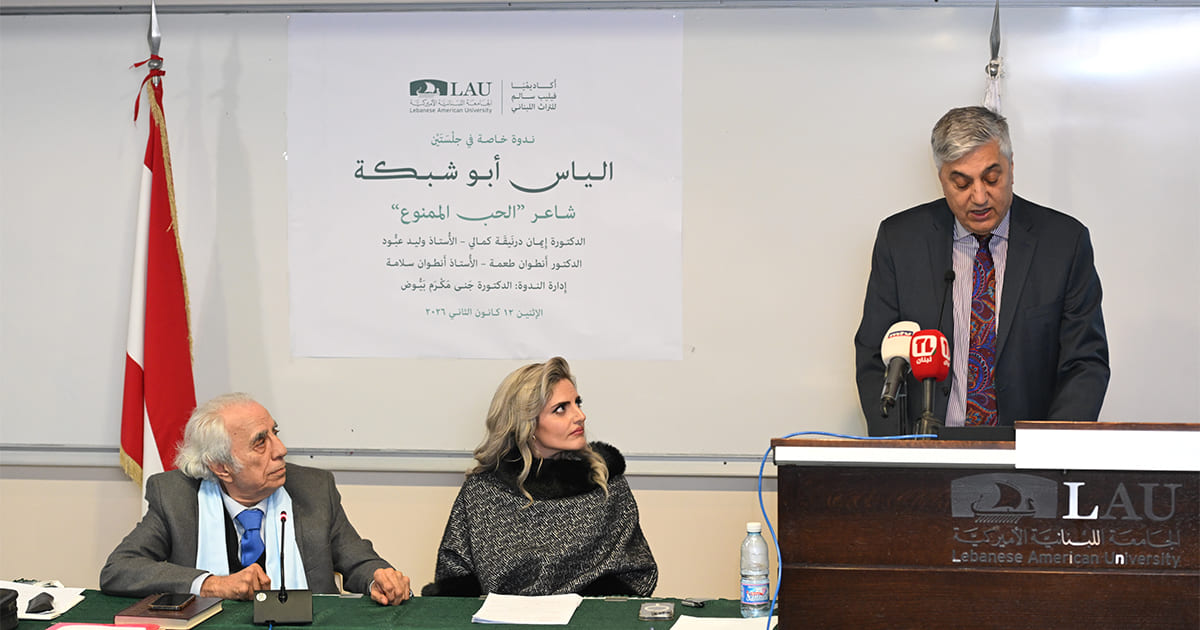
Amid thunder and rain, the LAU Beirut campus became a gathering place for poetry as the Philip A. Salem Academy for Lebanese Heritage hosted its first public event under its new name.
The weather seemed to echo the emotional intensity of the evening, as scholars, writers, and students revisited the life and work of Elias Abu Shabaki (1903–1947), a poet whose verses of love, longing, and inner conflict continue to ripple across generations. Titled Elias Abu Shabaki: Poet of Forbidden Love, the event marked both a literary tribute and a new beginning.
Formerly known as the Center for Lebanese Heritage (CLH), the academy was founded 24 years ago by poet and literary scholar Henri Zoghaib, who continues to oversee its activities. From its earliest days, it has served as a space for sustained reflection on Lebanon’s literary, cultural, and intellectual life. Its transition into the Philip A. Salem Academy for Lebanese Heritage marks a renewed phase shaped by scholarship, public dialogue, and the careful preservation of cultural memory.
The event, said Director of the academy Henri Zoghaib, marked four milestones: The 24th anniversary of the establishment of the CLH in January 2002; the 79th anniversary of the death of Abu Shabaki on January 27, 1947; the centenary of the publication of his first book, Al-Qithara; and the center’s transition to an academy in January 2026.
The symposium brought together voices from across the literary and academic community. Scholars Dr. Antoine Tohme and Dr. Iman Derneika Kamali joined the discussion, alongside Dr. Jana Makram Bayyoud, who moderated the program. Journalists Walid Abboud and Antoine Salameh also participated, offering reflections that connected literary analysis with broader cultural context.
Senior university leadership attended the event, including LAU President Chaouki T. Abdallah, joined by deans, faculty members, students, and members of the cultural community. Their presence underscored the academy’s role within LAU’s academic and cultural mission.
In his opening remarks, Dr. Abdallah reflected on the significance of the academy’s new name and acknowledged Dr. Philip A. Salem’s contribution to its future. The renaming, he noted, reflects a conviction that “a lasting Lebanon is one grounded in its civilizational heritage, historical legacy, and creative thought.”
Zoghaib and Dr. Bayyoud then guided the audience through Abu Shabaki’s literary journey, tracing the poet’s emergence as one of the most distinctive voices of modern Arabic poetry. Born in 1903, Abu Shabaki transformed personal loss and emotional struggle into verse that challenged social conventions and explored the boundaries of love and desire. His first poetry collection, Al-Qithara, published in 1926 and highlighted during the symposium on the occasion of its centennial anniversary, marked a turning point in Lebanese poetry.
Throughout the discussion, Abu Shabaki’s work emerged as deeply human and strikingly relevant. His willingness to confront taboo subjects and articulate inner conflict with emotional honesty, Zoghaib noted, continues to resonate, particularly with younger generations navigating questions of freedom, morality, and identity.
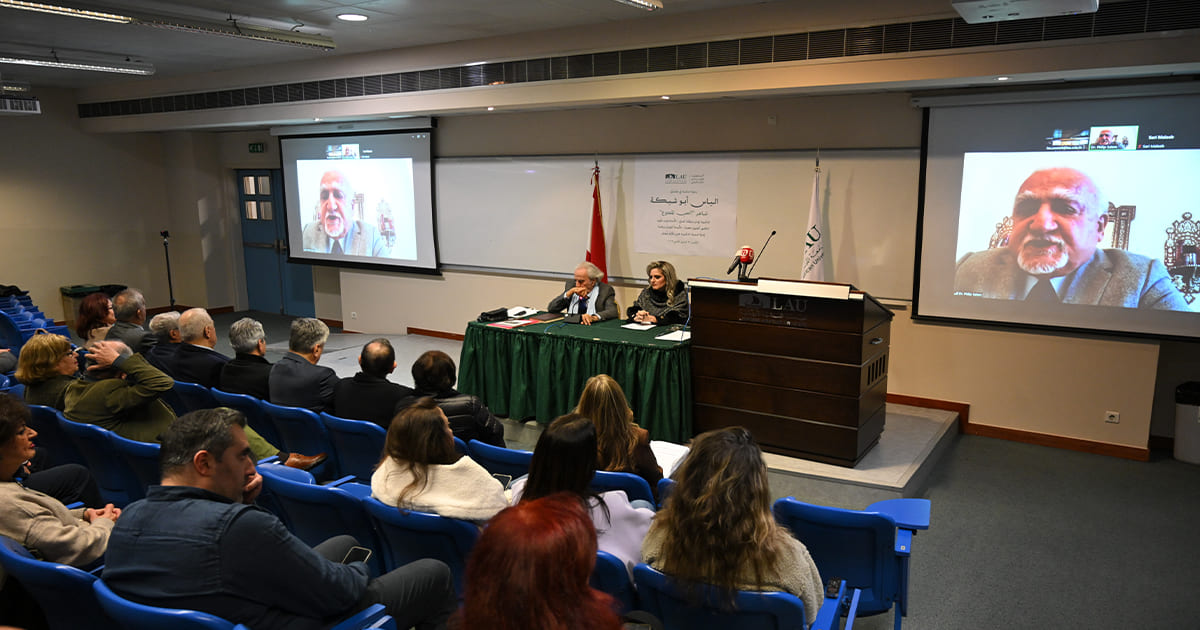
Joining the gathering virtually from Houston, Dr. Salem reflected on the significance of the academy bearing his name. The moment, he said, was both an honor and a responsibility. Cultural heritage, he emphasized, lies at the heart of identity, especially in a country shaped by decades of upheaval and displacement.
As the inaugural event drew to a close, it reaffirmed LAU’s role as a space where literature, memory, and dialogue converge. Through initiatives such as this, the Philip A. Salem Academy for Lebanese Heritage continues to bring cultural memory into conversation with the present.
Dr. Salem captured this sentiment in his closing reflection, echoing the enduring themes of Abu Shabaki’s poetry: “Heritage determines who we are. It shapes our identity, our sense of belonging, and our connection to a history that gives us dignity, resilience, and the ability to endure.”
The discussions will be published in full in the upcoming Spring 2026 issue of Mirrors of Heritage, the flagship journal of the Philip A. Salem Academy for Lebanese Heritage.


