Alumnus Zak Kassas Returns to LAU to Share Pioneering Research on Navigation Resilience
The LAU School of Engineering welcomed back distinguished alumnus Dr. Zak Kassas for a landmark lecture on LEO satellites, highlighting both cutting-edge research and the lasting impact of alumni engagement on the university’s global community.
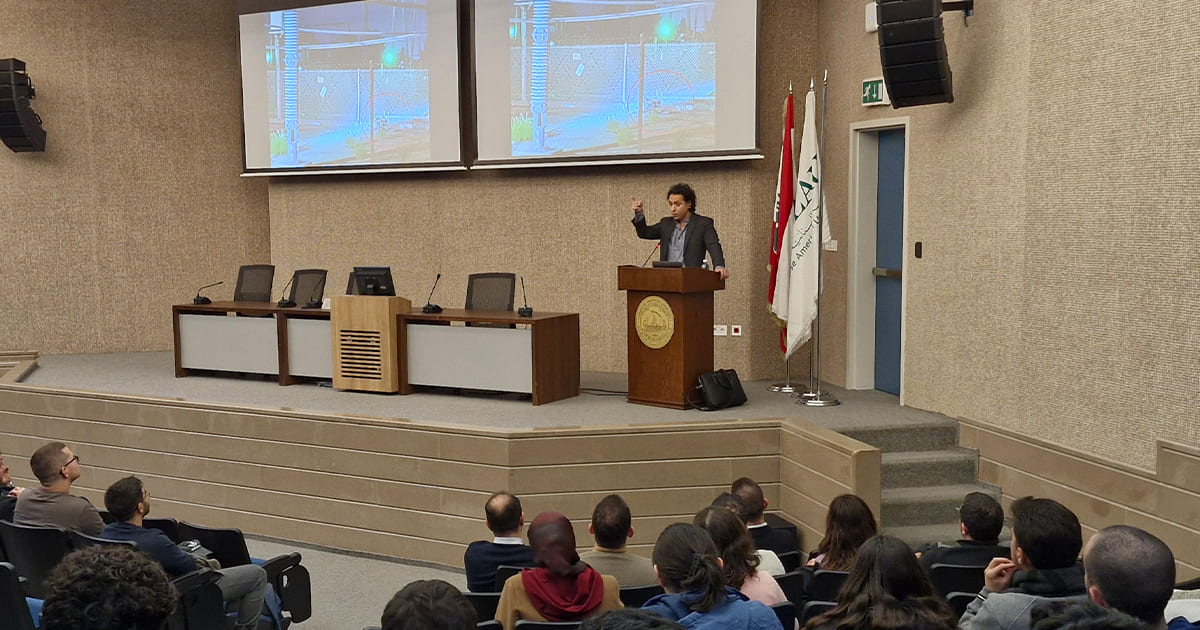
Alumnus Dr. Zak Kassas (BE ’01), professor at the Ohio State University and a globally recognized expert in navigation and autonomous systems, returned to LAU on January 16, 2026, to deliver a special lecture on megaconstellation Low Earth Orbit (LEO) satellites—satellites orbiting close to Earth that are rapidly transforming navigation and communication, making it essential to understand their complex signals for accurate, reliable positioning in real-world applications.
The event, held at the LAU Byblos campus, brought together faculty, students, researchers, and engineering professionals. Titled Ad Astra: Navigation with Megaconstellation LEO Satellites, the talk was presented as part of the IEEE Aerospace and Electronic Systems Society (AESS) Distinguished Lecture Series hosted by the LAU School of Engineering. It explored cutting-edge approaches to positioning, navigation, and timing (PNT) using these transformative LEO satellite constellations.
Dr. Kassas described what he called a “space renaissance,” marked by the rapid deployment of tens of thousands of LEO satellites. While these megaconstellations are primarily designed for global broadband connectivity, he demonstrated how their signals can also be harnessed for navigation, particularly in environments where traditional global navigation satellite systems (GNSS) are unavailable or unreliable.
Drawing on his extensive research, he outlined the technical challenges of leveraging LEO signals—including unknown signal structures, loosely synchronized systems, oscillator instability, and complex propagation effects—and introduced STAN (Simultaneous Tracking and Navigation), a comprehensive framework developed to overcome these limitations. Combining theoretical modeling, cognitive software-defined radio design, and real-world experimentation, STAN enables ground, aerial, and maritime vehicles to navigate with signals from Starlink, OneWeb, Iridium, Orbcomm, and NOAA constellations with unprecedented accuracy.
Beyond its technical significance, the event carried special meaning for the LAU community. Dr. Kassas earned his Bachelor of Engineering with honors in electrical engineering from LAU before pursuing advanced degrees at the Ohio State University and the University of Texas at Austin. His return to campus reflects a continued commitment to giving back, through mentorship, knowledge-sharing, and the generous contribution of his time to the institution that shaped his early academic years.
Dr. Kassas’s career has been marked by rapid advancement and global recognition. A recipient of the Presidential Early Career Award for Scientists and Engineers (PECASE), he is also a Fellow of the IEEE and the Institute of Navigation, and was ranked by ScholarGPS as the top scholar worldwide in navigation. His research has attracted over $28 million in competitive funding and has been widely featured in leading scientific and mainstream media outlets.
For students, the lecture offered both technical insight and inspiration. Dr. Kassas’s experience, from an LAU graduate to an internationally recognized researcher, demonstrated how a strong academic foundation, combined with perseverance and curiosity, can lead to transformative impact. His engagement with students reinforced LAU’s emphasis on meaningful alumni involvement as a cornerstone of academic excellence and community building.


